
 Reading Time: 8 mins #
 This post may contain affiliate links.
You’re juggling a demanding job, a side hustle, family obligations, and a social life. You’re exhausted, your bank account is scraping by, and your gym membership has become a distant memory. You’re running on fumes, but you tell yourself, “This is temporary. I’ll rest when I’m ahead.” Sound familiar? You’re not alone.
Welcome to the age of energy imbalance. In today’s achievement-driven world, we often wear exhaustion as a badge of honor. We push ourselves to the limit in pursuit of success, convinced that our sacrifices will pay off. But what happens when we burn the candle at both ends until it melts into a puddle of wax? Let’s explore how energy imbalance, whether in your personal life, professional world, or financial landscape, can quietly sabotage your well-being and how recalibrating it can unlock a healthier, wealthier, and more fulfilling life.
“Sleep is an investment in your energy, health, and productivity.” – Arianna Huffington (The Sleep Revolution)

What Is Energy Imbalance? (And Why Should You Care?)
Energy imbalance occurs when the resources you expend; time, money, mental and physical effort, consistently exceed what you replenish. Think of it like a bank account: when your withdrawals exceed your deposits, you end up in debt. Pushing your limits occasionally can lead to growth, but chronic imbalance? That’s a recipe for burnout, stress, and regret. It’s like running a marathon at a sprint, initially, you might make impressive progress, but before long, you’ll crash before the finish line.
The kicker is energy imbalance isn’t inherently bad. Short-term sprints can yield promotions, financial windfalls, or personal milestones. But when that sprint becomes your default mode, the real perils begin. Let’s break down how energy imbalance shows up in three key areas of life.
1. Personal Energy Imbalance: Your Body and Mind Aren’t Machines
Neglecting self-care isn’t a badge of honor, it’s a ticking time bomb. The World Health Organization (WHO) labels chronic stress as the “health epidemic of the 21st century,” linked to 60% of workplace absences. The consequences can be dire when you push your body and mind too hard without proper rest. For example, sleep deprivation; one of the key signs of imbalance, costs the U.S. economy $411 billion annually in lost productivity. Mentally, burnout fuels anxiety and depression, with 76% of adults reporting mental health struggles in 2023 due to overwhelming workloads.
The Paradox of ‘Productivity’:
Sure, pulling all-nighters might help you “crush goals” temporarily. But research shows that working 55+ hours a week increases stroke risk by 35%. Your body doesn’t just work for you; it keeps score. And eventually, that score catches up with you. In his book “Why We Sleep,“ neuroscientist Matthew Walker explains the critical importance of sleep for cognitive function and emotional stability. Sacrificing sleep in the name of productivity isn’t just dangerous; it’s counterproductive.
Simple Adjustments to Make Today:
- Prioritize sleep: Prioritize sleep like it’s non-negotiable (because it is). Aim for 7–9 hours nightly to keep your body and mind performing at their best.
- Embrace “micro-recovery”: Take five-minute meditation breaks or schedule walking meetings. Small moments of recovery add up over time.
- Set boundaries without guilt: Saying no isn’t selfish, it’s essential for survival. Protect your energy by knowing your limits.

[“From Burnout to Balance: Reclaiming Your Energy” – Image by moneycatzzz.com]
2. Professional Energy Imbalance: When Hustle Culture Backfires
Burnout isn’t just a buzzword; it’s a costly epidemic. A 2023 Gallup study found that 28% of employees report being “always” or “very often” burned out, which costs employers $1.8 trillion annually in turnover and lost productivity. Hustling non-stop might seem a good way to impress your boss, but it often leads to diminishing returns. Overwork drains your mental and physical resources, stifles creativity, causes errors, and breeds resentment.
The Short-Term Gain Trap:
Yes, working 12-hour days might win you a promotion now. However, the trade-off is fundamental: working long hours correlates with a 20% drop in cognitive performance over time. As author Greg McKeown wisely puts it, “You can’t have a million-dollar dream on a minimum-wage work ethic” in his book “Essentialism: The Disciplined Pursuit of Less.“ McKeown argues that focusing on fewer, more important tasks leads to higher productivity and more tremendous success—not working yourself to exhaustion.

What You Can Do:
- Time-block ruthlessly: Use the 80/20 rule — focus on tasks that drive 80% of your results, and ditch the rest.
- Automate or delegate: Leverage tools like Zapier or outsource time-consuming tasks to free up your mental bandwidth.
- Negotiate realistic deadlines: Avoid over-promising. Over-delivering today could mean you’re paying the price tomorrow.
3. Financial Energy Imbalance: Spending Tomorrow’s Dollars Today
The average American carries $6,365 in credit card debt, and 39% can’t cover a $400 emergency, according to the Federal Reserve (2023). Financial imbalance; spending more than you earn or investing recklessly, creates a fragile existence. Even high earners aren’t immune: lifestyle inflation can trap you in a “golden handcuffs” cycle.
The Illusion of ‘More’:
We often fall for the dopamine rush of retail therapy or speculative investments (hello, meme stocks). “People first, then money, then things,” as financial planner Suze Orman warns in her book “The Money Book for the Young, Fabulous & Broke,” illustrating that prioritizing fleeting pleasures over long-term stability only deepens the imbalance.
Practical Solutions:
- Track your “financial vitals”: Apps like YNAB or Mint can help you identify spending leaks and better manage your budget.
- Build a “sleep-at-night” fund: Aim for 3–6 months of living expenses in a liquid savings account.
- Invest in assets, not liabilities: Real estate, index funds, and personal development will serve you better than luxury cars or impulsive purchases.
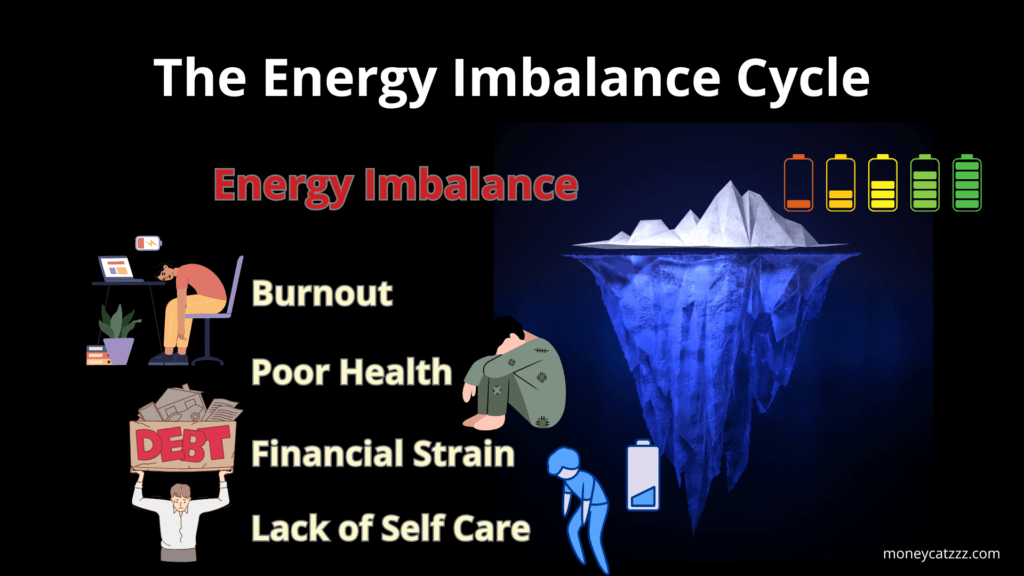
[“How Burnout Spills Over into Every Area of Life” – Image by moneycatzzz.com]
The Domino Effect: How One Imbalance Triggers the Others
Here’s where it gets scary: energy imbalance in one area often spills into the others, creating a dangerous cascade. For example:
- Professional burnout → Poor health choices → Rising medical bills (financial strain)
- Financial stress → Overtime work → Neglected relationships (personal toll)
- Chronic illness → Lost income → Debt (vicious cycle)
A study from the University of Nottingham revealed that financially stressed employees are 34% more likely to experience productivity loss. It’s all connected—imbalances in one area of life often exacerbate the others.
Rebalancing Your Energy Portfolio: Practical Strategies
Now that we’ve covered the perils, let’s focus on reclaiming your energy and building a sustainable, harmonious life. Here are some strategies to help you get started:
- Audit Your Inputs and Outputs: Track your time, spending, and energy for a week. Identify “energy vampires“—those time-wasting activities or relationships that drain you.
- Embrace the Power of “Enough”: Set non-negotiable recovery periods. Billionaire Arianna Huffington swears to reset her energy by unplugging devices after 8 PM (as discussed in her book “The Sleep Revolution“).
- Leverage Compound Growth (Financially and Personally):
- Health: Walking 30 minutes daily reduces heart disease risk by 40% over 20 years.
- Wealth: Investing $500 monthly at 7% growth could turn into $1 million in 30 years.
- Reframe “Balance” as “Harmony”: Balance implies perfection, which can feel unattainable. Harmony, on the other hand, allows for flexibility. Some weeks, work will take priority; other times, it will be family. Adjust as needed.
The Bright Side of Energy Balance
Mastering energy balance isn’t about giving up what you want but making what matters most sustainable. Those who achieve it report:
- 50% higher job satisfaction (Gallup)
- 30% lower risk of chronic disease (CDC)
- 3x greater likelihood of retiring comfortably (National Bureau of Economic Research)
The benefits are abundantly clear that energy balance isn’t just about avoiding burnout, it’s about living a longer, healthier, and more fulfilling life.
The Journey of Rebalancing: A Lifelong Commitment
Rebalancing your energy isn’t a task you can tick off a to-do list; it’s a lifelong commitment to living intentionally. James Clear (Atomic Habits) emphasizes that miniature, consistent changes can lead to transformative results over time. A single step, like setting an intentional boundary or making one healthier choice today, might seem small. Still, over time, it builds into an empowered life not ruled by energy imbalances.
Remember, you’re not just managing your time or your money; you’re managing the most important currency you have: your energy. And by protecting and prioritizing it, you’re investing in the person you want to be tomorrow.
Take a moment to assess if you are living intentionally with your energy or simply reacting to life’s demands. Begin with a tiny step. Whether it’s going to bed 15 minutes earlier, saying no to an unnecessary commitment, or scheduling a few minutes for mindfulness, each decision you make today will echo through your future.
The power to rebalance your life lies in your hands, don’t wait until you’re burnt out to make the change. Start now, and watch how it transforms your inner and outer world.
The key to thriving in today’s fast-paced world is understanding that energy is finite. By actively managing it, we prevent burnout and unlock the potential to lead more fulfilling, impactful lives. So, what’s your next step in the journey of rebalancing? The path is yours; every small action brings you closer to your best self.

References
- Clear, James. Atomic Habits: An Easy & Proven Way to Build Good Habits & Break Bad Ones. Penguin, 2018.
- McKeown, Greg. Essentialism: The Disciplined Pursuit of Less. Crown Business, 2014.
- Walker, Matthew. Why We Sleep: Unlocking the Power of Sleep and Dreams. Scribner, 2017.
- Orman, Suze. The Money Book for the Young, Fabulous & Broke. TarcherPerigee, 2005.
- Huffington, Arianna. The Sleep Revolution: Transforming Your Life, One Night at a Time. Harmony, 2016.
Organizations and Studies Referenced
- World Health Organization (WHO). “Chronic Stress and Health.” World Health Organization,.
- Gallup. “State of the Global Workplace: 2023 Report.” Gallup,.
- Federal Reserve. “Report on the Economic Well-Being of U.S. Households in 2023.” Federal Reserve,.
- Centers for Disease Control and Prevention (CDC). “The Impact of Work-Life Imbalance on Health.” Centers for Disease Control and Prevention,.
- Peer-Reviewed Studies:
Disclosure: This post may contain affiliate links. We only recommend products we believe in, and We may receive a commission at no cost to you! Thank you for your support!
Acknowledgement: Cover Image by moneycatzzz.com on Canva
Signup to our Newsletter for regular updates:
Disclaimer: The information is provided for general information only – moneycatzzz.com makes no representations or warranties in relation to the information, including but not limited to any representation or warranty as to the fitness for any particular purpose of the information to the fullest extent permitted by law. While every effort has been made to ensure that the information provided in this article is accurate, reliable, and complete as of the time of writing, the information provided in this article should not be relied upon to make any financial, investment, real estate or legal decisions. Additionally, the information should not substitute advice from a trained professional who can take into account your personal facts and circumstances, and we accept no liability if you use the information to form decisions.