
Reading Time: 8 mins #
This post may contain affiliate links.
You already know.
Â
You’ve known for a while, probably. Maybe you noticed it the last time their name appeared on your phone, and your shoulders dropped before you’d read a single word. Maybe it was the particular exhaustion after the call you didn’t want to take but took anyway, the two hours of recovery time you needed to feel like yourself again.
Â
The question was never whether this friendship drains you. You settled that quietly, alone, some time ago.
Â
The question is: why are you still in it?
Â
Ending a friendship when you already know it’s time is rarely about information. It’s about the guilt that shows up the moment you move toward the door. The loyalty that was supposed to protect the relationship started protecting the wrong person.
Your body has been filing this complaint for months. Julianne Holt-Lunstad’s research on social relationships found that low-quality relationships pose health risks comparable to those of isolation. The friendship that costs you more than it gives isn’t neutral — it’s actively working against you.
Â
The slow leak does that. It doesn’t announce itself. The tire loses pressure, gradually, quietly, until one morning you realize you’ve been driving on a near-flat tire for longer than you can remember. The car still moved. You still showed up, but every trip costs more than it should have.
Â
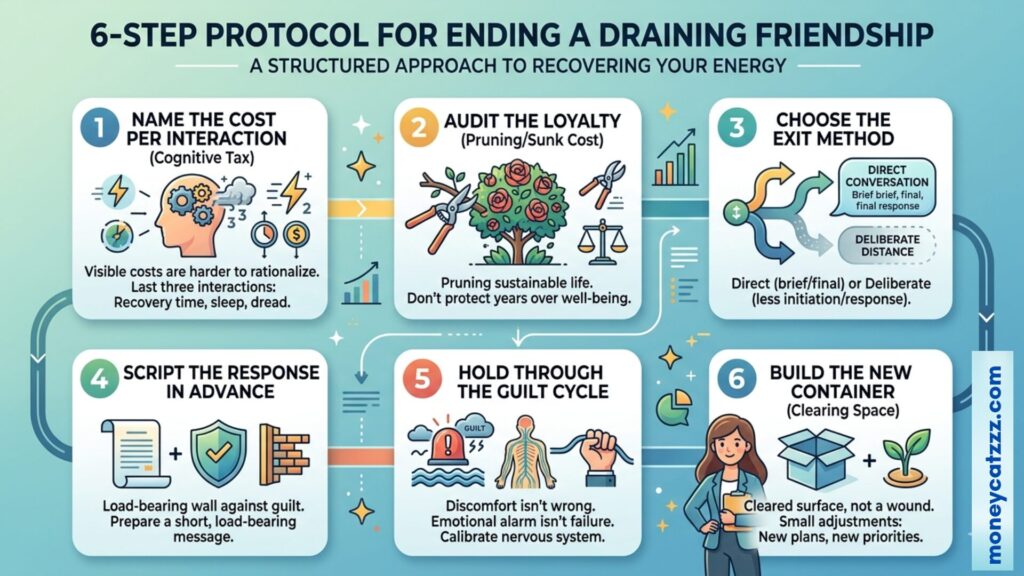
This protocol is for the reader who is certain but frozen. Six steps. Run them in order.
Phase 0: Why You’re Still Stuck
The paralysis isn’t weakness. It’s math.

Â

Â
Where:
- Cclarity​ = how clearly you’ve named what this friendship costs
- Rreadiness​ = how long you’ve carried the decision alone
- Gguilt​ = the weight of shared history and perceived obligation
- Ffear​ = anticipated conflict and social consequence
You may have high clarity and genuine readiness. But if the guilt and fear in the denominator are large enough, the exit stalls. You’re not confused. You’re not weak. The denominator is just unusually heavy right now.
Â
The protocol works on both the numerator and the denominator simultaneously.

Step 1: Name the Cost Per Interaction
We are not classifying “this friendship is draining.” That’s too broad to act on.
Â
Get specific. Think about the last three interactions. After each one, what did you lose? Write it down like a receipt. Hours of recovery time. Sleep. An afternoon of focus that never came back. The low-grade dread that settled in for two days after a single text exchange.
Â
Roy Baumeister’s research on cognitive performance shows that managing difficult social relationships consumes the same executive resources as complex problem-solving. You’re not imagining the mental fog — you’re paying a real cognitive tax every time, on top of the emotional one.
Â
The receipt makes the cost visible. Visible costs are harder to rationalize away.
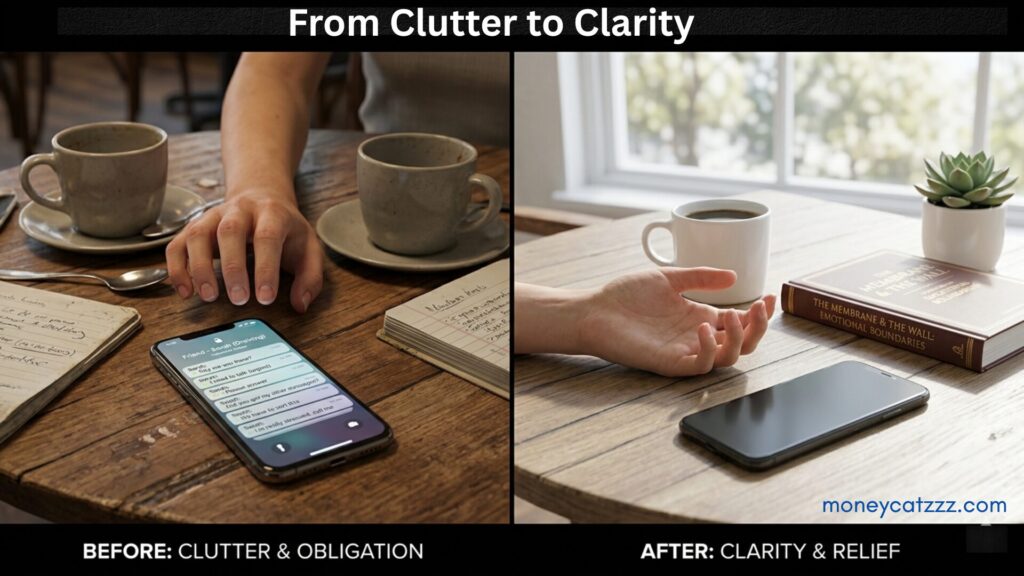
[From Clutter to Clarity | moneycatzzz.com]
Step 2: Audit the Loyalty
This is where most people stop reading.
Â
Pull the lever from Henry Cloud’s work on necessary endings — not for the philosophy, but for the single image that makes the sunk-cost trap mechanical rather than moral. A rosebush requires pruning. The gardener doesn’t cut the branches because they’re bad. She cuts them because the plant cannot sustain everything and still produce anything worth having.
Â
You’ve invested years. That investment is real. But years spent are not evidence that continuing is wise. It’s evidence that leaving feels expensive — those are genuinely different problems.
Â
Ask yourself one question, and answer it plainly: if you’d met this person for the first time six months ago, would you be building this friendship today?
Â
If the answer is no, you’re not protecting a friendship. You’re protecting the years.
Â
That’s a sunk cost. Not a reason.
Step 3: Choose the Exit Method
Two options. Both are legitimate. Neither is universally correct.
Â
The direct conversation. You tell them. You keep it brief, honest, and final. No performance, no paragraph of explanation. Something close to:
Â
“I’ve realized I need to step back from this friendship. I wish you well.”
Â
This works when the person can receive it without turning the conversation into another extraction. It works when you need a clean ending for your own sense of integrity, or when the friendship has enough mutual respect left for a direct close that honors what it once was.
The deliberate distance. You stop initiating and respond less. You let the friendship’s infrastructure quietly dismantle. No announcement, no confrontation.
Â
This works when a direct conversation would become a hostage negotiation. When the dynamic is manipulative enough, giving them a formal ending hands them a new opening, or when your nervous system genuinely cannot sustain a face-to-face exit without high cost to you.
Â
Neither option is cowardly. The cowardice would be choosing neither and staying indefinitely.
Step 4: Script the Response in Advance
You will hear from them.
Â
Maybe not immediately. But eventually. And when you do, you need to have already decided what you’ll say, because in that moment, your guilt will be louder than your clarity.
Â
Research on implementation intentions found that pre-deciding your response to a specific trigger dramatically increases the likelihood you’ll follow through. Peter Gollwitzer suggests that the script isn’t a performance — it’s a load-bearing wall that keeps guilt from deciding for you.
Write it down now, before the message arrives. Keep it short. Something like:
“I’m not in a position to continue this friendship. I wish you genuinely well.”
If you need help with language, use templates. Keep them saved. The goal is for ending a friendship to become a procedure you can execute under pressure, not a moral battle you re-litigate every time they reach out.
Step 5: Hold Through the Guilt Cycle
This is where it breaks down.
Â
You draft the message. Your hand stops. Your chest tightens, and your mind runs a rapid audit of every kind thing they ever did, every shared memory, every version of them you once loved. You close the app.
Â
The fear of causing disappointment in others doesn’t function like a preference. It functions like a phobia. Harriet Braiker’s work on people-pleasing describes this pattern with clinical precision: the hand that stops mid-send isn’t a weakness — it’s a fear response with a long history, conditioned over years, sometimes decades.
Â
Discomfort after a boundary is not a signal that you were wrong. It’s a signal that you’re unused to holding the line. The nervous system will recalibrate. Give it time.
Â
Do not revise the message for at least one full discomfort cycle. That might be an hour. It might be a day. What it cannot be is a permanent reason to stay.
[Friendship Break-up Audit | moneycatzzz.com]
Step 6: Build the New Container
Friendship occupied space; real, structural space.
Â
Tuesday evening plans. The Sunday morning check-in. The person you texted when something went wrong. The slow leak kept that space full, even when what filled it cost you.
Â
Now it’s empty, it is going to feel wrong for a while, and that’s structurally accurate, not evidence that you made a mistake.
Don’t rush to fill it or perform recovery. Just look at the practical shape of your week and make one small adjustment. Tuesday evening becomes something that belongs to you. The Sunday morning thread becomes quiet.
Â
The space a draining friendship leaves behind is not a wound — it’s a cleared surface. What you put there next is yours to choose, without someone else’s needs constantly reordering your priorities.
The Tire, Revisited
You can keep driving on near-flat.
Â
Plenty of people do. The car still moves. You still get to places. But the chassis wears down in ways you don’t see until something more expensive breaks.
Â
Ending a friendship that drains you is not an act of cruelty — it’s basic maintenance on a life that deserves to run properly.
Â
You already knew that.
Â
You just needed someone to write down the steps.
_________________________
Beyond the Protocol: Mastering Your Structural Membrane
Disclosure: This post may contain affiliate links. We only recommend products we believe in, and we may receive a commission at no cost to you! Thank you for your support!
Acknowledgment: Cover Image by moneycatzzz.com
Disclaimer: The information is provided for general information only – moneycatzzz.com makes no representations or warranties in relation to the information, including but not limited to any representation or warranty as to the fitness for any particular purpose of the information to the fullest extent permitted by law. While every effort has been made to ensure that the information provided in this article is accurate, reliable, and complete as of the time of writing, the information provided in this article should not be relied upon to make any financial, investment, real estate or legal decisions. Additionally, the information should not substitute advice from a trained professional who can take into account your personal facts and circumstances, and we accept no liability if you use the information to form decisions.