
 Reading Time: 8 mins #
 This post may contain affiliate links.
You have 1,247 saved articles. Seventeen half-read books on your nightstand. Four hundred and thirty-two Kindle highlights you’ve never looked at twice. I know because I checked mine. The numbers were worse.
There’s a quiet, intellectual drain at work here; a tax on your potential that rarely gets audited. It starts simply enough: you stumble onto a profound insight, tap ‘save,’ and spend ten minutes perfectly formatting the highlights. Then? Nothing but static. You’ve traded away your scarcest assets, your hours and your focus—for a hit of “growth theater” that yields absolutely no cognitive equity. It’s a total collapse of knowledge retention.
This isn’t some moral failing or a lack of grit. It’s a category error; plain and simple. You’ve convinced yourself that the logistics of collecting are the same thing as the grueling labor of knowing.
Stop viewing your notes app as a pristine digital library; it’s a bucket with a hole in the bottom. You can keep pouring in the “water” of new ideas until you’re exhausted, but because the structure itself is compromised, you’ll be standing there thirsty the second you actually need to produce a result.
The Leaky Bucket Problem
I did an audit last month. Opened my notes app, sorted by date, and scrolled back six months. Picked ten entries at random, then closed the app and tried to explain each one without looking.
I could do two. Three, if I’m being generous. The other seven? I had no memory of saving them. No idea what insight had seemed so urgent that I stopped what I was doing to capture it. That’s an 80% forgetting rate. I’d invested hours reading those pieces. More time highlighting and organizing them. The return?—a vague sense that I’m the person who reads important things.
This is the second brain failure. Not the system. The premise. We’ve built elaborate note-taking systems for storing information we will never access. Then we wonder why nothing changes. The knowledge retention research tells us why. We’re using the wrong approach entirely.
The data backs this up. Hermann Ebbinghaus discovered in the 1880s that we forget roughly 70% of new information within 24 hours without active reinforcement. Your notes app doesn’t reinforce anything—it archives. That’s the difference between a bucket and a well. A bucket holds water temporarily—it leaks, so you have to keep filling it. A well goes deep. One good source, properly tapped, gives you water forever.
Most people are walking around with leaky buckets, wondering why they’re always thirsty.

Why Smart People Hoard Information They Never Use
The psychology here isn’t complicated. Saving something feels like progress. You saw the insight. You captured it. You tagged it. Your system is working. Except it’s not. You’ve performed the appearance of learning without doing the work of learning.
Information hoarding gives you the same dopamine hit as actually knowing something, but without the effort. It’s junk food. Tastes good going down. Leaves you empty an hour later. I know this because I did it for years. I built the perfect system—nested folders. Smart tags. Cross-references between notes. I could find anything in seconds. The problem? I never looked. I was actually too busy adding more notes to use the ones I had.
Sönke Ahrens argues that note-taking systems aren’t about storage, and I tend to agree. They’re about transformation. The Zettelkasten method forces you to translate ideas into your own language, which is where knowledge retention actually happens. Your highlights are someone else’s words. Until you’ve rewritten them, they’re not yours. But rewriting is hard. Saving is easy. So we save. And save. And save—then we die with hard drives full of wisdom we never metabolized.
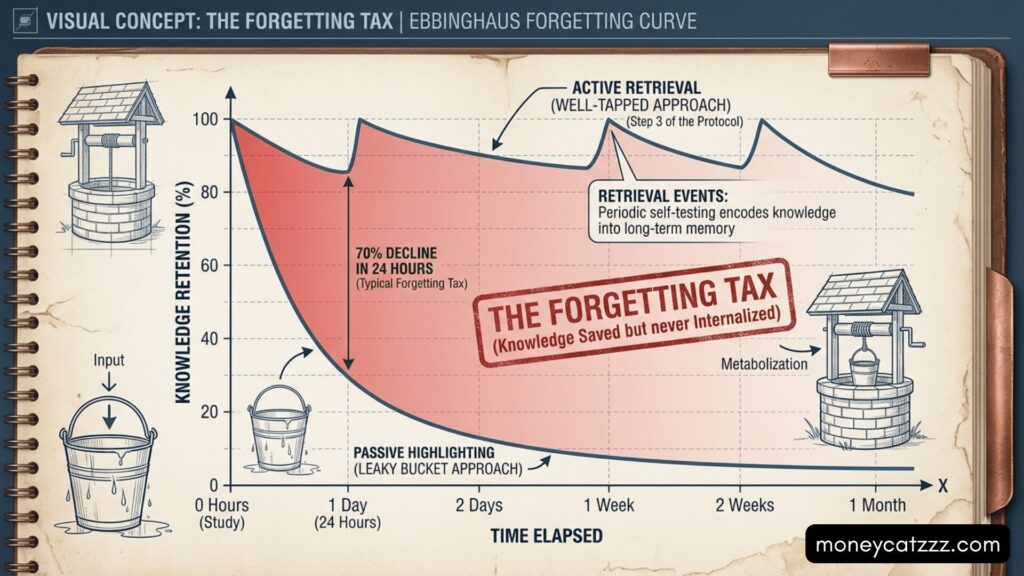
[“Why Your Notes App is a Leaky Bucket | Image by moneycatzzz.com]
The Shame Nobody Talks About
Here’s the part that hurts. You’re smart. You read the right books. You follow the right people—have the system everyone recommends, but when someone asks what you’re learning, you freeze.
You’ve got nothing. Not because you haven’t read anything, but because you can’t remember a single thing you’ve read. That shame keeps you adding more notes. If you read one more book, save one more article, build one more connection, then you’ll finally feel like you know something. You won’t. More input doesn’t solve the information hoarding problem. It makes it worse. This is the repeating brain failure at its most painful; the gap between what you’ve saved and what you actually know.
The Execution Gap: Where Ideas Go to Die
There’s a moment in Nicholson Baker’s novel “The Anthologist” that haunted me for weeks. The main character is a poet who can’t finish writing an introduction to his poetry anthology. He knows everything about poetry. Thousands of references. Decades of reading. That knowledge has become a prison. He’s so full of other people’s ideas that he’s lost access to his own.
The book offers no solution. That’s its genius. It’s a mirror. If you’ve ever had forty-seven browser tabs open and felt too paralyzed to write a single sentence, you’re living in that novel.
This is the creative execution gap. The space between knowing and doing. Between having the information and applying it. Cal Newport calls this the difference between shallow work and deep work. Saving an article is shallow. Anyone can do it. Applying its core idea to your actual life? That’s deep. That requires something from you. Most people have built entire note-taking systems out of shallow work. Then they wonder why nothing in their actual brain has changed. The creative execution gap explains why your carefully organized notes never translate into real-world action.
The Illusion of Knowledge
A 2008 study published in Science by Karpicke and Roediger showed something brutal. Students who practiced retrieval—testing themselves without notes—retained 80% of the material after a week. Students who re-studied the same material retained 36%. Your Kindle highlights are re-studying. Your saved articles are being re-read. They feel productive. They’re the losing strategy for knowledge retention.
Recognition creates the illusion of learning. You scroll through your notes and think, “Oh yeah, I remember that.” Your brain interprets that recognition as knowledge. But recognition itself isn’t retrieval. Retrieval is pulling the idea from memory without prompts—that’s what encodes it.
Your notes app gives you endless recognition and zero retrieval. You feel smart while getting dumber. This is why people can read thirty self-help books and still have the same problems. They’ve identified a thousand solutions, but they’ve yet to implement any of them—the creative execution gap widens with every article you save but never apply.
The Three-Step Metabolization Protocol
I deleted 90% of my notes three months ago. I kept a hundred entries out of over a thousand, then stopped adding new ones until I’d actually used what I kept. Here’s the protocol that fixed my secondary brain failure.
Step 1: The Brutal Inventory
Don’t save anything new for one week. Just review what you have. Pick ten random notes from the last year. For each one, close the app and try to explain it. If you can’t, you have two choices—delete it or commit to metabolizing it this week.
Track the ratio. Saved versus internalized. My ratio was embarrassing. Yours probably will be too. That’s the point. You can’t fix a problem you won’t measure. Most people skip this step because it’s uncomfortable, they’d rather keep pretending their note-taking systems work than face how much they’ve forgotten. Don’t be like most people—confront your information hoarding habit directly.
Step 2: The One-Thing Rule
You get one idea per week. That’s it. Not one article with twelve highlighted bullet points, but one specific insight you can articulate in your own language. Read the book, extract one thing, and write it down without glancing back at the source, then, and this is the non-negotiable part—apply it before Sunday.
This is what knowledge retention actually looks like. It isn’t a “perfect note” sitting in a digital vault; it is a lived application.
- Week of March 3: “Wait ten seconds before saying yes to anything.” That’s it. No framework. No twelve-step process. One idea, applied twenty times that week. Now it’s automatic. I own it.
- Week of March 10: “If I’m not going to do something right now, say that instead of ‘later.‘” One idea. Practiced. Internalized and added to the well.
Contrast that with my old approach: reading a book, highlighting forty passages, saving them all, and remembering absolutely none of them. Ahrens is right—the goal isn’t to collect information. It’s about developing ideas through the friction of putting them into your own words and testing them against the reality of your life. That is how you close the creative execution gap.
Step 3: The Sunday Retrieval Practice
Every Sunday before you read anything new, close your notes app. Take out blank paper. Write what you learned this week. If you can’t write it without looking—you didn’t learn it. Only after this forced retrieval do you get to consume something new.
This is the metabolization checkpoint. It prevents the leaky bucket problem. You’re not adding more water until you’ve confirmed the well is actually filling. The first two Sundays, I had nothing to write. I’d read plenty. Saved nothing to memory. By week four, I could write three ideas from memory and explain how I’d applied each one. That’s the difference between a bucket and a well.
The bucket always feels full when you’re pouring. The well reveals itself when you draw from it. This weekly practice transformed my knowledge retention more than any system I’d built.
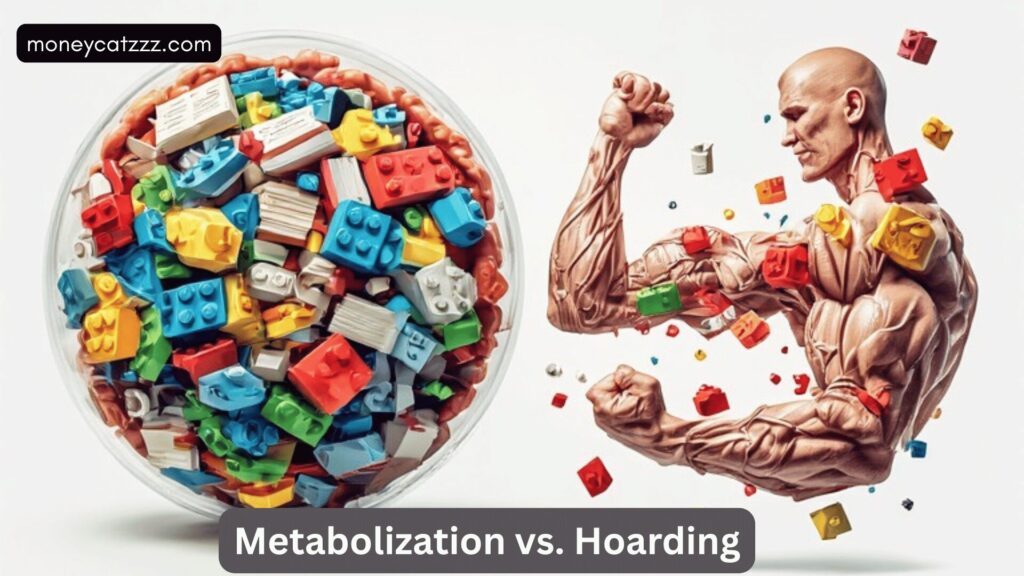
[“Closing the Creative Execution Gap” – Image by moneycatzzz.com]
What I Kept, What I Deleted, What Changed
The ideas I kept weren’t the most sophisticated. They were the most useful. I deleted every “interesting framework“ I’d saved. Kept the ones I’d actually applied. I deleted every “I should remember this someday“ note. Kept the ones I used that week. I deleted every highlight longer than two sentences. If I couldn’t compress it into my own words, it confirms I didn’t understand it.
After twelve weeks: twelve ideas, fully metabolized. Compare that to the previous year: four hundred saved articles, zero behavioral changes. The forgetting tax isn’t just about memory. It’s about the opportunity cost.
Every hour you spend hoarding information is an hour you’re not spending integrating. You think you’re building knowledge. You’re building a museum of things you’ll never look at again—that’s second brain failure in its purest form.

The Digital Mausoleum
Your notes app has become a graveyard of good intentions. Beautiful headstones—perfectly formatted highlights, clever tags—but everything’s dead. You visit occasionally. You feel a pang of guilt. You leave flowers by adding more notes. But nothing comes back to life.
You are both the curator and the mourner. You built this place thinking it was a library but it’s a tomb. The creative execution gap is the space between what’s buried there and what’s alive in your actual behavior.
Stop paying the tax. Your notes app isn’t making you smarter. It’s making you feel smart while preventing the hard work of actually becoming smart. That work is simple. It’s not easy, but it’s simple. One idea. Your words. Applied once. Then you own it. It’s in the well—You can draw from it whenever you need it.
Everything else is a leaky bucket. You can keep pouring if you want. But when you look down, you’ll still be empty.
The protocol starts tomorrow. Before you save anything new, retrieve something old. Write it without looking if you can’t, delete it, or use it. Stop hoarding. Start metabolizing. The tax is optional. You’ve just been paying it for so long you forgot you had a choice.
The Digital Mausoleum: Closing the Gap Between Collecting and Knowing
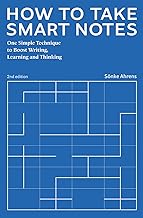
How To Take Smart Notes

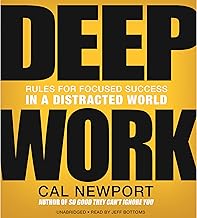
Deep Work
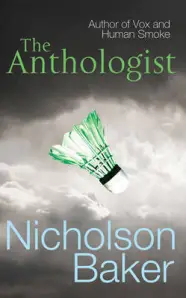
The Anthologist
Disclosure: This post may contain affiliate links. We only recommend products we believe in, and we may receive a commission at no cost to you! Thank you for your support!
Acknowledgment: Cover Image by moneycatzzz.com
Disclaimer: The information is provided for general information only – moneycatzzz.com makes no representations or warranties in relation to the information, including but not limited to any representation or warranty as to the fitness for any particular purpose of the information to the fullest extent permitted by law. While every effort has been made to ensure that the information provided in this article is accurate, reliable, and complete as of the time of writing, the information provided in this article should not be relied upon to make any financial, investment, real estate or legal decisions. Additionally, the information should not substitute advice from a trained professional who can take into account your personal facts and circumstances, and we accept no liability if you use the information to form decisions.