Reading Time: 8 mins #
This post may contain affiliate links.

The manuscript had been on my desk for eleven months. I had written the first chapter, then stopped. A finished book with a real cover and a spot on a shelf felt as distant as a star. I could not see the path, so I did nothing.
Â
I sat on the edge of my unmade bed and stared at it. The morning light hit the dust on the cover — I had not opened it in weeks.
Â
Outside, a neighbor’s child kicked a ball toward a plastic goalpost in a small, patchy yard. He missed, kicked again, and missed again. On the fifth try, the ball wobbled through. He raised both arms, delighted. No crowd. No camera. Just a boy and a wobbling ball.
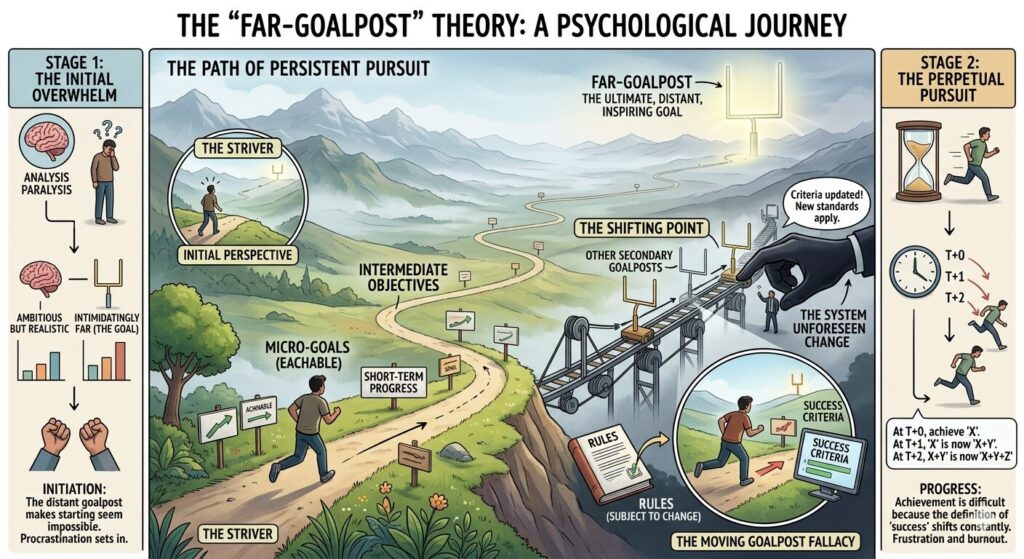
As I watched him run after it, I thought about all the energy I had spent staring at the far target. The promotion. The marathon. The six‑figure deal. The repaired relationship. All worthy. All distant. While I waited for perfect conditions, I scored nothing. The near goalpost, the one I could kick at right now, felt too small to count, so I ignored it — then I wondered why I felt stuck.
Â
The near goalpost is not a consolation prize. It is the only thing that ever got me moving.
The Far Objective Fantasy
I knew this trap like the back of my hand. I had lived in it for years. In my twenties, I dreamed of becoming a published author. I imagined the book tour, the interviews, the readers who would write to say my words had changed their lives. That fantasy was warm. It was also useless — it kept me from writing a single sentence.
Â
I did the same with exercise. I wanted to run a marathon. I bought the shoes, downloaded a training plan, and studied the race route. Then I stopped. The distance was too intimidating — I never ran a single mile.
Â
The far objective is not the enemy. The paralysis it produces is. When the target is too far, the mind gives up before the body starts. I had given up many times.
The Goalpost in the Backyard
A few years ago, I watched a documentary about Jerry Seinfeld. A young comedian asked him for advice on writing better jokes. Seinfeld told him to get a wall calendar and a red marker. Every day he wrote new material, he should put a big X on that date. After a few days, he would have a chain. His only job was not to break the chain — no pressure to write an hour. No demand for genius — show up and mark an X.
Â
The young comedian later said, “I stopped waiting for inspiration. I just showed up and made my X.” The far‑off target of mastering comedy was too big to think about. The achievable milestone, one X today, was so small it felt silly. But it worked, the chain grew, and so did the material.
Â
That is the goalpost in your own backyard. There is no applause. The grass is uneven. You can still kick the ball right now. James Clear calls this the “two‑minute rule,” which is to shrink a habit until it takes less than two minutes to start. The goal is not perfection but to show up. The chain does the rest.
[Conquering the Nearest Corner | moneycatzzz.com]
The Shame of the Small Win
I used to dismiss small wins. Writing one paragraph felt like a failure. Walking ten minutes seems like nothing. Saving five dollars was embarrassing. I worried that celebrating tiny achievements would reveal how low my standards had fallen.
Â
However, that shame is a liar. It protects the far objective fantasy. As long as you never score near, you can still dream about scoring far. The dream is warm. The small win is cold and real. So you stay in the dream.
Â
I often think about Shavy Jain, who spent years trying to lose weight through dramatic diets and grueling workout regimens. Nothing stuck. Then she shifted a single, tiny environmental trigger. She brushed her teeth immediately after dinner. That simple act functioned as a clear psychological signal that the kitchen was officially closed for the night. She also moved healthy snacks to the most visible shelf while pushing processed junk food to the dark back of the cabinet. No more late‑night snacking occurred.
These minor behavioral tweaks lacked cinematic heroism, functioning instead as highly immediate milestones that she could complete in under a minute. Over the course of a single year, she lost thirty‑five kilograms.
Â
When people asked her how she managed it, she explained that she stopped trying to be perfect and focused on making the healthiest option the easiest path. BJ Fogg mapped this exact methodology in his behavioral research on tiny habits. The core rule is simple: start so small that failing is physically impossible. A toothbrush, a quick shelf swap, and a steady chain of red X’s are all it takes.
Â
The deep shame of the small win had almost kept her from starting at all. She took the shot anyway.
The Progress Principle
Teresa Amabile and Steven Kramer spent years tracking the daily lives of knowledge workers to understand what truly drives human motivation and workplace happiness. Their conclusion, published in The Progress Principle, was remarkably straightforward: making small, meaningful steps forward every day is the single most powerful human motivator.
Â
The concept of the massive, sudden breakthrough is a total myth. Big milestones like a major promotion, a finished manuscript, a completed marathon, or a massive client acquisition feel excellent, but the daily fuel of human drive is the small win. It is the simple X on a wall calendar, a cleared email inbox, a brief walk down the block, or a single tidy desk drawer. Real progress doesn’t require grand scale, provided it remains completely tangible.
Â
I closed the text and looked back at my own manuscript. One sentence. All I needed to do was produce one single sentence.
My Own Near Goalpost
I walked over to the desk, sat down, and opened the document. The cursor blinked steadily against the blank page. I typed: “The rain started on a Tuesday.” Then I stared at the screen for a full minute before closing the laptop lid.
Â
The next day, I wrote another sentence, the day after that, a full paragraph. Within a month, I had carved out an entire chapter. Within a year, I held a complete rough draft. The far target had not magically moved closer, but I had finally learned how to score near. The ball wobbled through the net. No crowd cheered for me, but I smiled at the screen anyway.
I applied the same principles to physical movement. I didn’t try for five miles; I just walked to the corner of the street and back. Then I went a little farther the next day. A few months later, I ran an entire 5K race. It wasn’t a marathon, but I had started near. The far objective remained out there on the horizon, but it no longer felt impossible — it just felt like the step after the next one.
Â
The near goalpost had finally solidified into an automatic habit. I did not feel heroic, but I certainly felt less stuck.
[The Far-Goalpost Theory |moneycatzzz.com]
How to Find Your Nearest Goalpost
I started asking myself a simple question: What can I complete in the next ten minutes that would make today feel slightly better than yesterday?
Â
The answer is never grand. Wash the dishes. Send one email. Read two pages. Put on your shoes. Touch the gym door. Brush your teeth after dinner. Make the healthiest option the easiest option.
Â
The near goalpost is not the final target. It is the next benchmark and the one after that. Each small score builds a chain. The chain becomes its own motivation.
The Far Target Revisited
I still dream about the finished book, running a marathon, the big deal, the repaired relationship, the life that feels complete. Those far objectives are not lies — they are real. But they are not the place to start.
Â
You start in your own backyard, kick the ball toward the nearest goalpost. It feels silly. You miss. You kick again. Eventually, the ball goes through. You raise your arms. No one is watching. That is fine. You are training for the stadium, but it has not arrived yet.
Â
The near milestone is not a compromise. It is the only honest place to begin.
The Chain That Keeps Going
I looked at my calendar. Red X’s marked most days. Some days were blank. I did not break the chain; I just missed a day and started again.
Â
The chain was not a prison. It was a reminder. Progress does not require perfection — it requires the next near goalpost.
Â
I walked to the window. The neighbor’s child was still kicking. The ball went wide. He laughed and chased it. I smiled.
Â
I sat down at the desk. The cursor blinked. I typed one more sentence.
____________________
Disclosure: This post may contain affiliate links. We only recommend products we believe in, and we may receive a commission at no cost to you! Thank you for your support!
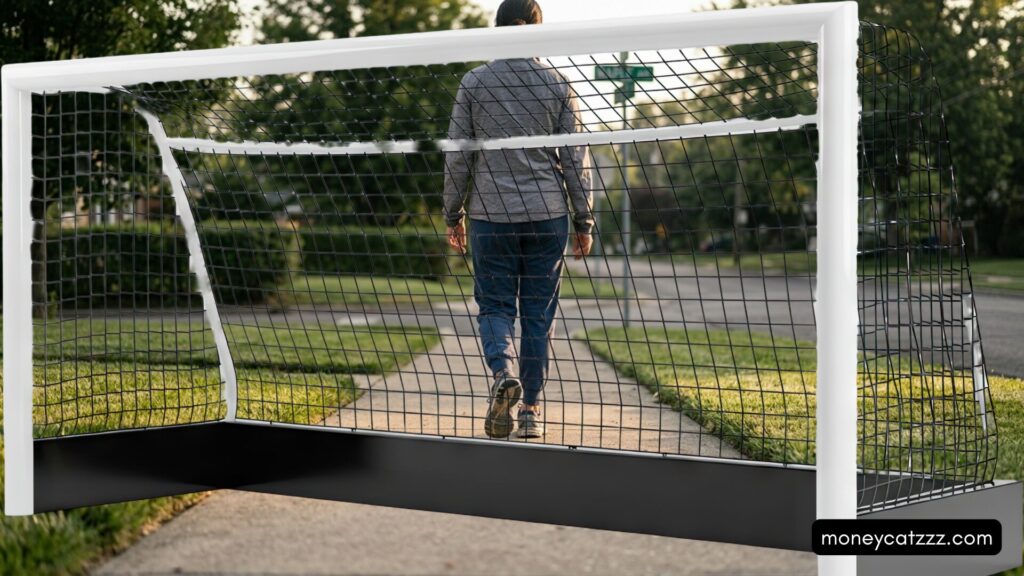
Acknowledgment: Cover Image by moneycatzzz.com
Disclaimer: The information is provided for general information only – moneycatzzz.com makes no representations or warranties in relation to the information, including but not limited to any representation or warranty as to the fitness for any particular purpose of the information to the fullest extent permitted by law. While every effort has been made to ensure that the information provided in this article is accurate, reliable, and complete as of the time of writing, the information provided in this article should not be relied upon to make any financial, investment, real estate or legal decisions. Additionally, the information should not substitute advice from a trained professional who can take into account your personal facts and circumstances, and we accept no liability if you use the information to form decisions.