
 Reading Time: 8 mins #
 This post may contain affiliate links.
The Cost of Perfectionism: Why It's Time to Stop Chasing Perfection
In the grand theatre of life, many of us spend our days pursuing an impossible standard—striving for the perfect resume, curating a flawless online persona, and demanding perfection in everything we do. However, this relentless pursuit of perfection often leads to burnout, anxiety, and a deep sense of unfulfillment.
A study by ResearchGate, found that nearly 80% of millennials struggle with perfectionism, resulting in stress, procrastination, and self-doubt. But what if we changed our perspective? Instead of chasing perfection, shifting our focus to progress and growth can open the door to a more fulfilling and joyful life.
The Hidden Costs of Perfectionism
Perfectionism may seem like a positive trait, but it often holds us back in ways we don’t realize:
- Paralyzed by Fear – The fear of not being good enough prevents us from taking risks, trying new things, and stepping outside our comfort zone.
- Constant Stress and Anxiety – The pressure to be flawless leads to chronic stress, self-doubt, and a diminished sense of self-worth.
- Hinders Learning and Growth – When we avoid mistakes at all costs, we miss opportunities to learn, improve, and grow.
- Erosion of Self-Compassion – Striving for perfection makes us our harshest critics, damaging our ability to practice self-acceptance and resilience.
Shifting the Focus: Progress Over Perfection
Instead of exhausting ourselves in the pursuit of flawlessness, embracing progress and self-improvement allows us to:
- Reduce Stress and Increase Motivation – Celebrating small wins fosters confidence and long-term growth.
- Build Resilience – Viewing failures as lessons helps us adapt and bounce back stronger.
- Enhance Creativity and Innovation – Letting go of perfectionist tendencies encourages experimentation and new ideas.
We create space for growth, happiness, and true fulfillment by learning to stop chasing perfection.
“Done is better than perfect.” – Sheryl Sandberg
Why You Need to Stop Chasing Perfection
The Hidden Costs of Chasing Perfection
Perfectionism might masquerade as a virtue, but it’s a double-edged sword. Here’s how it hinders our personal growth:
- Paralyzed by Fear: The fear of not being good enough can be paralyzing. It prevents us from taking risks, trying new things, and stepping outside our comfort zone.
- Constant Stress and Anxiety: The constant pressure to be flawless is a heavy burden to carry. It leads to chronic stress, anxiety, and a diminished sense of self-worth.
- Hinders Learning and Growth: Perfectionism discourages learning from mistakes. Instead of seeing setbacks as opportunities to improve, we view them as failures, slowing our progress.
- Erosion of Self-Compassion: We become our harshest critics when striving for an impossible ideal. This constant self-criticism erodes our self-compassion, a key ingredient for personal well-being.

[Don’t go chasing waterfalls”– moneycatzzz.com]
The Magic of Letting Go: Stop Chasing Perfection and Grow
How Letting Go of Perfection Leads to Growth
Embracing progress isn’t just about focusing on the journey instead of the destination; it’s also about letting go of the things that hold us back. Perfectionism thrives on a need for control, but actual progress requires embracing the unknown and accepting that setbacks are inevitable. Here’s how letting go can fuel your growth journey:
- Letting Go of the Need for Perfection: This is the cornerstone. By letting go of the pressure to be flawless, we free ourselves to experiment, learn from mistakes, and celebrate small wins. It allows us to focus on effort and improvement, not just the outcome.
- Letting Go of Fear of Failure: Perfectionism thrives on the fear of not being good enough. When we let go of this fear, we open ourselves to taking risks and trying new things. We embrace challenges as opportunities to learn and grow, even if they only sometimes lead to immediate success.
- Letting Go of Comparisons: Perfectionism often fuels social comparison, leading to feelings of inadequacy. We compare ourselves to others’ seemingly perfect online personas, forgetting everyone is on their unique journey. Letting go of comparisons frees us to focus on our growth and celebrate our achievements.
- Letting Go of the Past: Dwelling on past mistakes or missed opportunities can hinder progress. By letting go of the past and embracing the present, we can channel our energy into creating a brighter future.
Letting go doesn’t mean giving up or becoming complacent. It’s about acknowledging limitations, accepting setbacks as part of the learning process, and focusing on the continuous improvement that leads to genuine progress. It’s about embracing the journey with all its imperfections because that’s where the real magic happens.

The Power of Progress: A Shift Away from Chasing Perfection
Shifting from Perfection to Progress: A Game-Changer for Success
Let’s break free from the shackles of perfection and embrace progress. Here’s why this mindset shift is a game-changer:
- Reduced Stress and Increased Motivation: By focusing on progress, we celebrate the small wins and acknowledge the effort we put in. This reduces stress and fosters a sense of accomplishment, keeping us motivated.
- Enhanced Self-Compassion: Embracing progress allows us to appreciate our growth and forgive ourselves for mistakes. This fosters self-compassion, a key to building resilience and navigating challenges effectively.
- Building Resilience: Life is a rollercoaster of achievements and setbacks. When we focus on progress, we view failures as learning opportunities. This builds resilience and equips us with the tools to navigate challenges and bounce back stronger.
- Unleashing Creativity and Innovation: When we abandon the fear of imperfection, we free ourselves to experiment, explore new ideas, and embrace creative solutions. This opens doors to innovation and personal growth.
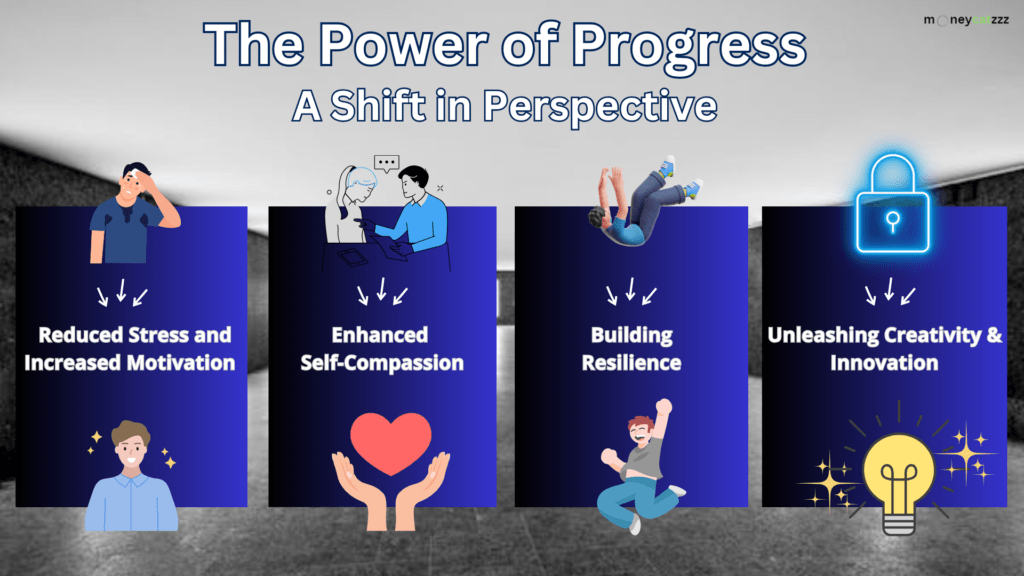
[“The Power of Progress’ – moneycatzzz.com]
Eastern Philosophies on Growth: Why You Should Stop Chasing Perfection
Lessons from Ikigai, Wabi-Sabi & Kaizen: Letting Go of Perfection
Embracing progress resonates beautifully with Eastern philosophies that emphasize continuous growth and learning:
- Ikigai (Japan): “Reason for being.” Finding the intersection of passion, vocation, mission, and profession fuels purpose and fulfillment. Carol Dweck’s “Mindset“ highlights the growth mindset needed to discover and pursue your Ikigai.
- Wabi-Sabi (Japan): Celebrates imperfection and the beauty of impermanence. Align with progress by valuing the journey and accepting flaws. Brené Brown’s “The Gifts of Imperfection“ encourages self-acceptance, key to appreciating Wabi-Sabi’s impermanence and beauty.
- Kaizen (Japan): Continuous improvement. It focuses on making small, incremental changes over time. Aligns with progress by emphasizing constant learning and refinement.
Beyond the East: How Different Traditions Encourage Letting Go of Perfection
What Stoicism & Shoshin Teach Us About Progress Over Perfection
The pursuit of progress extends beyond Eastern philosophies:
- Stoicism (Western Philosophy): Accepting what’s outside your control and focusing on what you can control. Embracing progress aligns with Stoicism’s focus on effort and progress within your control. Marcus Aurelius’ “Meditations“ offers guidance on cultivating a growth mindset aligned with progress.
- Flow State (Western Psychology): A complete immersion in an activity characterized by focused attention and enjoyment. Progress fosters a growth mindset that helps find activities that induce this fulfilling state. Mihaly Csikszentmihalyi’s “Flow“ explores cultivating Flow, a valuable tool for staying engaged and motivated on your progress journey.
- Shoshin (Zen Buddhism): “Beginner’s mind.” Approaching each experience with openness, curiosity, and a willingness to learn. Shoshin aligns with progress by encouraging you to view each step as an opportunity to grow.
These are just a few examples of how philosophies from various cultures can support your journey of embracing progress. Remember, the core message is that growth, learning, and continuous improvement are critical to a fulfilling life. Find the philosophies that resonate most with you and use them as a source of inspiration as you move forward on your path.
Subscribe to our “Newsletter” for future features on the the Philosophies described above.
Beyond Perfection: Cultivating a Growth Mindset for Lasting Success
Reframing Mistakes as Stepping Stones to Success
Embracing progress is more than just a strategy – it’s a shift towards a growth mindset. This mindset encourages the belief that skills and abilities can be developed through effort and learning. Here’s how to cultivate a growth mindset:
- Challenge Negative Self-Talk: Recognize and challenge negative self-talk that reinforces perfectionism. Replace phrases like “I’m not good enough” with empowering statements like “I’m learning and growing daily.“
- Embrace Challenges: View challenges as opportunities to learn and grow. Step outside your comfort zone and take on new things, even if you’re still determining if you’ll succeed. Celebrate your effort, even if the outcome could be better.
- Learn from Others: Surround yourself with positive and supportive people who celebrate your progress. Seek mentors and role models who demonstrate a growth mindset. Their experiences and guidance can help you navigate your journey of progress.
- Focus on the Process, Not Just the Outcome: Enjoy the journey of learning and growth, not just the end goal. Savor mastering a new skill or working to overcome a challenging objective. Celebrate the small “aha” moments and the incremental improvements you make.
The Growth Mindset Mogul: How Oprah Winfrey Stopped Chasing Perfection and Built an Empire
How Oprah Winfrey Overcame Perfectionism to Achieve Greatness
A media mogul and philanthropist, Oprah Winfrey is a powerful example of a growth mindset. She faced countless rejections early in her career, but instead of letting them define her, she used them as fuel for improvement. Oprah embraced feedback, honed her craft, and never stopped learning. This growth mindset propelled her to become one of the most successful talk show hosts in history, a global influencer, and a champion for self-improvement.
Oprah’s story beautifully illustrates the power of progress. It’s not about achieving perfection; it’s about embracing challenges, learning from setbacks, and striving to be your best self.

[“Opray Winfrey on Life” – moneycatzzz.com]
This relentless pursuit of improvement is a hallmark of the growth mindset, and the benefits of embracing progress over perfection extend far beyond individual achievement.
The Long-Term Benefits of Progress: Why Perfection Won’t Lead to Success
Perfection vs. Progress: Why One Leads to Burnout and the Other to Success
By embracing progress over perfection, you unlock a treasure trove of long-term benefits:
- Increased Happiness and Well-being: Letting go of the relentless pursuit of perfection fosters self-acceptance and a sense of inner peace. This leads to greater happiness and overall well-being.
- Stronger Relationships: Building healthy relationships requires vulnerability and the ability to accept feedback. When you embrace imperfections, you connect with others on a deeper level, fostering more robust and more authentic relationships.
- A Life of Authenticity: Letting go of the need to be perfect allows you to embrace your true self. You live with greater authenticity and can express your unique talents and perspectives freely.
- Lifelong Learning: When you focus on progress, you open yourself to a lifetime of learning and growth. You always explore new possibilities and expand your skill set.
[“Learn to Let Go and Move Forward” – Image by Pexels from Pixabay]
Personal Growth in Action: How I Stopped Chasing Perfection and Found Success
As a blogger and digital nomad, constantly traveling and creating content, I can tell you perfectionism used to be my biggest enemy. The pressure to capture the perfect photo, write a flawless blog post, and curate an idyllic online persona was paralyzing. It led to missed opportunities, analysis paralysis, and a constant feeling of inadequacy.
My Personal Journey: Letting Go of Perfection and Embracing Growth
Embracing progress changed everything. Instead of obsessing over flawless content, I focused on consistent creation and learning from each experience. I published more, experimented with different styles, and embraced the beauty of imperfection. My audience grew, I connected with more readers, and the joy of sharing my journey replaced the anxiety of achieving perfection.
This shift was challenging. There were still moments of self-doubt, but the focus on progress kept me moving forward. Now, I celebrate every new follower, every positive comment, and every lesson learned on the road. It’s a journey of continuous growth, and that’s what makes it truly fulfilling.

Remember, progress isn’t about becoming perfect. It’s about moving forward, learning from your experiences, and becoming the best version of yourself. Embrace the journey, celebrate your wins (big and small), and enjoy the freedom from letting go of the pursuit of an impossible ideal.
Ready to Start Your Progress Journey Today?
Here are some additional resources to help you on your path:
- “Mindset: The New Psychology of Success” by Carol Dweck
- “The Gifts of Imperfection” by Brené Brown
- “Progress Not Perfection: Your Journey Matters” by Kate Larsen
- Websites: Growth Mindset Institute
- Websites: Greater Good Science Center
Remember, you are not alone on this journey. Embrace the power of progress, celebrate your growth, and unlock the potential for a more fulfilling and joyful life!
Disclosure: This post may contain affiliate links. We only recommend products we believe in, and We may receive a commission at no cost to you! Thanks for your support!”
Acknowledgement: Cover Photo by Pedro Figueras
Signup to our Newsletter for regular updates:
Disclaimer: The information is provided for general information only – moneycatzzz.com makes no representations or warranties in relation to the information, including but not limited to any representation or warranty as to the fitness for any particular purpose of the information to the fullest extent permitted by law. While every effort has been made to ensure that the information provided in this article is accurate, reliable, and complete as of the time of writing, the information provided in this article should not be relied upon to make any financial, investment, real estate or legal decisions. Additionally, the information should not substitute advice from a trained professional who can take into account your personal facts and circumstances, and we accept no liability if you use the information to form decisions.