
 Reading Time: 8 mins #
 This post may contain affiliate links.
Creativity and Problem-Solving: Unlocking A Natural Human Ability
Creativity and problem-solving are not exclusive gifts but fundamental human capacities, evident from our first primal cry at birth—a universal act of adaptation and communication. This innate ability, however, often becomes buried under self-doubt, societal expectations, and the fear of failure. Yet, by tapping into our natural inclination for creative expression, we can reignite the spark that fuels innovation and personal growth. In today’s world, where 70% of employers prioritize creative thinking, cultivating this skill is more essential than ever.
Simple shifts can make a difference in overcoming mental blocks and enhancing creative thinking techniques. Changing your environment, establishing a creative routine, and seeking inspiration through art, nature, or diverse experiences can stimulate fresh ideas. Studies in neuroscience reveal that divergent thinking—generating multiple solutions—paired with convergent thinking—selecting the best ideas—activates key brain regions, allowing us to think more flexibly and initially.
Creativity isn’t just for artists—it influences everyday decision-making and professional success. Whether brainstorming innovative business strategies, tackling unexpected challenges, or reimagining personal projects, embracing creative thinking techniques and overcoming mental blocks unlocks our potential. By fostering an open mindset and integrating problem-solving strategies into daily life, we sharpen our ability to navigate complexity and drive meaningful change.
“You can’t use up creativity. The more you use, the more you have.” – Maya Angelou
What is Creativity?
Creativity isn’t an exclusive gift bestowed upon a select few—it’s a dynamic process that blends innate ability with learned skill. For centuries, scholars, psychologists, and innovators have debated its origins. Is it something we are born with, or can it be cultivated? Let’s break it down:
| Perspective | Explanation |
|---|---|
| The “Born With It” View | Some argue that creativity is an inherent trait, much like eye color or athletic ability—you either have it or you don’t. |
The “Learned Skill” Perspective | Others believe that creativity and problem-solving can be developed through practice, just like mastering an instrument or learning a new language. |
Creativity and Problem-Solving: A Skill You Can Strengthen
While some individuals may naturally excel in creative thinking techniques, research confirms that creativity functions like a muscle—the more you engage it, the stronger it becomes. Studies in cognitive neuroscience reveal that regular idea-generation exercises and problem-solving challenges can rewire neural pathways, leading to greater innovative thinking.
A 2023 study by the American Psychological Association found that individuals who regularly practiced divergent thinking—the ability to generate multiple solutions—showed a 30% increase in problem-solving efficiency over those who did not.
Overcoming Mental Blocks to Unlock Creativity
Even the most brilliant minds encounter creative roadblocks. Overcoming mental blocks often requires shifting perspective and embracing new experiences. To break free from a fixed mindset, consider:
- Changing your routine: Introducing novelty sparks fresh neural connections.
- Practicing free association: Letting thoughts flow without judgment can lead to unexpected breakthroughs.
- Using constraints strategically: Sometimes, limits force more innovative problem-solving approaches.
By integrating creative thinking techniques into your daily life, you can cultivate a mindset that fuels creativity and problem-solving and transforms challenges into opportunities for innovation.
A Historical Perspective on Creativity
For millennia, societies have sought to define creativity. In ancient times, it was often seen as a divine gift granted only to artists, philosophers, and inventors. The Greeks attributed poetic inspiration to the Muses, while Renaissance thinkers viewed creativity and problem-solving as the domain of geniuses like Leonardo da Vinci.
From Mysticism to Science: How Creativity Works
Modern research paints a different picture—one rooted in neuroscience and cognitive psychology. Creativity isn’t just about spontaneous bursts of genius; it’s a structured cognitive process that blends two key modes of thought:
| Thinking Mode | Function |
|---|---|
| Divergent Thinking | Generates new ideas, explores possibilities, and fuels imagination. |
| Convergent Thinking | Analyzes, refines, and selects the most effective solutions. |
This interplay between divergent and convergent thinking activates multiple brain regions, particularly the prefrontal cortex and default mode network, helping us connect unrelated concepts and develop innovative solutions.
Did You Know? A 2024 study from Stanford University found that individuals who regularly practice creative thinking techniques experience increased neural plasticity, enhancing their ability to overcome mental blocks and generate original ideas.
Creativity and Problem-Solving: Forging New Paths
By understanding the science behind creativity, we can move beyond outdated myths and actively cultivate creative problem-solving skills. Whether through brainstorming sessions, mind mapping, or lateral thinking exercises, unlocking creativity is less about waiting for inspiration and more about training your brain to think differently.
Power Up Your Creativity: Proven Techniques to Spark Innovation
Unlocking your creativity and problem-solving skills isn’t about waiting for inspiration—it’s about using structured techniques to train your brain to think differently. Whether brainstorming alone or collaborating with a team, these creative thinking techniques can help you overcome mental blocks and generate breakthrough ideas.
1. Brainstorming Bonanza: Quantity Fuels Quality
Set a timer, grab a pen (or your team), and unleash a flood of ideas. The goal? Write down everything—no idea is too wild. Research shows that generating many ideas increases the likelihood of hitting on a truly innovative solution.
When brainstorming, defer judgment. Creativity thrives when we suspend criticism and allow ideas to flow freely.
2. Mind Mapping Magic: Visualizing Your Creativity
A mind map is a powerful way to organize ideas and see hidden connections.
- Start with a central theme (e.g., “Creative Problem-Solving”).
- Branch out with related ideas, keywords, and subtopics.
- Look for unexpected connections that could lead to innovative solutions.
3. SCAMPER: A Blueprint for Innovation
SCAMPER is a structured creativity tool that helps you reimagine existing ideas by applying seven thinking prompts:
| SCAMPER Technique | How It Fuels Creativity |
|---|---|
| Substitute | What can be replaced to improve the idea? |
| Combine | How can two ideas be merged into something new? |
| Adapt | What changes could make this more effective? |
| Modify | How can you enhance or alter it? |
| Put to Other Uses | Can this be used differently than intended? |
| Eliminate | What unnecessary parts can be removed? |
| Reverse | What happens if you flip the concept entirely? |
By integrating these creative thinking techniques into your daily routine, you can train your brain to approach problems from fresh perspectives, unlocking limitless innovative potential.
[“SCAMPER Your Way to Innovation” – moneycatzzz.com
The Art of Problem-Solving: Tackling Challenges with Precision
Life presents us with various problems, from math equations to social dilemmas. The key to successful problem-solving lies in understanding the type of problem you’re facing.
Well-Defined Problems: Clear Challenges with a Defined Path
These problems are straightforward, with a clear starting point and rules, such as a math equation or a jigsaw puzzle. For these types of challenges, structured problem-solving techniques work best. Tools like root cause analysis and the 5 Whys method can help you dissect the problem step-by-step, uncovering the root issue efficiently.
By recognizing and applying the right approach, you can overcome mental blocks and find creative solutions to even the most well-defined problems.

Ill-Defined Problems: Navigating Ambiguity with Creativity
Ill-defined problems are like a beautifully wrapped present labeled “Mystery Inside!” These challenges are more ambiguous, often with no clear solution, and require refining the goals and the approach. Examples include designing a new learning experience or solving environmental issues.
Creative Problem-Solving Techniques for Ill-Defined Challenges
For these complex problems, creativity and problem-solving are crucial. Techniques like brainstorming (generating a wide array of ideas), mind mapping (visualizing connections), and design thinking (focusing on user needs) become essential in tackling uncertainty.
Recognizing whether you’re dealing with a well-defined or ill-defined problem helps you select the appropriate strategy, ensuring you’re equipped with the right tools to find innovative solutions.
Breaking Through Creative Blocks: Reigniting Your Creativity
Even the most creative minds face mental blocks. If you’re staring at a blank page or feel stuck, it’s time to unleash strategies to break free. Here are some proven methods to overcome creative blocks and spark fresh ideas:
Effective Strategies to Overcome Mental Blocks
- Embrace Time Limits: Set a timer for a brief brainstorming session (5-10 minutes). The pressure of deadlines can help you generate more ideas, and quantity often leads to quality breakthroughs.
- Practice Mindfulness: If the creative void feels overwhelming, step back and practice mindfulness. Meditation or mindful walking can clear your mind and allow new ideas to emerge.
- Change Your Scenery: A change of environment can be a game-changer. Work in a different space—a coffee shop or a park—and see how a fresh perspective helps spark new, creative connections.
Using these creative thinking techniques allows you to power through mental roadblocks and reignite your problem-solving skills.
The Power of Collaboration: Fueling Creative Success
Collaboration is a powerful tool for overcoming creative blocks. Two minds are often better than one! Engage in brainstorming sessions with colleagues, bounce ideas off friends, or explore online creative communities to find inspiration and support.
Inspiration and Self-Compassion: Key to Creative Flow
- Seek Inspiration Everywhere: Surround yourself with sources of wonder. Dive into art, music, nature, or anything that sparks curiosity. Inspiration is abundant, so stay open to new experiences and perspectives.
- Practice Self-Compassion: Your inner critic can be a major roadblock. Be kind to yourself when facing creative struggles. Acknowledge that setbacks are a natural part of the process and celebrate every small step forward. Even a small spark can reignite your creative problem-solving abilities.
Stay persistent and explore different strategies, from creative thinking techniques to self-compassion. By remaining open and committed, your creative flow will soon return.
Sharpen Your Problem-Solving Toolkit: Key Techniques
To tackle challenging problems effectively, a structured approach can make all the difference. Here are some essential frameworks to enhance your problem-solving capabilities:
Powerful Problem-Solving Frameworks
- The 5 Whys Method: A simple yet effective technique. Keep asking “why” until you uncover the root cause of the issue. This method helps dig deep and identify the actual problem.
- Root Cause Analysis: Go beyond surface-level symptoms. This method helps you identify the root cause of a problem, and tools like cause-and-effect diagrams can help map out potential issues.
- Design Thinking Process: A human-centered approach focusing on empathy and iterative solutions. It guides you through understanding the user, defining the problem, brainstorming ideas, prototyping, and testing, ensuring that creative problem-solving aligns with user needs.
These tools can significantly enhance your ability to overcome creative and problem-solving challenges with clarity and precision.
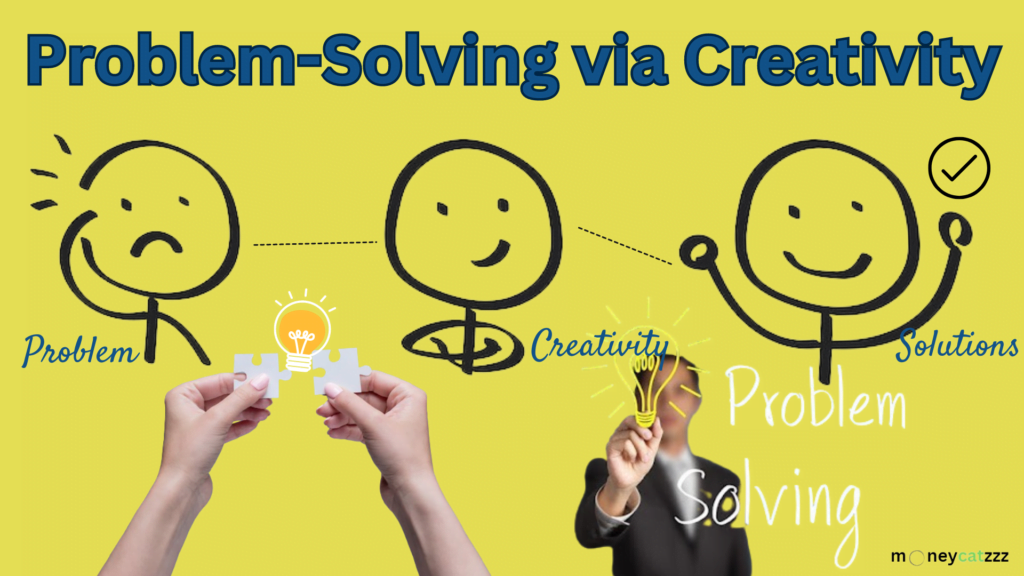
[“Problem Solving thru Creativity”- moneycatzzz.com]
Breaking Through Creative Blocks: Strategies for Success
Even the most creative minds encounter roadblocks. But don’t worry – overcoming them is possible with the right strategies. Here are some effective techniques to reignite your creative flow:
Effective Strategies to Overcome Creative Blocks
- Take a Break: Sometimes, stepping away from the task is the best solution. Engage in unrelated activities like walking or listening to music to refresh your mind and return with new perspectives.
- Change Your Environment: A change of scenery can do wonders. Whether working in a coffee shop, a park, or a different room in your house, a fresh environment can spark new ideas and creative breakthroughs.
- Seek Inspiration: Surround yourself with stimuli that ignite your curiosity. Art, music, nature, or any form of creative expression, inspiration can be found anywhere. Stay open to what excites you!
- Practice Self-Compassion: Be kind to yourself. Creative blocks are part of the process. Accept setbacks as opportunities for growth and celebrate your progress, even the small wins.
By staying persistent, embracing new approaches, and being patient, you’ll break through those mental blocks and unleash your creativity and problem-solving potential!
Beyond the “Big C”: Embracing Everyday Creativity
When we think of creativity, we often envision the “Big C” creativity – the groundbreaking inventions or revolutionary works of art that leave a lasting legacy. However, creativity is much more than these monumental achievements. It’s a vital skill we exercise daily in countless ways, often without realizing it. This is where “little c” creativity comes into play.
Examples of Everyday Creativity in Action
- Finding a New Recipe: When you’re missing an ingredient, you improvise by substituting or combining flavors, creating a delicious new twist on a familiar dish.
- Problem-Solving at Work: Encountering a technical issue? Instead of relying on the usual solution, you think creatively and develop a more efficient approach.
- Reimagining Your Workspace: Feeling uninspired in your home office? A simple rearrangement, adding plants, or creating a mood board can transform your space into a more motivating environment.
- Crafting a Unique Outfit: You experiment with unexpected color combinations or layer pieces in a fresh way to create a standout outfit for a night out.
- Tackling a DIY Project: You refresh your patio furniture with a creative touch, adding colorful accents or incorporating recycled materials to create something unique.
- Coming Up With New Ways to Learn: When traditional methods don’t work, you create flashcards with mind maps or develop mnemonic devices to remember key information for an exam.
- Finding Joy in Everyday Activities: You take a walk in nature and notice the intricate patterns of a spiderweb or the vibrant colors of a flower, appreciating the beauty in the everyday world.
Embracing everyday creativity can enhance personal and professional growth, providing countless opportunities for problem-solving and innovation in the smallest moments.
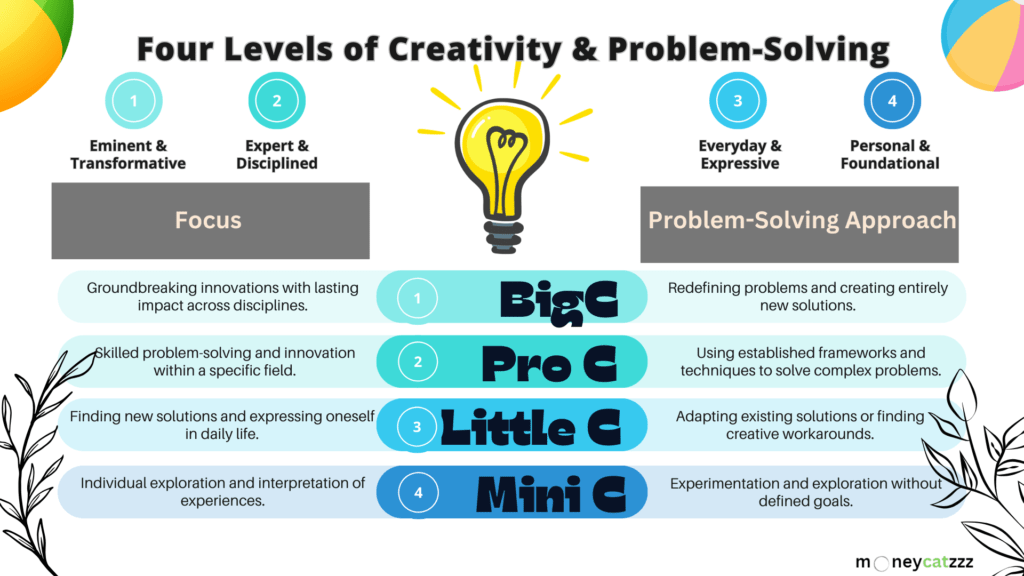
[“Four Levels of Creativity & Problem-Solving” – moneycatzzz.com]
Overcoming Obstacles and Reigniting the Spark
Our creative journey often faces challenges. Social conditioning may lead us to believe creativity is only for the “talented” few, while fear of failure and self-doubt can stifle our creative spirit. However, history shows that many defied these limitations – the artist who broke artistic boundaries, the scientist who questioned established theories, and the entrepreneur who disrupted industries. Their stories remind us that creativity thrives in environments that embrace experimentation, encourage unconventional ideas, and celebrate the courage to take risks.
The Far-Reaching Benefits of Creativity
The benefits of nurturing creativity go beyond personal fulfillment – it drives innovation across many fields. From scientific discoveries to technological breakthroughs and art that sparks social change, creativity is the catalyst. Studies show that creativity enhances problem-solving skills, fosters resilience in the face of challenges, and contributes to overall mental well-being.

Ignite Your Problem-Solving Prowess
Effective problem-solving starts with a growth mindset – the belief that abilities can improve with effort and learning. Embrace challenges as opportunities for growth, learn from mistakes, and celebrate your problem-solving successes.
Cultivate Your Creative Jungle
By acknowledging our inherent creativity and embracing its multifaceted nature, we open the door to endless possibilities. Throughout history, individuals who dared to push boundaries have taught us invaluable creative thinking and problem-solving lessons. As we embark on our creative journeys, we can draw inspiration from these pioneers who forged new paths. The key is fostering a mindset that encourages exploration, experimentation, and learning from successes and failures.
So, how can you begin nurturing your creative jungle? Whether you’re an aspiring artist, a business professional, or simply someone eager to tap into your creative potential, the process begins with a willingness to step outside your comfort zone. For artists, this might mean signing up for online courses or participating in local workshops to gain new skills and perspectives. For professionals, integrating brainstorming sessions, mind mapping, or design thinking exercises into your work routine can spark fresh ideas and approaches to challenges.
Remember, the most powerful aspect of creativity isn’t just the result—it’s the journey of exploration and discovery. Embrace the messiness of the creative process, silence your inner critic, and allow yourself to enjoy the act of creating. Each step you take, each idea you explore, is part of the unfolding symphony of your creativity. So start creating today, and watch as your creative jungle blossoms, filled with inspiration, innovation, and endless possibilities.
Fueling Your Creative Fire: A Bookworm’s Guide
Rejuvenate your creativity with these insightful books that offer both inspiration and practical tools:
- “Steal Like An Artist” by Austin Kleon: Kleon encourages you to embrace inspiration by remixing and building upon others’ work rather than simply copying. This book helps you find your unique voice through creative collaboration.
- “Big Magic: Creative Living Beyond Fear” by Elizabeth Gilbert: For those hindered by fear, Gilbert offers empowering guidance on cultivating a relationship with creativity, overcoming the fear of failure, and embracing inspired action.
- “The War of Art” by Steven Pressfield tackles “Resistance,” the internal force that blocks us from pursuing creative dreams. His book provides practical strategies to overcome procrastination and silence self-doubt.
- “Creativity, Inc.“ by Ed Catmull and Amy Wallace: Dive into the culture behind Pixar’s creativity and innovation. Catmull shares how the studio fosters collaboration, creativity, and growth, offering valuable lessons for cultivating an empowered creative environment.
Arm yourself with these tools and begin your creative journey today. The spark of creativity lies within—waiting to be nurtured and transformed into your unique symphony of self-expression.
Disclosure: This post may contain affiliate links. We only recommend products we believe in, and We may receive a commission at no cost to you! Thanks for your support!”
Acknowledgement: Cover Image by freepiks.com
Disclaimer: The information is provided for general information only – moneycatzzz.com makes no representations or warranties in relation to the information, including but not limited to any representation or warranty as to the fitness for any particular purpose of the information to the fullest extent permitted by law. While every effort has been made to ensure that the information provided in this article is accurate, reliable, and complete as of the time of writing, the information provided in this article should not be relied upon to make any financial, investment, real estate or legal decisions. Additionally, the information should not substitute advice from a trained professional who can take into account your personal facts and circumstances, and we accept no liability if you use the information to form decisions.