
 Reading Time: 7 mins #
 This post may contain affiliate links.
Understanding and connecting with others has never been more crucial in an increasingly divided world. Recent research from the University of Cambridge reveals that individuals with high empathy report 23% greater life satisfaction and 32% lower stress levels. Let’s delve into the transformative power of empathy and compassion, and how they can revolutionize our relationships and society.
“Empathy is about understanding, compassion is about action.” — Stephen Covey
Understanding Empathy and Compassion
Empathy and compassion, while often used interchangeably, have distinct meanings. Empathy is the ability to understand and share the feelings of another, while compassion goes a step further, involving the desire to take action to alleviate another’s suffering.
As Brené Brown eloquently puts it in her book “Daring Greatly,” empathy is a strange and powerful force. There is no script. There is no right way or wrong way to do it. It’s simply listening, holding space, withholding judgment, emotionally connecting, and communicating that incredibly healing message of ‘You’re not alone.‘
The Science Behind Empathy and Compassion
As Christian Keysers elucidates in his seminal work “The Empathic Brain,” our brains are wired for empathy through a complex interplay of neural mechanisms, most notably mirror neurons. These neurons, located in areas associated with action, sensation, and emotion, fire when we perform an action and when we observe someone else doing the same. This neural synchronization, often described as “feeling with” or “mirroring” another person’s experience, is fundamental to human cognition.
Beyond mirror neurons, empathy involves a broader network of brain regions, including the insula, anterior cingulate cortex, and prefrontal cortex. These areas work together to process emotions, understand intentions, and regulate our responses to others’ experiences. This neural circuitry allows us to recognize and share emotions and respond compassionately, a desire to alleviate another person’s suffering.
In essence, our brains are naturally attuned to understanding and sharing the experiences of others. This biological foundation, rooted in the intricate interplay of neural mechanisms, provides a solid basis for cultivating and strengthening our empathic abilities. By understanding the neuroscience of empathy, we can gain insights into fostering compassion and building more harmonious relationships.

[“Empathy and compassion” – Image by freepik]
Developing Empathy: A Step-by-Step Approach
- Active Listening: Pay full attention to others without interrupting or judging.
- Perspective-Taking: Try to see situations from others’ viewpoints.
- Emotional Recognition: Practice identifying and naming emotions in yourself and others.
- Cultural Awareness: Learn about different cultures and life experiences.
- Mindfulness: Cultivate present-moment awareness to be more attuned to others.
By consistently practicing these steps, we can enhance our empathic abilities and foster deeper connections with those around us.
Cultivating Compassion: Moving from Understanding to Action
While empathy allows us to understand others, compassion motivates us to help. In “The Compassionate Mind,” Paul Gilbert outlines strategies for developing compassion:
- Self-Compassion: Treat yourself with kindness and understanding.
- Loving-Kindness Meditation: Practice wishing well-being for others, including strangers.
- Volunteering: Engage in activities that directly help others.
- Gratitude Practice: Regularly acknowledge the good in your life and others’ contributions.
- Compassionate Communication: Use language that is supportive and non-judgmental.
These practices benefit others and enhance our well-being and sense of purpose.
Overcoming Barriers to Empathy and Compassion
Several factors can hinder our ability to empathize and show compassion:
- Cognitive Biases: Our brains often make quick judgments that can be inaccurate.
- Emotional Burnout: Constant exposure to others’ suffering can lead to compassion fatigue.
- Fear of Vulnerability: Opening ourselves to others’ emotions can feel risky.
- Cultural Differences: Misunderstandings can arise from diverse cultural norms.
Recognizing these barriers is the first step in overcoming them. As Thich Nhat Hanh wisely states in “The Art of Communicating,” “Understanding is the essence of love. If you cannot understand, you cannot love.” By acknowledging and understanding these barriers, we can better prepare ourselves to navigate the complexities of empathy and compassion, leading to more meaningful connections and a more harmonious society.
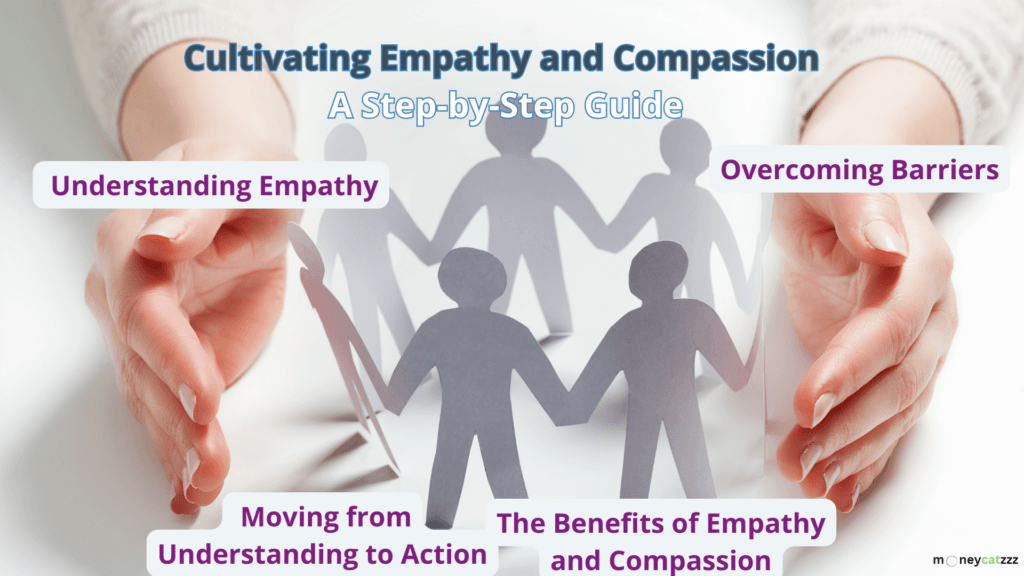
[“A Guide to Empathy and Compassion” – moneycatzzz.com]
The Role of Technology in Empathy and Compassion
In our digital age, technology plays a complex role in our capacity for empathy and compassion. While social media can connect us globally, it can also create echo chambers and reduce face-to-face interactions.
In her book “Reclaiming Conversation,” Sherry Turkle argues the importance of real-world connections: “Face-to-face conversation is the most human – and humanizing – thing we do. Fully present to one another, we learn to listen. It’s where we develop the capacity for empathy. It’s where we experience the joy of being heard and being understood.”
Balancing our online and offline interactions is crucial for maintaining and developing our empathic abilities.
Empathy and Compassion in Leadership
In the professional world, empathetic and compassionate leadership is gaining recognition as a crucial factor in organizational success. As Simon Sinek points out in “Leaders Eat Last,” “Empathy is a valuable leadership tool. It allows us to create bonds of trust; it gives us insights into what others may be feeling or thinking; it helps us understand how or why others are reacting to situations; it sharpens our ‘people acumen,’ and informs our decisions.” This recognition empowers us to lead with empathy and make a positive impact.
Leaders prioritizing empathy and compassion often see increased employee engagement, loyalty, and productivity.

Real-Life Case Studies
- The Empathy School Revolution: A high school in Detroit implemented a curriculum focused on empathy and emotional intelligence. Within two years, they saw a 50% decrease in behavioral issues and a 40% increase in academic performance.
- The Compassionate Company: A tech startup in San Francisco made compassion a core company value, encouraging employees to volunteer regularly and practice mindfulness. They reported a 65% increase in employee satisfaction and a 28% decrease in turnover rates.
These examples illustrate the tangible benefits of prioritizing empathy and compassion in various settings.
Long-Term Benefits of Empathy and Compassion
Cultivating empathy and compassion offers numerous personal and societal benefits:
- Stronger, more fulfilling relationships
- Improved mental health and well-being
- Enhanced conflict resolution skills
- Greater social cohesion and reduced prejudice
- Increased innovation through diverse perspective-taking
Developing these qualities enriches our lives and contributes to a more understanding and harmonious world. Cultivating empathy and compassion leads to a society with stronger, more fulfilling relationships, improved mental health and well-being, enhanced conflict resolution skills, greater social cohesion, and reduced prejudice. It also fosters increased innovation through diverse perspective-taking. These societal benefits give us hope and optimism for a future built on understanding and kindness.

In conclusion, empathy and compassion are not just feel-good concepts but essential skills for navigating our complex, interconnected world. Roman Krznaric suggests in his book “Empathy: Why It Matters, and How to Get It,” we need to move beyond the age of introspection and enter the age of outrospection, where we discover ourselves and make sense of the world through empathic connections with others.
By consciously cultivating empathy and compassion, we open ourselves to deeper, more meaningful connections and contribute to a more understanding and compassionate society. Every small act of kindness or compassion ripples outward, creating a more favorable environment for all.
Are you ready to embark on your journey of empathy and compassion? Start by practicing active listening in your next conversation, or try a loving-kindness meditation. For more resources on developing these crucial skills, check out our curated list of books and courses on emotional intelligence and compassionate communication.
You can also explore other resources like online forums, workshops, and podcasts. Together, we can create a world where understanding and kindness prevail.
Disclosure: This post may contain affiliate links. We only recommend products we believe in, and We may receive a commission at no cost to you! Thanks for your support!
Acknowledgement: Cover Image by Unsplash.com
Disclaimer: The information is provided for general information only – moneycatzzz.com makes no representations or warranties in relation to the information, including but not limited to any representation or warranty as to the fitness for any particular purpose of the information to the fullest extent permitted by law. While every effort has been made to ensure that the information provided in this article is accurate, reliable, and complete as of the time of writing, the information provided in this article should not be relied upon to make any financial, investment, real estate or legal decisions. Additionally, the information should not substitute advice from a trained professional who can take into account your personal facts and circumstances, and we accept no liability if you use the information to form decisions.