 Reading Time: 8 mins #
 This post may contain affiliate links.
I used to believe that learning was a one‑way street. You acquire knowledge, you keep it, you grow; the more you know, the more confident you become.
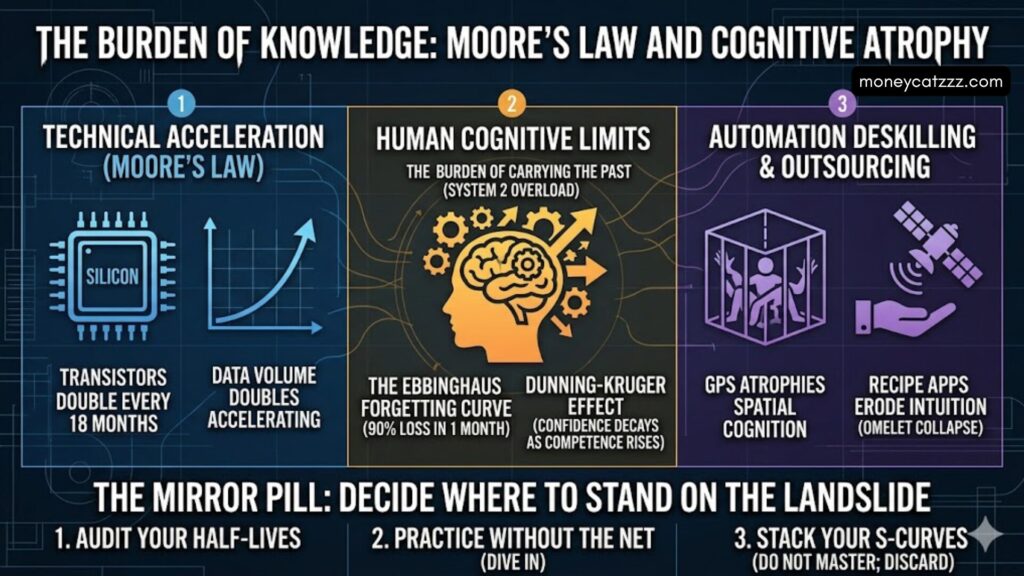
Then I discovered Moore’s Law. My understanding of it, my knowledge version. The law’s primary observation was that human knowledge doubles at an accelerating pace. What took centuries to discover now takes decades. What took decades now takes years.
The law might resemble “abundance,” but it is not. It is a slow‑motion disaster for the human brain.
When knowledge doubles faster than you can absorb it, your existing skills expire. Your memory betrays you. Your confidence collapses. And you end up staring at your fifth‑grader’s math homework like it is written in ancient Greek.
I remembered trying to help my niece with her fifth‑grade math homework last month. She showed me a worksheet full of “number bonds” and “partial quotients.” I have a college degree, once aced calculus, but I stared at the page as if it were written in Linear B.
My niece said, “Aunt Liz, do you want me to Google it?”
That is when I realized: my knowledge had not disappeared. It had just stopped being the right dialect. The language of math changed while I was not looking, and I was not alone.
A 2025 survey of 1,000 parents found that nearly 3 in 5 struggle to help their children with homework. Eighty‑one percent avoid math specifically. Forty‑four percent have used ChatGPT to assist.
The problem is not bad parenting. Parenting is not the same as running Intel, TSMC, or ASML. The general principle of Moore’s Law applies to transistors, but can human knowledge double at an accelerating pace without consequences?
The slow‑motion collision between exponential growth and the human skull remains an enigma. Centuries compress into decades. Decades into years.

The Burden of Carrying the Past
The pile of knowledge does not just grow; it also gains weight. Economist Benjamin Jones calls this the Burden of Knowledge. Each generation must learn more to stand where the last generation stood.
Think about medical school a hundred years ago. A doctor could read every relevant journal in a year. Now, a cardiologist cannot even keep up with the papers published in a single month; the starting line moves. You are carrying more, hence making you slower.
Daniel Kahneman’s Nobel Prize-winning dual-system theory explains how we perceive the world, make choices, and form judgments: System 1, fast and intuitive; System 2, slow and deliberate. The Burden of Knowledge forces you into System 2 all the time. Kahneman did not predict that the volume of knowledge would make judgment impossible. You cannot rely on intuition because the rules keep changing. You have to think slowly about everything, and that is exhausting.
So there I was, staring at a fifth‑grade worksheet, unable to trust my own math instincts. My System 1 had retired. My System 2 was frozen. My acquired math knowledge was largely redundant.
The Leaky Bucket
Without reinforcement, humans forget 50 to 80 percent of new information within days, according to Ebbinghaus, a German psychologist. His “forgetting curve“ theory states that up to 90 percent of information is lost within a month. Your brain is a leaky bucket. The firehose of new knowledge only makes the leak more obvious.
I tried to learn Spanish two years ago with Duolingo, mainly using their Podcasts and Flashcards. I felt smart for three months. I had to stop due to traveling, and six months later, I could not even order a coffee. The forgetting curve ate my knowledge for breakfast.
It is a proven fact that the half‑life of a skill is the time it takes for half of its value to expire. In technology fields, the half‑life of a technical skill is now 2.5 to 5 years. In medicine, some knowledge decays in months. IBM research suggests tech skills have a half‑life of just 2.5 years.
At this rate, you are losing more distinct value because knowledge expires faster than you can acquire it.

[The Digital Proxy | moneycatzzz.com]
James Clear offers a framework. Small, daily habits compound into massive results regardless of the objective, such as building muscle or saving money. Unfortunately, it does not work for knowledge in a doubling world because the target moves. You are not climbing a mountain. You are climbing a landslide.
When everything “aligns,” it means your values, actions, and external circumstances are in total harmony. Clear’s advice is not wrong, but it is incomplete. He assumes stability. Moore’s Law assumes chaos.
The Navigation Trap
Our over‑reliance on turn‑by‑turn navigation correlates with weakened spatial memory. Some users hand over all environmental engagement to personalized algorithms. A review in Philosophy and Psychology surveyed evidence on GPS and spatial cognition and revealed some astonishing findings.
The research concludes that many people who have driven to the same grocery store for years would be lost in the parking lot without their phone.
The skill atrophied because the tool replaced it. Your knowledge of the route did not vanish overnight. It decayed slowly, one turn‑by‑turn instruction at a time. You outsourced your spatial memory to a satellite that never forgets. You did.
Use it or lose it.
Muscle memory matters. For piano, for driving, for anything you want to keep. I drove to a friend’s house purposely without GPS. I got lost twice. I turned around three times, arrived twenty minutes late, and was annoyed. Like fingers on the ivory keys, I remembered the route the next time. The brain is not a hard drive. It is a muscle. Atrophy is reversible.
The Cook Who Forgot How to Cook
A survey by Samsung UK found that 47% of 18‑to‑24‑year‑olds can cook only 1 or 2 meals from memory. 22% of Brits manage just two dishes without a recipe, and 6% cannot cook a single meal without step‑by‑step instructions.
You have 47 recipes saved on your phone. You still cannot make an omelet without looking it up.
All the while, the intuition decayed, the muscle memory eroded, and the knowledge moved from your head to the cloud. The cloud is temporal.
I am no Michelin‑star cook, but I used to know that a roux is one part fat, one part flour. I learned it from my grandmother, who never owned a cookbook — physical or digital. Now I watch a 60‑second TikTok video for every side dish. My knowledge of cooking has a half‑life measured in scrolls and “likes.“
Nicholas Carr argued that automation deskills us. We put ourselves in a “Glass Cage.” When a machine does the work, we stop practicing the underlying skill. The GPS deskills navigation just as much as the recipe app dulls cooking.
Carr documented alarming examples. Pilots forgot how to fly because the autopilot did everything for them. The same thing happens when you let your phone navigate you to the grocery store. Lower stakes. Same mechanism.
The Emotional Punch
As you learn more, you become more aware of how much you do not know. The Dunning‑Kruger effect describes how low‑competence people overestimate their ability, while high‑competence people underestimate theirs.
Confidence drops even as competence rises. You feel dumber the harder you work. The curve is undeniable. The Dunning‑Kruger effect is nature’s way of protecting beginners from despair. Beyond that, it is a slow, quiet torture.
Much of LinkedIn is people showing off a new framework, obtaining a new certification, or learning a new programming language. I have none of these so‑called markers, so my confidence shrinks. My impostor syndrome lived rent-free in my head, but the data says I am fine. The data is not real. It is the curve.
[Moore’s Law and The Burden of Knowledge | moneycatzzz.com]
A Wry Protocol (Not Seven Steps, Just Three)
Here are three simple and practical steps. The aim is not to pass each step the first time but to evolve and progress over time.
1: Audit your half‑lives. Pick three skills you once had that have decayed: math, navigation, cooking, a language, or a musical instrument. For each, estimate how many years it has been since you last used it without assistance. That is your personal half‑life. It is shorter than you think.
2: Practice once without the net. Dive in with no GPS, recipe, or any AI assistance like ChatGPT. The discomfort is the point — that is the re‑wiring.
3: Stack your S‑curves. Your career is not a ladder. It is a series of peaks and plateaus. Each new skill has a steep learning curve, then a plateau, then decay. The trick is to jump to a new curve before the old one collapses. Do not try to master everything. Try to know when to discard.

Do not surrender to despair by blaming technology. The GPS and the recipe app are not villains; they are tools. The problem is the passive relationship to the tool. The learning curve is steep, but that is no excuse to remain passive.
You are not going to burn your phone and navigate by stars. No one is asking you to return to some pre‑digital Eden. That is fantasy. The real question is simpler and harder:
What do you need to keep in your head, and what can you safely outsource?
Hard Stop
Moore’s Law will continue to hold; the doubling of knowledge is not slowing. The half‑life of skills is not lengthening. The starting line will keep moving.
You cannot stop the curve. You can only decide where to stand on it.
Follow the steps, stop outsourcing everything. Practice one forgotten skill this week without your phone — let yourself get lost. Burn the omelet. The burn is the beginning of remembering.
And if you burn it, eat it anyway. That is the curve.
The Offloaded Mind: Three Texts on Automation, Habit, and Cognitive Bias
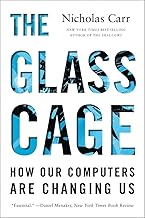
The Glass Cage

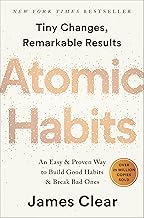
Atomic Habits
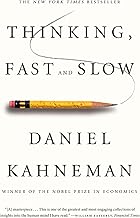
Thinking, Fast and Slow
Disclosure: This post may contain affiliate links. We only recommend products we believe in, and we may receive a commission at no cost to you! Thank you for your support!
Acknowledgment: Cover Image by moneycatzzz.com
Disclaimer: The information is provided for general information only – moneycatzzz.com makes no representations or warranties in relation to the information, including but not limited to any representation or warranty as to the fitness for any particular purpose of the information to the fullest extent permitted by law. While every effort has been made to ensure that the information provided in this article is accurate, reliable, and complete as of the time of writing, the information provided in this article should not be relied upon to make any financial, investment, real estate or legal decisions. Additionally, the information should not substitute advice from a trained professional who can take into account your personal facts and circumstances, and we accept no liability if you use the information to form decisions.
Signup to our Newsletter for regular updates:
Lorem ipsum dolor sit amet, consectetur adipiscing elit. Ut elit tellus, luctus nec ullamcorper mattis, pulvinar dapibus leo.