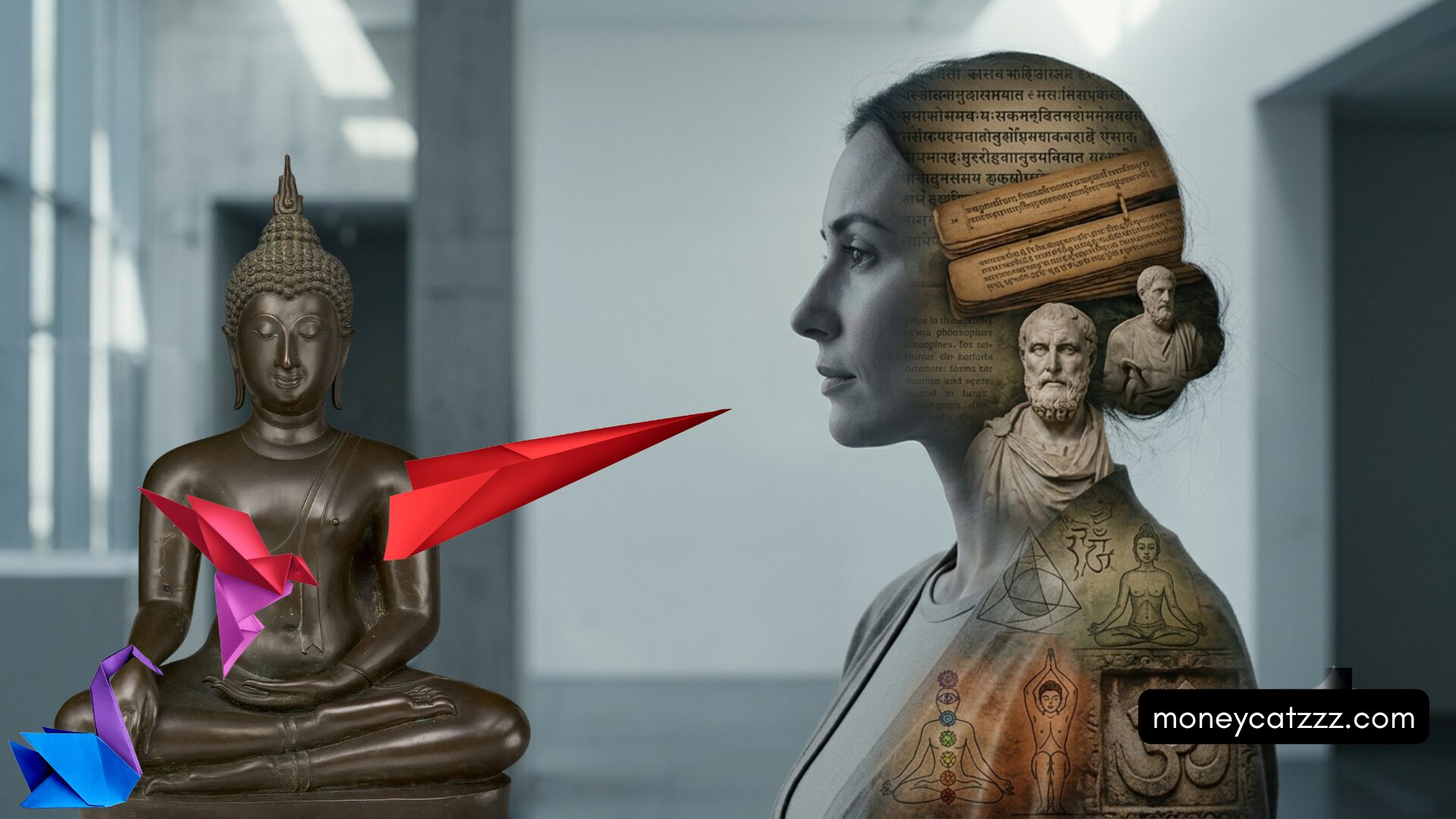
 Reading Time: 8 mins #
 This post may contain affiliate links.
The Difference Between Relief and Resolution
I have been meditating for six years, driven by the common transformation beliefs that surround modern mindfulness.
My stress levels are lower. My focus is better. Personal relationship with anxiety has become more functional. I can sit with discomfort longer than I used to; I can observe a difficult emotion without being entirely consumed by it. By every metric the modern wellness industry uses to measure the value of a contemplative practice, I am succeeding.
For six years, that felt like progress. But sitting with my own mind meant learning its exact geography, and eventually, I noticed what wasn’t shifting. Beneath the steady breathing and the improved focus, nothing fundamental had actually moved.
The same patterns keep returning.
I assumed the problem was my effort, I needed: more practice, more consistency, better posture, and earlier mornings. Then I looked more closely at the original instrument, only to discover I had been using a surgical scalpel for a massage.
The relief was real. But I was using a tool built for deep intervention to simply make discomfort manageable.
What the Scalpel Was Built For
Theravada Buddhism is the oldest surviving school of Buddhist teaching.
It preserves what scholars consider the closest textual record of the original instruction. And the original instruction was not about stress reduction.
The Buddha’s diagnosis was specific, and it stands in sharp contrast to modern transformation beliefs.The human condition produces suffering (dukkha) because of three root causes: craving, aversion, and delusion. The practice he prescribed was designed to address those root causes directly. Not to manage their symptoms. To dissolve the conditions that generate them.
The instrument is the Noble Eightfold Path. Eight components: right view, right intention, right speech, right action, right livelihood, right effort, right concentration, right mindfulness. The meditation technique is component eight. It operates within a framework of ethics (sila), and wisdom (panna) that provides the surgical context. Without that context, the technique is extracted from the procedure for which it was designed.

The goal of the full practice is nibbana (liberation). The complete cessation of the conditions that produce suffering, not a better quality of experience within the existing conditions. The elimination of the root cause of the conditions themselves.
That is surgery: demanding, precise, and radical. The modern adaptation is aimed at something far more modest.
Jon Kabat-Zinn extracted the meditation technique from that framework in 1979 and developed Mindfulness-Based Stress Reduction at the University of Massachusetts Medical School. The extraction was deliberate. Making the technique available to secular clinical populations required removing the religious context. The extraction worked. The stress relief is documented and real. What was removed along with the religious context was the goal. And a surgical instrument without its goal is no longer a scalpel. It is a very sophisticated massage tool.
The Pattern Repeats
Theravada is not the only tradition that has been mined for techniques and stripped of its transformational purpose.
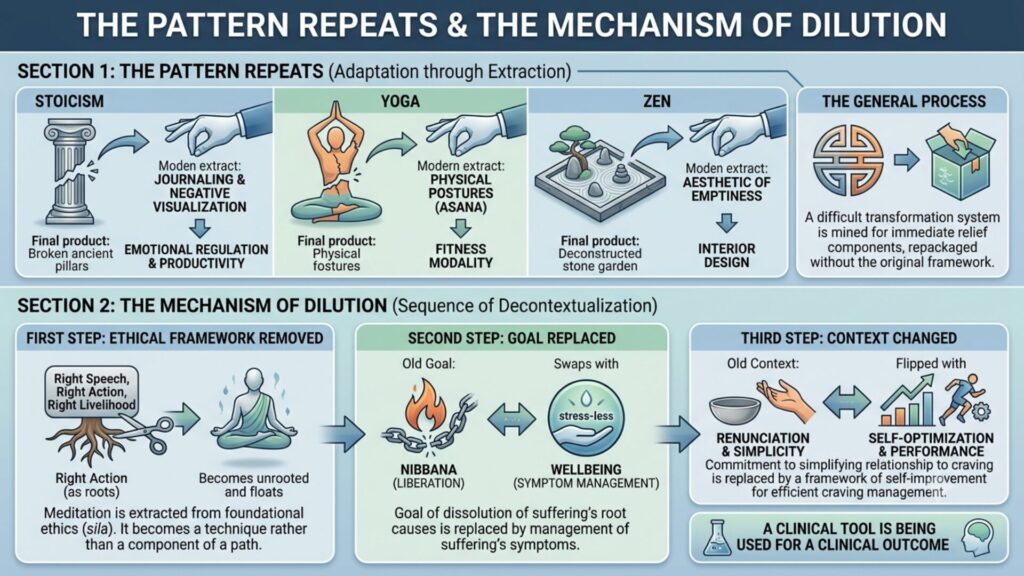
Stoicism built a complete philosophical system: logic, physics, and ethics as interconnected disciplines. The goal was eudaimonia, human flourishing through virtue, which required the full integration of all three. Contemporary transformation beliefs discard this larger structure, extracting the journaling practice and negative visualization technique to apply them strictly to emotional regulation and productivity. Marcus Aurelius was conducting a demanding philosophical self-examination within a complete worldview. The modern reader uses the same format to prepare for difficult conversations.
Yoga’s eight limbs include the physical postures as preparation for meditation and samadhi, a state of absorption the Yoga Sutras describe as the dissolution of the boundary between observer and observed. The modern version extracts the asana and turns it into a fitness modality. The scalpel becomes a foam roller.
Zen’s koan practice was designed to produce the collapse of ordinary conceptual thinking, a destabilizing liberation from the framework through which the self constructs its experience. The modern version extracts the aesthetic of emptiness and applies it to interior design.
The pattern is consistent across traditions and far from accidental. A complete system designed for a difficult transformation is mined for the components that produce immediate relief, and those components are repackaged without the framework that gave them their surgical precision. The dilution is not malicious; it is simply the market responding to demand. People want relief, relief is available, and the technique delivers it. The surgery was never part of the transaction.

The Mechanism of Dilution
The dilution of spiritual practice follows the same sequence every time.
First, the ethical framework is removed. In Theravada, sila (the ethical precepts) precedes and supports meditation practice. Right speech, right action, and right livelihood are not supplementary; they are the foundation that makes the deeper practice possible. Remove them, and the meditation floats free of its roots. It becomes a technique rather than a component of a path.
Second, the goal is replaced. Liberation becomes wellbeing. The dismantling of the root causes of suffering becomes the management of suffering’s symptoms. These are not the same goal. The scalpel designed for one cannot produce the outcomes of the other, not because the technique is insufficient, but because it is now aimed at a different target.
Third, the context of renunciation is replaced with self-optimization, the original practice required, at minimum, a serious commitment to simplifying one’s relationship to craving. The modern version is offered within a framework of self-improvement that takes craving as a given and attempts to make its management more efficient.
Ancient practices vs modern wellness is consequently not a story about authenticity or corruption. It is a story about purpose. The massage is a legitimate service. The scalpel is a legitimate instrument. Confusion between them produces neither a good massage nor effective surgery.
Alan Wallace, a scholar and former Buddhist monk, makes this point with precision in The Attention Revolution. The full scope of meditative practice in the Theravada tradition involves deep stages of concentration (samatha) that modern adaptations rarely touch. This is a boundary of design, not practitioner capability. The modern goal simply does not require that level of depth.
The modern practice is calibrated to its modern goal. The problem is the widespread belief that the modern goal is the same as the original one.
The Relief Is Real
To be clear, this is not a dismissal of modern mindfulness. The stress reduction is real: focus sharpens, emotional volatility settles, and people gain the space to sit with discomfort without being swept away by it. Modern psychological frameworks draw on these exact techniques for good reason: they deliver genuine relief. The evidence is solid, but we should be clear about what is happening: a clinical tool is being used for a clinical outcome.
The relief is genuine. The tool performs exactly as intended within its limited scope.
You might also like:

The Staircase I Will Never Climb
Yesterday I Was Clever, Today I Am Wise
The issue is subtler than utility. Extracting a technique from its framework creates a specific kind of confusion: its efficacy obscures its limits. A practitioner experiences real relief, feels noticeably better, and assumes they have touched the core of the practice. What they have actually acquired is a sophisticated coping mechanism, leaving the underlying structure entirely untouched.
Describing the limits of modern practice is not a dismissal of its utility; it is a clarification of design. It is a description of what mindfulness, in its modern form, is actually designed to produce. Knowing the difference between the two is useful before you decide which one you need.
The Wound Underneath
Six years of consistent practice. Measurable improvements across every relevant metric.
The wound is still there.
By wound I mean something specific. Not a bad week or a difficult season. The persistent architecture of craving and aversion that the original practice was designed to dismantle at the root. The engine is running underneath the stress, not the stress itself.
Desire generates anxiety when it goes unmet. Aversion turns every unwanted arrival into suffering. The assumption of a fixed self that requires continuous protection and optimization runs both of those engines simultaneously, quietly, without announcing itself as the source.
Six years of daily meditation made those dynamics quieter.
It did not make them smaller.
The shift from radical overhaul to symptom management is not a failure. Most practitioners never intended to seek the overhaul. They wanted relief from pressure. A way to stabilize the working week. A method for navigating daily anxiety without being consumed by it.
The modern practice delivered exactly what was asked of it.
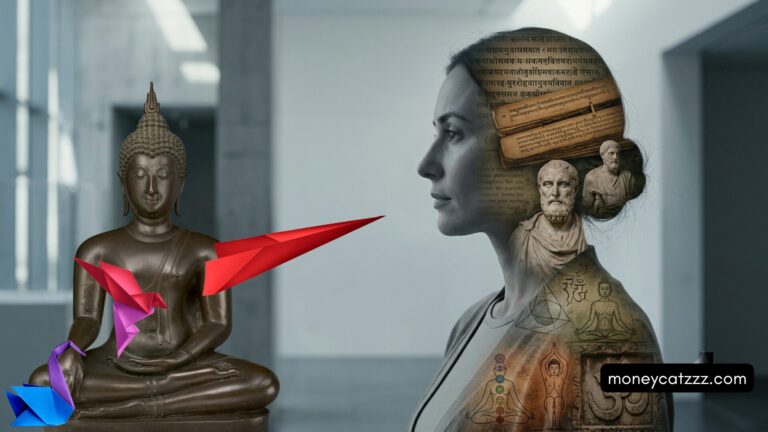
[The Deconstruction Pipeline: How Contemplative Traditions Are Diluted | moneycatzzz.com]
What rarely gets examined is whether symptom management was ever meant to be the terminus. The original tradition made an uncompromising offer: the dissolution of the very self-concept built to manage the symptoms. Not a better relationship with the self. The direct seeing of the self as a constructed and impermanent process.
That is not a self-care routine.
That is a fundamental disruption of the person doing the caring.
Most people are not looking for that disruption. That is honest and worth saying plainly. The modern adaptation serves its people well. The massage is not a failed surgery. It is a different procedure with a different purpose.
The problem is the persistent confusion between the two.
For stress reduction, emotional regulation, and improved focus, the modern adaptation remains an exceptionally functional tool. It delivers precisely what it promises.
The original framework, however, operates toward an entirely different end. The classical Theravada path demands the full integration of ethical conduct (sila), refined concentration (samatha), and penetrative insight (panna). Its ultimate target is the direct perception of impermanence (anicca), unsatisfactoriness (dukkha), and non-self (anatta): an insight that dissolves the core delusion rather than calming its symptoms.
That outcome is fundamentally incompatible with self-optimization. It offers no promise of a more resilient, highly productive persona. Instead, it exposes the optimized self as a temporary construction, demanding a level of surrender that modern self-help was specifically designed to avoid.
The scalpel is still a scalpel. The full surgical procedure is still available.
The question worth asking, before the next ten-minute session, is which one you actually need.

Recovering the Original Purpose
Recovering the original purpose does not require becoming a monk.
It requires honesty about what you are trying to achieve.
If the goal is stress reduction, emotional regulation, and improved focus, the modern practice is the right tool, and it works. Use it without apology. The relief is real, and the outcomes are documented.
The classical Theravada path operates toward an entirely different end. It demands the full integration of ethical conduct (sila), refined concentration (samatha), and penetrative insight (panna). In that sequence. Not as parallel tracks but as a structured progression in which each stage prepares the ground for the next.
The target of that progression is direct seeing: the unmediated perception of impermanence (anicca), unsatisfactoriness (dukkha), and non-self (anatta). This is an investigation conducted entirely at the level of lived sensation, bypassing intellectual proposition As the actual texture of moment-to-moment experience, observed continuously until the observation dissolves the delusion generating the suffering, rather than calming its surface.
That outcome is not compatible with self-optimization.
It does not promise a more resilient, highly productive version of yourself. It exposes the self as a temporary construction being optimized. That is a level of surrender that most modern self-help frameworks were specifically designed to help people avoid.
The scalpel is still a scalpel. The full surgical procedure is still available.
The question worth asking, before the next ten-minute session, is which one you actually need.
__________________________________________________
Beyond Self-Help: Books That Diagnose Modern Mindfulness
Mindfulness for Beginners

The Attention Revolution
Making of Buddhist Modernism


Disclosure: This post may contain affiliate links. We only recommend products we believe in, and we may receive a commission at no cost to you! Thank you for your support!
Acknowledgment: Cover Image by moneycatzzz.com
Disclaimer: The information is provided for general information only – moneycatzzz.com makes no representations or warranties in relation to the information, including but not limited to any representation or warranty as to the fitness for any particular purpose of the information to the fullest extent permitted by law. While every effort has been made to ensure that the information provided in this article is accurate, reliable, and complete as of the time of writing, the information provided in this article should not be relied upon to make any financial, investment, real estate or legal decisions. Additionally, the information should not substitute advice from a trained professional who can take into account your personal facts and circumstances, and we accept no liability if you use the information to form decisions.