
 Reading Time: 10 mins #
 This post may contain affiliate links.
The Grief Nobody’s Naming
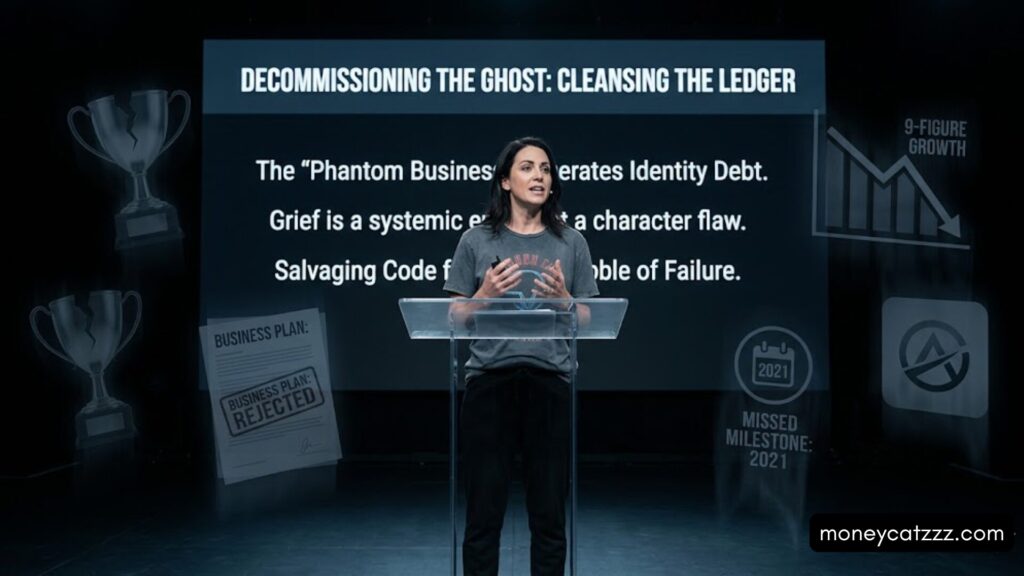
Tracy was wearing the t-shirt from her failed startup while pitching her new one. Navy blue, logo faded from too many washes, the company name of a business that had been dead for eight months.
I watched her try to sell investors on her new vision while literally still clothed in the old one. Her pitch was fine—her energy was split. Half of her was in the room, talking about the future, while the other half was still running the business that had collapsed. Trying to make it mean something when it is all but gone.
She didn’t close. The pitch was not bad, but you can’t sell to people on what’s next when you’re still grieving what was. The loss was leaking out of every sentence—nobody wanted to invest in someone who hadn’t finished mourning.
This is the grief business culture that few acknowledge. We talk about pivots, transitions, and lessons learned. We celebrate failure fast and move on faster. Nobody talks about the actual loss. The death of the thing you built, the identity you shed, the version of success you thought you’d have by now.
What Professional Grief Actually Looks Like
Professional grief is not dramatic. You’re not crying at your desk or unable to function. You’re performing fine, maybe even well, but there’s a heaviness you can’t explain.
You’re tired in a way sleep doesn’t fix. You compare yourself to everyone and come up short. Success stories make you bitter instead of inspired. You’re going through the motions of building something new while part of you is still attached to something dead.
That’s grief. Unprocessed, unacknowledged, and quietly draining every ounce of energy you’re trying to put into what’s next.
Francis Weller identifies five gates of grief, and one of them is “what we expected and did not receive.” In business, that’s the company you thought you’d have by 35. The partnership was supposed to last. The version of yourself you promised you’d become.
When these expectations die, and you don’t mourn them, the grief doesn’t disappear. It just runs in the background, draining power from everything you’re trying to build.
Why Business Culture Forbids Mourning
Business culture has no space for grief. You’re supposed to fail fast, learn from your mistakes, and get back up. Mourning is weakness. Attachment is unprofessional. Real entrepreneurs move on.
So like lemmings, you do. You start the next “thing” before you finish processing the residue effect that eats up your RAM in the background. You rebrand the failure as a pivot, perform resilience while carrying unfinished loss like a weight in your chest.
The problem is that grief doesn’t care about your timeline. It doesn’t speed up because you have a new pitch deck. It sits there, accumulating mass, until you finally stop and deal with it.

The Three Losses You’re Carrying
Most entrepreneurs are managing multiple layers of grief simultaneously without naming any of them.
The Business That Failed
Some are more obvious than others. The company you shut down, the product that didn’t work, the venture that ran out of money. There’s a death certificate for each, even if it’s just a final Slack message or a domain that expired.
Even when the business is clearly dead, the grief isn’t finished. You’re still thinking about what you could have done differently. You’re defending decisions to yourself years later. You’re carrying the weight of everyone you let down, every promise you didn’t keep.
Karen, an Etsy entrepreneur, shut down her operations three years ago. She has since built two successful ventures. Yet she still can’t talk about the first one without her voice changing—the grief is unfinished—and it’s costing her energy she doesn’t have to spare.
[The Invisible Boardroom: Pitching Through the Static of Past Failures | moneycatzzz.com]
The Identity You Shed
This one’s harder to see. You didn’t just lose a business. You lost who you were while building it.
The version of yourself that was going to be the founder who scaled to nine figures. The person who was building the thing that would change the industry. The identity you present to investors, employees, and your family.
When the business ends, that person dies too. And you have to figure out who you are now, which is harder when you’re pretending the loss didn’t happen.
Career transition research shows that identity loss often hits harder than financial loss. Psychologist Pauline Boss calls this “ambiguous loss” because there’s no body, no funeral, no clear endpoint. You’re just suddenly someone different, and you never got to say goodbye to who you were.
The Timeline That Passed
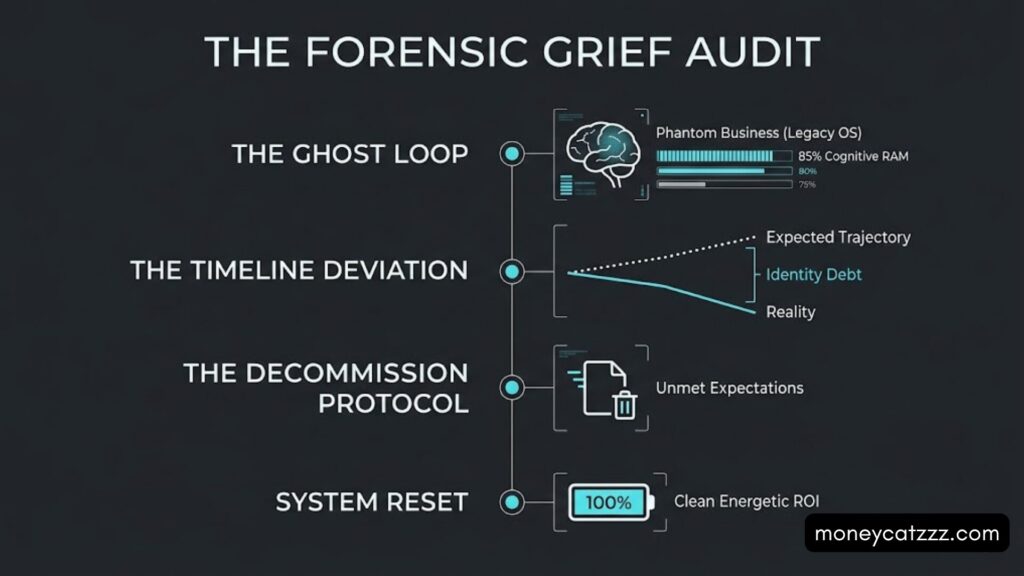
The Timeline Deviation
This is the invisible grief that remains after the post-mortem is over. You can explain away a Business Failure with market data. You can rebrand an Entrepreneurial Identity with a new LinkedIn title. But the timeline? You can’t audit your way out of the years you feel you’ve lost. It is the silent mourning of the milestones you expected to have reached by now, creating a background hum of “behind-ness” that distorts every current decision.
That gap between expectation and reality is a loss. And when you don’t acknowledge it, it becomes a constant background hum of inadequacy.
I see this most in people going through a career transition in their late thirties or forties. They’re successful by objective measures, but they’re mourning the version of success they thought they’d have achieved by now. The grief makes it impossible to appreciate what they’ve actually built.
[The Forensic Architecture of Moving On | moneycatzzz.com]
The Energetic Tax of Unfinished Grieving
Unacknowledged grief isn’t a “soft” emotional state; it is a high-latency System Drag that directly degrades your capacity to design anything new. When you bypass the forensic work of mourning, you trigger a silent Energy Audit failure that compromises your current venture.
The Ghost Business Loop: Why Current Projects Feel Heavy
When a Timeline Deviation remains unaddressed, it manifests as a persistent background process. You are currently attempting to operate two competing systems simultaneously:
Primary Venture (the tangible business you are building now) and the Phantom Business (the ghost venture you are still carrying in your head).
The Phantom Business: This is a “legacy OS” that refused to uninstall. It is the idealized version of success you projected—the revenue milestones and industry status you expected to have secured by now. It isn’t just a memory; it is an active, shadow-map of where you “should” be.
The Filtering Error: The shadow-map is still active; every decision made for the Primary Venture is filtered through a destructive comparison with the Phantom Business. You aren’t judging progress against market reality; you are judging it against a ghost.
Real-world wins feel mathematically insignificant because they don’t match the inflated metrics of the ghost-timeline. Minor setbacks are interpreted as evidence of total systemic failure.
This constant cross-referencing is a massive drain on your Cognitive RAM. You are spending your most valuable energetic capital mourning a non-existent past instead of optimizing your actual present.
To build the future, you must first decommission the ghost.
The Split-Screen Problem
Your attention is divided. Part of you is here, working on the current project. Part of you is stuck in the past, replaying the business failure, defending old decisions, and mourning the entrepreneurial identity you lost.
You can’t give full energy to what’s in front of you because half your field is still occupied by what’s behind you.
When things fall apart, and they often do, there’s a treasure of a book to get your grip around. Pema Chödrön, an American-born Tibetan Buddhist, talks about how we avoid sitting with discomfort by staying in motion. Entrepreneurs do this constantly. When grief surfaces, they immediately pivot, start the next thing, and stay busy—anything to avoid actually feeling the loss.
But unprocessed grief doesn’t disappear. It compounds. And eventually, the weight of it makes everything harder than it needs to be.
The Grief Audit: What You’re Actually Mourning
Most people have no idea what they’re specifically grieving. They know something feels off, heavy, stuck.
Run this audit. Write down:
The Business Loss: What specifically died? Not just “the company failed,” but what did you lose? The team, the vision, the identity, the future you were building toward?
The Identity Loss: Who were you when that business was alive? What did you call yourself? How did you introduce yourself at events? Who did you think you were becoming?
The Timeline Loss: What did you think your career would look like by now? What milestones did you expect to hit? What version of success are you comparing yourself to?
For each loss, rate the grief on a scale of one to ten. Anything above a five is actively costing you energy.
Mapping Your Phantom Business
You’re still running the ghost business in your head. The venture you thought you’d have, the success you expected, the version of yourself you promised you’d become.
Write out what the phantom business looks like. Revenue, team size, your role, and how you spend your days. Be specific.
Then write out what your actual business looks like—same categories.
The gap between those two documents is what you’re grieving. And until you acknowledge that gap and release the phantom version, you’ll keep draining energy comparing the real to the imagined.
Closing the Loop: The Release Practice
You can’t skip grief. You can only delay it. And delayed grief costs more than processed grief because it compounds while you’re ignoring it.
Here’s how to actually finish mourning so you can move on.

[Decommissioning the Ghost: Clearing Your Energetic RAM | moneycatzzz.com]
The Post-Mortem: Killing the Ghost of Traf-O-Data
In 1972, long before the world knew Windows, Bill Gates and Paul Allen launched Traf-O-Data. The mission was technical: automate the processing of raw traffic-count data. They spent years building a specialized computer to process tire-bump tapes for local governments.
The business was a technical success but a commercial failure when the state of Washington began providing free traffic-processing services; their Phantom Business—the vision of a global traffic-data empire—evaporated overnight.
Instead of rebranding the failure as a “pivot” or performing a resilience ritual to save face, Gates and Allen conducted a brutal Energy Audit, a literal Release Ritual. They recognized that the Traf-O-Data hardware was a “dead body”. They didn’t just move on; they forensically extracted the high-value code (the 8008 emulator they’d built) and abandoned the rest.
This was their Memorial Meeting. By formally acknowledging that the traffic-data empire was dead, they cleared their Cognitive RAM. They weren’t “failed traffic engineers“ anymore; they were “software architects”. Two years later, that same freed-up energy and salvaged code became the foundation of Microsoft.

The Structural Lesson
You don’t need a literal coffin, you need a dose of Gates-level Clarity. You must identify which part of your venture is the “dead hardware“ and which is the “salvageable code.“ Until you name the failure, you are just a lemming wearing a faded logo, carrying a Phantom Business that no longer exists.
The Business You Build After Grief
Six months after the pitch meeting, I saw Tracy again—this time at a different event, in a different shirt, with a different company.
Same person, but the energy had changed. She closed her round in three weeks.
I asked her what shifted. She said she’d finally acknowledged what she was carrying. The grief for the business that failed, the version of herself that died with it, the timeline she’d lost.
She wrote it all down, held a small closing ceremony with her old co-founders for “closure“. They named what they’d built, acknowledged the lost, and kept what they were releasing.
The ghost business finally stopped running—the next could start.
When you finish mourning, you regain your full energy. Not because the loss disappears, but because you’re no longer spending power trying to pretend it didn’t happen.
The unmet expectations stop haunting you. The career transition becomes a choice instead of a failure. The entrepreneurial identity you lost makes space for the one you’re becoming.
You can’t build the next thing while you’re still mourning the last thing.
But once you finish mourning, you’d be surprised how fast you can move.
3 Pick Me Ups for Life Journey

Ambiguous Loss


When Things Fall Apart
Disclosure: This post may contain affiliate links. We only recommend products we believe in, and we may receive a commission at no cost to you! Thank you for your support!
Acknowledgment: Cover Image by moneycatzzz.com
Disclaimer: The information is provided for general information only – moneycatzzz.com makes no representations or warranties in relation to the information, including but not limited to any representation or warranty as to the fitness for any particular purpose of the information to the fullest extent permitted by law. While every effort has been made to ensure that the information provided in this article is accurate, reliable, and complete as of the time of writing, the information provided in this article should not be relied upon to make any financial, investment, real estate or legal decisions. Additionally, the information should not substitute advice from a trained professional who can take into account your personal facts and circumstances, and we accept no liability if you use the information to form decisions.