
 Reading Time: 8 mins #
 This post may contain affiliate links.
Tom Petty was singing “Free Fallin‘” in the hardware store when I watched a demolition expert explain his craft to his apprentice. “We don’t destroy buildings,” he said, handling detonator wire like prayer beads. “We reveal their hidden weaknesses through system testing. Every building wants to fall a certain way. We help it show us how.” Standing there between paint cans and power tools, I understood he wasn’t talking about buildings. He was describing the architecture of human change.
For three years, I’d maintained what I thought was an unshakeable new identity: meditation every morning, no alcohol, structured routines. I was proud of my streak, my discipline, my transformation. Then came the phone call about my father’s diagnosis, and within 48 hours, every new habit collapsed. Not gradually, but instantly, like a building whose support beams were never actually load-bearing.
That collapse taught me what the demolition expert knew: untested structures are illusions. Real strength comes not from avoiding failure but from engineering it deliberately. This is the principle of controlled demolition applied to identity.
The Evolution of Legacy Code
When we decide to change, we imagine ourselves deleting old patterns like files from a hard drive. But consciousness doesn’t work that way. Every habit, every automatic response, every emotional pattern you’ve ever developed remains encoded in your neural architecture as legacy code.
Legacy code in software development refers to old programming that still runs in the background, often conflicting with new systems. In human terms, it’s the decades of conditioning that shaped your survival. The anxiety responses that kept you safe. The defensive mechanisms that protected you from pain. The comfort habits that soothed difficult emotions.
You can’t delete legacy code; you can only write new code on top of it. But here’s the critical insight: until you know precisely where the old code still has control, you’re not transformed. You’re just wearing a costume over your original programming.
Nassim Taleb explores this in Antifragile, showing that systems become stronger not by avoiding stress but by experiencing it in controlled doses. Your new identity needs the same stress testing that engineers apply to bridges: controlled pressure to reveal hidden weaknesses.
System Vulnerability as Teacher
Most people discover their system vulnerability during a crisis. They lose a job, face rejection, encounter unexpected pressure, and suddenly their carefully constructed new self evaporates. They call this failure. I call it accidental system diagnostics.
The tragedy isn’t the collapse; it’s that the collapse happens without observation. You learn nothing from unconscious failure. But conscious, deliberate testing of your system’s limits? That’s where real strength emerges.
I mapped my own vulnerabilities:
- Exhaustion triggered old comfort eating patterns
- Criticism activated defensive legacy code
- Boredom initiated automatic distraction seeking
- Isolation revived depressive thought loops
Each vulnerability was a gap in my identity architecture, a place where new code hadn’t fully integrated. Without system testing, I would never have known these gaps existed until life tested them for me, usually at the worst possible moment.
Controlled Demolition as Practice
Controlled demolition in construction requires three elements: precise knowledge of structural weaknesses, calculated pressure application, and careful observation of collapse patterns. The same principles apply to testing personal transformation.
The protocol I developed:
Phase 1: Environmental Re-entry
Deliberately return to environments that trigger old patterns. Not to prove strength, but to observe response. If you quit drinking, go to a bar (with a trusted friend). If you left a toxic workplace, visit similar environments. Watch what activates.
Phase 2: Conscious Observation
The difference between relapse and research is awareness. During controlled demolition, you’re not trying to resist; you’re trying to observe. What thoughts arise? What body sensations emerge? Where does the pull originate?
Phase 3: Structural Reinforcement
Each test reveals specific weakness points. These aren’t failures; they’re engineering data. If exhaustion triggers collapse, you need protocols for states of exhaustion. If criticism destroys new confidence, you need a different response architecture.
Research on behavioral change shows that habits formed under varied conditions are 60% more resilient than those formed in controlled environments. System testing deliberately creates those diverse conditions.

[“The Systemic Testing Protocol” – Image by moneycatzzz.com]
Stress Testing the New Identity
Real stress testing doesn’t mean throwing yourself into chaos. It means systematic pressure application to reveal structural integrity. Software companies don’t test new systems by immediately processing millions of transactions; they gradually increase load while monitoring performance.
My stress testing protocol:
Level 1: Mild Discomfort
Introduce small challenges to new habits. Skip one comfort routine; face minor criticism. Experience slight hunger or fatigue. Monitor system response.
Level 2: Moderate Pressure
Engage with environments that historically triggered old patterns. Have difficult conversations. Navigate complex social dynamics; document where new code holds versus where legacy code activates.

Level 3: Controlled Crisis
Under careful conditions (therapy, trusted friends, safe environments), deliberately trigger major stressors. Not to suffer, but to observe system response under maximum pressure.
Donella Meadows explains in Thinking in Systems that system behavior under stress reveals its proper structure. Your identity architecture might look solid during calm periods, but only pressure reveals whether you’ve built on bedrock or sand.
The Geometry of System Vulnerability
System vulnerability follows predictable patterns. Like structural engineers who know where buildings typically fail (joints, load-bearing walls, foundations), behavioral systems have common weakness points:
Transition Zones: The spaces between activities where old habits reassert themselves
Energy Valleys: Low-energy states where legacy code reactivates
Social Pressure Points: Situations where external expectations override internal changes
Emotional Floods: Intense feelings that overwhelm new programming
Understanding these geometries transforms system testing from random failure into strategic investigation. You’re not breaking down; you’re mapping your architectural limits.
Studies on habit formation indicate that habits tested under multiple conditions show 80% better long-term adherence than untested habits. The testing isn’t optional; it’s essential.
Identity Architecture After Testing
After six months of deliberate system testing, my identity shifted from fragile to antifragile. Not because I never failed, but because I’d mapped every failure point and reinforced accordingly.
The new architecture included:
- Redundant Systems: Multiple pathways to maintain new behaviors even when primary systems fail
- Degradation Protocols: Planned responses for low-energy states that don’t require complete collapse
- Circuit Breakers: Automatic stops that prevent legacy code from taking complete control
- Recovery Procedures: Clear paths back to baseline after temporary system failures
This isn’t about perfection. It’s about resilience. Buildings that survive earthquakes aren’t rigid; they’re designed to flex without breaking. Identity architecture needs the same flexibility.
Controlled Demolition Victories
The most powerful aspect of controlled demolition is that it removes fear. Once you’ve deliberately tested your limits and survived, accidental failure loses its terror. You’ve already seen yourself collapse and rebuild. You know the process.
A colleague recently asked how I maintain such consistency with my habits. The answer surprised him: I don’t retain them through strength but through systematic failure. Every weakness has been tested, mapped, and reinforced. The habits persist not because I’m disciplined but because I’ve removed the structural vulnerabilities that would cause collapse.
Atul Gawande’s The Checklist Manifesto shows how systems that acknowledge and plan for failure outperform those that assume success. Your identity architecture needs the same assumption: failure is coming, so let’s engineer it deliberately.
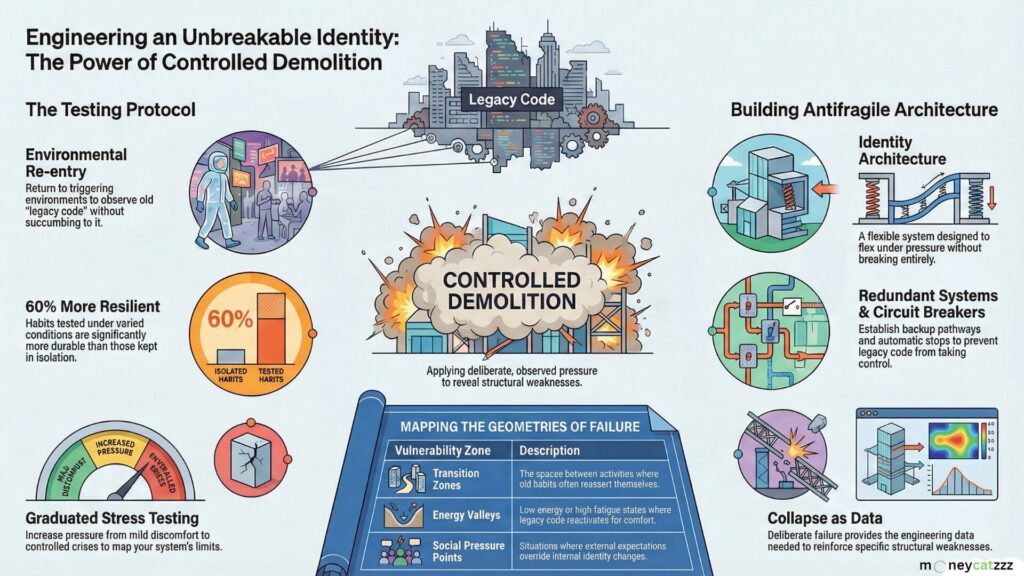
[“The Geometries of Failures” – Image by moneycatzzz.com]
The Testing Schedule
Implement system testing gradually:
Month 1: Identify three core new behaviors—document current vulnerability assumptions.
Month 2: Begin Level 1 stress testing. Introduce mild discomfort, observe response.
Month 3: Progress to Level 2. Engage triggering environments with conscious observation.
Month 4: Conduct controlled Level 3 tests with support systems in place.
Month 5: Analyze all test data. Identify patterns in system vulnerability.
Month 6: Implement architectural reinforcements based on testing results.
This isn’t a one-time process. Like software that needs regular security updates, your identity architecture requires ongoing testing and reinforcement.
The Liberation of Known Weakness
The demolition expert was right: every structure wants to fall a certain way. The question isn’t whether you’ll encounter pressure that reveals weakness, but whether you’ll discover those weaknesses deliberately or accidentally.
Through controlled demolition, through systematic stress testing, through conscious engagement with legacy code, you transform from someone hoping their changes will stick to someone who knows precisely why they will.
The paradox is beautiful: by planning for failure, you prevent it. By testing weakness, you build strength. By demolishing deliberately, you construct permanently.
Your old patterns aren’t enemies to be conquered. They’re teachers showing you exactly where your new architecture needs reinforcement. The collapse isn’t failure; it’s data.
The system is ready. The tests are waiting.
What will you deliberately break today to become unbreakable tomorrow?

The Flux Toolkit: Core Frameworks for Identity Stress Testing

Thinking in Systems

The Checklist Manifesto

Antifragile
Disclosure: This post may contain affiliate links. We only recommend products we believe in, and we may receive a commission at no cost to you! Thank you for your support!
Acknowledgment: Cover Image by moneycatzzz.com
Disclaimer: The information is provided for general information only – moneycatzzz.com makes no representations or warranties in relation to the information, including but not limited to any representation or warranty as to the fitness for any particular purpose of the information to the fullest extent permitted by law. While every effort has been made to ensure that the information provided in this article is accurate, reliable, and complete as of the time of writing, the information provided in this article should not be relied upon to make any financial, investment, real estate or legal decisions. Additionally, the information should not substitute advice from a trained professional who can take into account your personal facts and circumstances, and we accept no liability if you use the information to form decisions.