Reading Time: 8 mins #
This post may contain affiliate links.

This is part 3 of 10 of the Counting the Self Series.
The list is still on my refrigerator. I walk past it every morning: drink more water, exercise, meditate, call my mother on Sundays, read before bed, meal prep, journal. The whole transformation script, neatly arranged. I wrote it during one of those moments when making a change in your life felt urgent, as if I didn’t write it all down, I would forget who I was trying to become.
The list wasn’t inherently unreasonable, but its sheer volume made taking action impossible.
The Myth of the Fresh Start
You’ve been here too. Your list may be different, on your phone instead of your refrigerator, or you never wrote it down at all and carry it in your head: wake up earlier, stop scrolling before bed, respond to emails faster, keep the house cleaner. Be more present. Set better boundaries.
The list grows. It becomes proof that you aren’t doing enough, that you’re failing to be the person you know you could be.
So you set a date. Monday. The first of the month. The new year. You tell yourself this time will be different.
It is not different.
[MindValley Promo | Rewire your mind, transform life. | Nir Eyal]
By the second week, you’ve dropped half of it. By the third week, you’ve dropped all of it. You tell yourself you lack discipline, that other people have something you don’t, that you’re overwhelmed by change because you’re not trying hard enough.
This is not true.
You aren’t falling short because you lack discipline. You’re getting stuck because you’re trying to climb the entire staircase in a single leap.
The Staircase You Cannot See
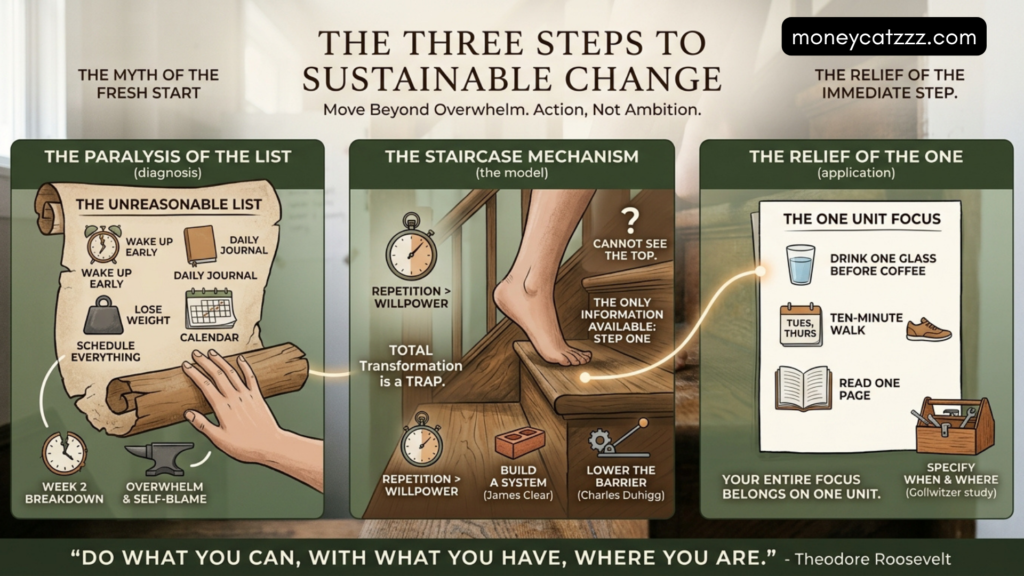
I have a staircase in my house: fourteen steps from the first floor to the second, and I’ve climbed it thousands of times. I don’t stand at the bottom and think about all fourteen steps before I move. I take one step, then another.
But when it comes to change, I do the opposite. I stand at the bottom, count every step, and map the entire climb before I allow myself to move. The steps feel responsible, even strategic, but they are neither; it is paralysis dressed up as planning.
The climb does not reveal itself from the bottom. You can’t see the landing from the first step, and you can’t know what the tenth step will require while you’re still standing at the base. The only information available to you is the first step: the height, the surface under your foot, and the effort required to lift it. That’s all you actually have.
[Why Small Works When Big Doesn’t | moneycatzzz.com]
That is enough.
But you don’t believe it is enough. You believe starting small is a way of lowering your standards, that real change requires total transformation, that the new version of yourself arrives fully formed or not at all.
This is the lie that keeps you standing still.
What I Did Instead
For years, every Monday and fresh start brought the same sudden burst of clarity: change everything right now. I broke down every single time.
My strength wasn’t the issue. The real flaw was expecting a complete personal transformation between sunset and sunrise.
So I stopped asking.
I picked one item from the list. Just one.
Drink more water.
I ignored arbitrary targets like eight glasses or full gallons. The sole rule was drinking a single glass of water before touching my morning coffee.
I did it for a week. Then two. By week four, my hand reached for the glass before I’d even turned on the kettle. The routine had quietly become mine.
Then I moved on to step two. Instead of committing to five workout days, I scheduled a ten-minute walk after lunch on Tuesdays and Thursdays. That was the entire commitment. Step three stayed on hold until summer arrived.
By the end of the year, I had climbed most of the staircase one deliberate step at a time. Some weeks, I missed or skipped a step; others, I just stood completely still. Yet the momentum held, and I never fell back to the bottom.
[The Three Steps to Sustainable Change | moneycatzzz.com]
Why Small Works When Big Doesn’t
The flaw in total life overhauls is relying on ambition over infrastructure. As James Clear observes in Atomic Habits, people rarely rise to the level of their goals; they fall to the level of their systems.
The system isn’t the entire staircase. The system is the first step. Repeated.
Charles Duhigg frames the mechanism plainly: habits rely on repetition rather than raw willpower. Smaller actions lower the barrier to repetition, allowing the behavior to lock in rapidly. I find it hard to argue with that finding.
Popular advice insists that three weeks is enough to rewrite your life. That myth does real damage. When Philippa Lally and her team at University College London tracked real habit formation, the average actual timeline was 66 days. Expecting radical change in 21 days leads straight to self-blame when the math fails to work.
The study also found something else. Small, specific behaviors become automatic faster than large, vague ones.
“Exercise more” doesn’t become a habit. “Walk for ten minutes after breakfast“ does.
The Relief You Are Looking For
Relief starts by taking a single step rather than conquering the whole staircase. Forget the third step, the middle landing, or the distant view from the top. Focus entirely on the immediate step right in front of you.
Starting with the first step might feel too small, like you’re not doing enough, like you’re postponing the real work. But the real work isn’t the transformation. It’s the repetition.
The step becomes real when you name it. Instead of “I will drink more water,“ shift to “I will drink one glass of water before I make coffee.“ The specificity is the structure, and the structure is the step.
Peter Gollwitzer’s research on implementation intentions shows this clearly: when people specify the when and where of a behavior, they are significantly more likely to follow through. Successful execution comes from removing the need to decide in the moment.
[MindValley Promo | Rewire your mind, transform life. | Vishen Lakhiani]
What the First Step Actually Is
The first step isn’t the one that sounds impressive. It’s the one you can actually take.
One glass of water. A ten-minute walk. A single page from a book, one phone call, or one surface cleared. Pick your one.
Ignore the overwhelming sum of every habit, walk, and written page. Your entire focus belongs to completing one single unit.
Climbing requires zero vision of the full staircase or exact timeline. Ideal conditions and unlimited motivation are purely optional.
You need to take step one, then step two.
Change feels impossible for one simple reason: attempting to overhaul your entire existence at once guarantees breakdown. Speed matters far less than continuation.
The Steps I Still Haven’t Taken
Meditation still hasn’t become a morning ritual. Calling my mother every Sunday remains unformed (she usually calls on Saturdays anyway), and I let it go to voicemail more often than I should. Daily journaling hasn’t stuck either.
The list stays on my refrigerator. I pass it every morning. Some items are crossed off; others remain untouched.
I used to view those open lines as proof of personal setbacks. Now I see them simply as steps waiting in line. The weight doesn’t vanish overnight, but the burden shifts the moment I stop treating an unwritten line as a verdict.
The climb is still here. So am I. I keep Roosevelt’s directive pinned right beside the list:
“Do what you can, with what you have, where you are.“
___________________________________________________
Read Related Articles:
Resonance: The Cost of Incompatible Frequencies
Why Modern Education Taught You to Think in Fragments
Happiness: The Alchemy of Self and Tribe
Disclosure: This post may contain affiliate links. We only recommend products we believe in, and we may receive a commission at no cost to you! Thank you for your support!
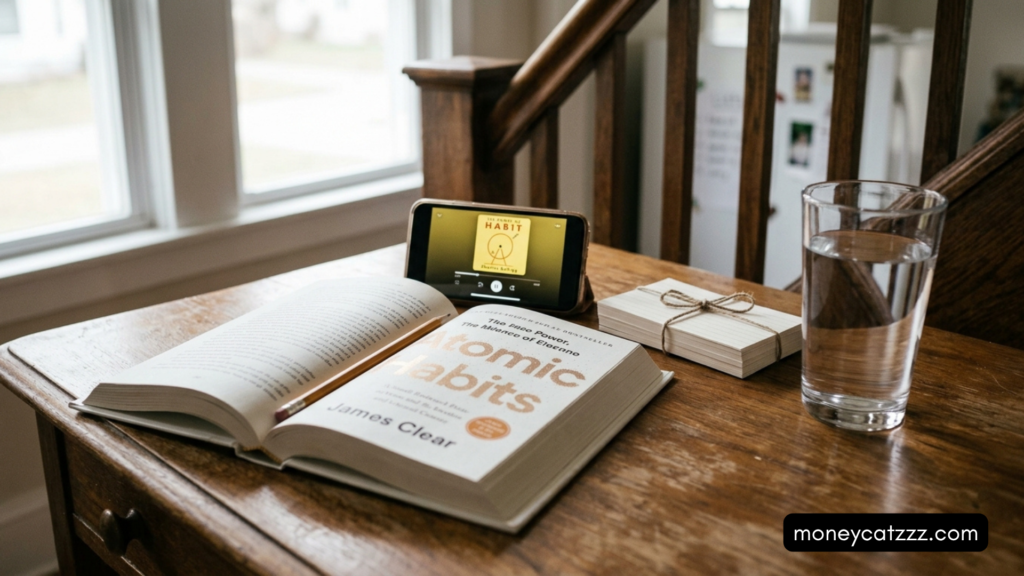
Acknowledgment: Cover Image by moneycatzzz.com
Disclaimer: The information is provided for general information only – moneycatzzz.com makes no representations or warranties in relation to the information, including but not limited to any representation or warranty as to the fitness for any particular purpose of the information to the fullest extent permitted by law. While every effort has been made to ensure that the information provided in this article is accurate, reliable, and complete as of the time of writing, the information provided in this article should not be relied upon to make any financial, investment, real estate or legal decisions. Additionally, the information should not substitute advice from a trained professional who can take into account your personal facts and circumstances, and we accept no liability if you use the information to form decisions.