
Reading Time: 8 mins #
This post may contain affiliate links.

I can throw away a jacket without a second thought. The worn-out boots, the expired spices, the box of phone chargers from three apartments ago; gone. Physical letting go is, by nature, mechanical. It costs me nothing, no fuss.
Â
But a memory? A single sentence someone said four years ago? That sits behind my sternum like a fish bone I cannot dislodge. I cannot delete it. I have tried.
Â
Letting‑go principles have their merits. There is good and bad in everything. Where there’s Yin, there’s Yang. But the advice assumes your brain has a trash button. It does not.
Two years ago, a former colleague told me, “I lacked strategic vision.“ Sounds like mild feedback, but it lodged behind my internal hard drive like King Arthur’s Excalibur. I meditated, bought the designer journals, and recited affirmations about forgiveness. Every morning, I release it: “I am this, “I am“ that, but the same knot remains in my stomach.
Â
The frustration of not being able to let go was worse than the knot. Just as Hank Williams Jr. sang in “So Easy to Forgive Her (But So Hard to Forget),“ the cultural script is loud and absolute: Just let it go. Forgive and forget. Don’t carry that weight.
Â
But the lyrics ignore how your mind actually works.
When Letting Go Works (And When It Doesn’t)
Letting go is more than a great song from “Frozen“; it is also the right move for hot coals. Trauma that dysregulates your nervous system: abuse, irreversible loss, or death. A door welded shut. In those cases, holding on to the burns.
“…grasping a hot coal with the intent of throwing it at someone else; you are the one who gets burned.“ –Buddhaghoá¹£a on holding on to anger.
Everyday grievances, like a critical comment, a drifting friendship, a failed project, are not hot coals; once a boundary is crossed, the receipt sticks.
Â
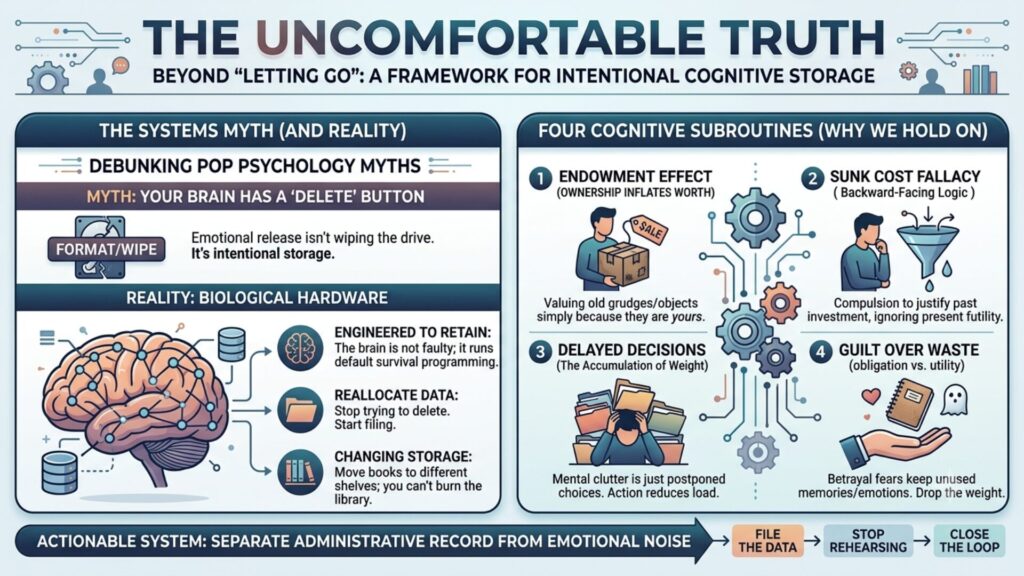
Your brain is wired to hold on; what you keep and how you keep it matters. You operate with a set of predictable mechanisms. This system is built in and is not a character flaw.
Four Mechanisms That Explain Why You Hold On
Your brain is not a malfunctioning machine; it is a system that performs exactly as it was designed to behave. When you find yourself unable to release a grievance, you are encountering the hardcoded subroutines of your own survival manual. These four mechanisms explain why the receipt remains in the drawer:
- Endowment effect. You value something more simply because it is yours: the broken espresso machine from your ex, the grudge you have rehearsed for months – ownership inflates worth.
- Sunk cost fallacy. You keep investing because you already invested: the extra years in a bad relationship, the nights spent replaying an argument. The logic is backward, but the feeling is real.
- Delayed decisions. Clutter, both physical or mental, is a pile of postponed choices: the conversation you keep meaning to have, the draft email you never send – adds weight gradually.
- Guilt over waste. Throwing away an expensive purchase feels wasteful. Throwing away a memory of someone you once loved feels like betrayal. So you keep the object and the emotion out of obligation.
Â
These are survival mechanisms, not a weakness. Your brain is trying to protect you. It just does not know when to stop.
[Intentionally Storage: Filing the Mental Data | moneycatzzz.com]
The Receipt Metaphor (Not a Balloon)
Forget the balloon. Letting go is not floating away. It is filing.
Â
One afternoon, after another failed meditation, I stopped trying to delete the memory. Instead, I opened a blank document and typed out the exact record: what my former colleague said, the date, and the specific room we were sitting in. I didn’t paint the scene. I just logged the receipt.
Â
I wasn’t looking to send it or build a shrine around it; I needed the facts on paper—a receipt.
Â
Then I closed the document and filed it. The knot in my stomach didn’t instantly vanish, but it stopped tightening, because I had stopped fighting myself.
What to Keep, What to Release
Emotional release isn’t about wiping the drive clean; it’s about changing how you store the data. When an event lodges in your mind, separate the administrative record from the emotional noise:
- Keep the Evidence: The fact that the event occurred. Refuse to gaslight yourself into rewriting history or minimizing what happened.
- Keep the Boundary: The hard operational rule you establish going forward (e.g., “I no longer accept projects from this person”).
- Keep the Lesson: The pragmatic data points you acquired about their behavior, your own thresholds, and how the system actually operates.
- Release the Loop: The endless rumination, the midnight replays, and the fantasy of a retroactively altered outcome. That loop, not the memory itself, is the part that burns.
Once you accept that deletion is a myth, filing becomes your only logical strategy.
The Cognitive Architecture of Retention
You will never fully delete a meaningful memory, because your brain isn’t wired to forget; it is engineered to retain.
- Loss Aversion: Nobel laureate Daniel Kahneman (Thinking, Fast and Slow) demonstrated that the psychological pain of losing something is roughly twice as powerful as the pleasure of gaining an equivalent amount. Your mind views letting go not as relief, but as a net loss.
- Sunk Cost: Hal Arkes and Catherine Blumer’s foundational research shows that once you have invested time, effort, or emotion into a situation, your logic becomes warped by a compulsion to justify that past investment.
- Somatic Memory: Dr. Bessel van der Kolk (The Body Keeps the Score) highlights that the nervous system stores physical and emotional data that the conscious mind attempts to force out.
- Compounding Identity: Author James Clear (Atomic Habits) points out that postponed choices and unresolved loops slowly compound into your daily identity.
Your brain isn’t malfunctioning when it holds on; it is running its default programming. The goal was never deletion. It is intentional storage.
The Uncomfortable Truth
We like to call our endless processing “work.” We tell ourselves we are sitting with the feeling, honoring the process, or waiting for the right moment to find closure. But strip away the therapeutic vocabulary, and the reality is much simpler.
Â
You are not healing. You are postponing a decision.
Â
The self-help industry has sold you a fantasy of complete emotional release: a clean, total mind-wipe that erases the static and leaves you pristine. There is no such marvelous relief. Your brain is not a hard drive you can format. It is a library. You can move a book to a different shelf, but you cannot burn it without setting the whole building on fire.
[The Uncomfortable Truth | moneycatzzz.com]
The Three Mechanics of Administrative Reset
What the culture calls a “mind-wipe” isn’t biological memory erasure; it is simply administrative management. When you look under the hood of functional psychological resets, you find three distinct mechanisms at play:
- Cognitive Offloading (The “Brain Dump“): Externalizing working memory onto paper without worrying about structure. You aren’t deleting thoughts; you are closing open browser tabs to free up live processing power and cut off rumination at the pass.
- Pattern Interruption (Cognitive Shuffling): Shifting the neural circuit out of analytical, problem-solving mode using breathwork or present-moment anchoring. You aren’t destroying the loop; you are voluntarily suppressing the signal long enough to interrupt the cycle.
- Framework Reset (“Unlearning“): Consciously retiring a mental model that no longer yields a return. You acknowledge the old habit or boundary, declare it obsolete, and assign a more productive framework in its place.
Notice what all three have in common: none of them eliminates data. They reallocate it.
So stop trying to delete. Start filing.
Three Diagnostic QuestionsÂ
Next time you are stuck on something you “should” let go of, run it through this list. No warm-up. Just the questions:
- Is this a hot coal or a receipt? Would holding it actively burn you (trauma, abuse, irreversible loss)? Or is it just a piece of paper you can file?
- Am I keeping it out of fear or out of choice? Fear-based keeping (avoiding a decision, hoping for change) is exhausting. Choice-based keeping (I need this evidence for my boundary) is a form of power.
- What would I actually lose if I let it go? If the answer is “nothing real,” let it go. If the answer is “my sense of justice” or “my memory of why I left,” then keep it. File it. Do not frame it.
To separate the data worth filing from the noise you need to drop, run your situation through a cold operational triage.
The Receipt Stays in the Drawer
It has been three years since that review. I still have the document, which I have not opened in over a year. I could delete it. But I do not need to. It sits in a folder called “Archive,” nested inside another folder called “Work.”
Â
Knowing it exists brings a quiet, unexpected peace; not through forgiveness or forgetting, but because I finally stopped pretending.
Â
The receipt stays in the drawer. You don’t frame it, and you don’t rehearse it. File the data, close the folder, and stop rehearsing.
________________________________________________
Disclosure: This post may contain affiliate links. We only recommend products we believe in, and we may receive a commission at no cost to you! Thank you for your support!

Acknowledgment: Cover Image by moneycatzzz.com
Disclaimer: The information is provided for general information only – moneycatzzz.com makes no representations or warranties in relation to the information, including but not limited to any representation or warranty as to the fitness for any particular purpose of the information to the fullest extent permitted by law. While every effort has been made to ensure that the information provided in this article is accurate, reliable, and complete as of the time of writing, the information provided in this article should not be relied upon to make any financial, investment, real estate or legal decisions. Additionally, the information should not substitute advice from a trained professional who can take into account your personal facts and circumstances, and we accept no liability if you use the information to form decisions.