Reading Time: 8 mins #
This post may contain affiliate links.

The Calcified Hull
A ship does not lose its speed to a sudden, dramatic storm. It loses it to the quiet, microscopic accumulation of things it chooses to carry; a persistent drag that eventually stalls the entire vessel.
Â
I stood at a commercial dry dock in a grimy shipyard near the lake last winter. They had hauled a massive steel freighter out of the freezing water, exposing its underbelly to the raw air.
Â
The steel below the waterline was completely unrecognizable.
Â
It was buried under a thick, gray armor of calcified shells, sharp ridges, and hardened salt crusts. The captain told me the vessel had been burning twice its usual fuel to maintain half its normal cruising speed.
Â
The ocean hadn’t cracked the steel. The ocean had applied a relentless, ambient friction.
Â
To look at that vessel is to see the exact profile of structural friction that governs a stalled life. We focus all our terror on the massive catastrophes, the public failures, the bankruptcies of the soul.
Â
But the real threat is entirely invisible. It is the slow, daily compromise that hitches a ride on your skin while you are too busy navigating the horizon to notice.
The Survey of the Slow Slowdown
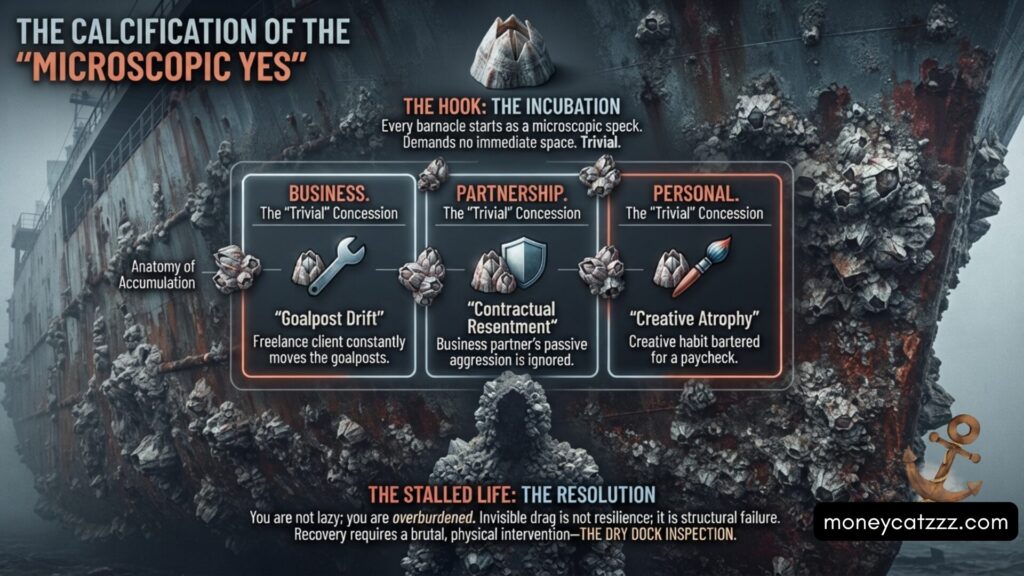
The Microscopic Yes
Every barnacle starts as a single, floating organism, a microscopic speck looking for a hard surface to call home. It doesn’t ask for much space. It demands no immediate sacrifice.
Â
I know that exact settlement. I spent three years allowing tiny, unchosen demands to fuse themselves directly to my daily schedule:
- The freelance client who constantly moved the goalposts by an inch.
- The business partner whose passive aggression I chose to ignore politely.
- The creative habit I quietly bartered away for a predictable paycheck.
Each instance felt too trivial to fight over. I told myself I was being flexible, that I was being resilient, but in reality, I was paying for minor concessions.
Every unaddressed boundary line is a foothold for attachment. When you refuse to execute a clean “no,” you allow a foreign weight to anchor itself to your primary hull. By the time the month ends, the clean steel of your original intent is buried under a layer of calcified obligations you never actually wanted.
[The Survey of the Slow Slowdown | moneycatzzz.com]
The Engineering of Drag
As the layers build up, the ship’s fluid dynamics warp completely. The water can no longer glide cleanly across the steel. It catches, it pulls, creating a heavy, shuddering drag that forces the engine to red-line as it crosses the bay.
Â
You wake up on a Tuesday morning feeling completely drained before you even pull your boots on. You scour your calendar, looking for a single disaster to blame for the fatigue, but it looks entirely normal. There is no smoking gun.
There is only the invisible drag of a thousand tiny compromises catching the current. You are burning through your psychological reserve funds to survive a routine day, running a high-grade fever of resentment because your structural baseline is choked with un-vetted weight.
Â
The hull is heavy, and the engine is paying the price.
The Dry Dock Scrutiny
We resist looking beneath the waterline because the cleaning process requires a brutal, physical intervention. You cannot wish a barnacle off the steel. You cannot negotiate with a calcification.
Â
I remember sitting in a fluorescent-lit corporate office during a bleak mid-career review. I had spent months trying to optimize my routine, rearranging my morning habits, changing my diet, and buying productivity planners to manage my focus; none of it touched the source of the paralysis.
Â
I had to drag my entire existence out of the water, look at the raw underside of my business relationships, and acknowledge the sheer volume of un-chosen baggage I had accumulated. I had to face the reality that my system was rigged for failure by the very things I had tolerated out of convenience.
Â
To discover how to scrape away invisible drag, you must accept the cold iron scraper.
[The Stalled Life (The Resolution) | moneycatzzz.com]
It means sitting in the silence of your own room and naming every single compromise that is currently draining your battery. It means terminating the stagnant contracts, ending the silent partnerships, and facing the terrifying vulnerability of a bare, unarmored surface.
Â
True efficiency is not about pushing harder against the water. It is about restoring the absolute cleanliness of your original architecture.
Reclaiming the Clean Steel
The shipyard workers didn’t use soft cloths or chemical solvents on the freighter. They used high-pressure sandblasters and heavy iron blades, stripping the steel back down to its raw, gray foundation. The sound was deafening, the air was thick with dust, and the process looked entirely destructive.
Â
But when they finished, the true line of the ship reappeared, sleek, functional, and ready for the deep water.
Â
We must fight for freedom from un-chosen weight by understanding that the accumulation never stops on its own. The sea will always attempt to reclaim your speed. The world will always try to park its liabilities on your time.
Do not allow the daily friction to dictate your terminal velocity. Look down at the architecture of your current commitments, audit the hidden spaces beneath your waterline, and clear the steel.
Â
The hull must be kept clean, or the journey will break you. Scrape the steel, drop the baggage, and let the ship move.
__________________________________________________
The Science of Structural Friction: Building Your Foundation
To understand why your internal systems stall despite high-level effort, you must look at the intersection of behavioral psychology and systems design. These resources provide the authoritative framework for why “optimization“ often fails and why structural intervention is required:
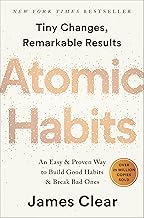
- Atomic Habits: The Power of Systems over Goals – James Clear’s exploration of how minor habits act as the foundational architecture for long-term output. This aligns with our “Microscopic Yes“ model, showing how small, un-vetted additions to your daily routine compound into significant behavioral drag.
- The Psychology of Cognitive Load – The Nielsen Norman Group provides a deep dive into how “clutter“ in our mental processes leads to paralysis. This is the scientific backbone for understanding why your “structural baseline“ becomes choked and why you burn through your psychological reserve funds faster than expected.
- Decision Fatigue and the Cost of Daily Choices – The American Psychological Association explains the exhaustion caused by constant, minor decision-making. This resource validates the “Mirror Life“ perspective that resentment and fatigue are not signs of weakness, but symptoms of a compromised internal structure.
Disclosure: This post may contain affiliate links. We only recommend products we believe in, and we may receive a commission at no cost to you! Thank you for your support!

Acknowledgment: Cover Image by moneycatzzz.com
Disclaimer: The information is provided for general information only – moneycatzzz.com makes no representations or warranties in relation to the information, including but not limited to any representation or warranty as to the fitness for any particular purpose of the information to the fullest extent permitted by law. While every effort has been made to ensure that the information provided in this article is accurate, reliable, and complete as of the time of writing, the information provided in this article should not be relied upon to make any financial, investment, real estate or legal decisions. Additionally, the information should not substitute advice from a trained professional who can take into account your personal facts and circumstances, and we accept no liability if you use the information to form decisions.