time cover

Time: What the Melting Glacier Taught Me About Loss

imagesReading Time: 8 mins #

disclosure line icon vector This post may contain affiliate links.

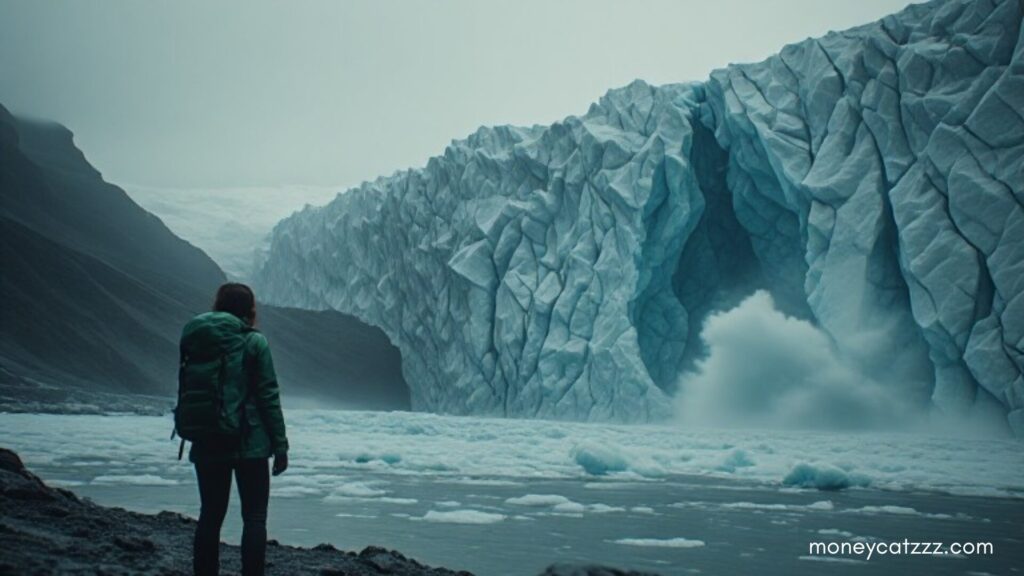
The ice made a sound I wasn’t expecting. Low frequency, almost subsonic. Like a building settling but slower, deeper. A chunk roughly the size of a car separated from the glacier face and dropped into the milky water below.


I was standing at Perito Moreno in southern Patagonia, watching something irreversible happen in real time.


That ice had been frozen for thousands of years. Now it was water. It would be water forever. No process would return it to that specific formation on that glacier face. The change was permanent and irreversible, and I’d witnessed it during an ordinary afternoon while tourists took selfies and checked their phones.


The guide said something about calving being natural. Technically true. What he didn’t mention was the rate, how the glacier’s equilibrium has shifted into a permanent deficit — how the interval between calving events keeps shortening.

How could you hear the failure before it actually happened?


Suddenly, I recognized the pattern. I’d heard that same sound in a dozen client meetings over the past year: different context, same physics. The crack of something ancient failing while everyone pretends it’s fine.

The Mechanics of Slow Catastrophe

Human brains evolved to respond to sudden threats: the lion in the grass, the falling rock. Immediate danger triggers immediate response, and we’re good at this.


Unfortunately, we’re terrible at responding to slow-moving catastrophes. The kind that compounds incrementally, unfolding before your eyes with zero urgency to act.


The glacier has been retreating for decades: every year, measurably less ice. The loss is documented, undeniable, and ignored by almost everyone who visits. They take photos, comment on how beautiful it is and leave.


I see the same pattern everywhere: the marriage has been deteriorating for five years, the business model that stopped working eighteen months ago, or the health markers that have been declining since your last physical.

Research on temporal discounting shows humans dramatically undervalue future consequences compared to present comfort. The farther away the consequence, the less it motivates action. The glacier demonstrates this perfectly. The loss is happening now, but the severe consequences feel distant — so we treat them as someone else’s problem.


The illusion of an infinite future distorts our relationship to time. We act as if we’ll always have more time to address things later, but Oliver Burkeman would dispute this in his book, Four Thousand Weeks.


The glacier has no such illusion. It melts at a rate determined by temperature, not by your readiness to deal with it.

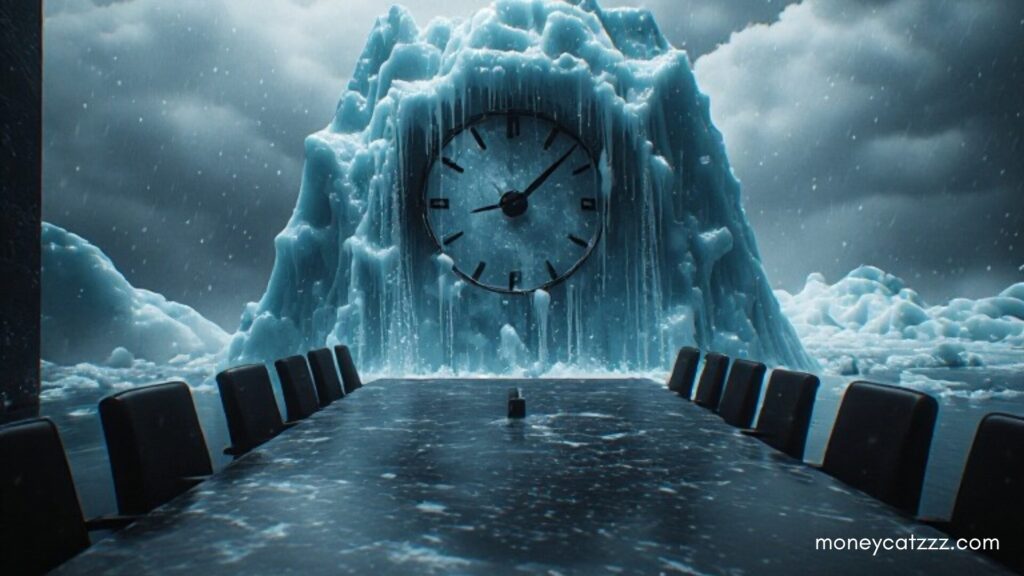
time - The Crack Before the Fall
[The Crack Before the Fall | moneycatzzz.com]

What Waiting Actually Costs

I have a client who knew her business partner was checked out two years before she finally addressed it. The signs were clear. Missed meetings, declining quality, passive-aggressive emails. The crack before the fall.


She stalled. For the right market moment, for him to change on his own, for the situation to resolve itself. For two years, she managed around the problem instead of addressing it, stripping the situation of all operational urgency.


By the time she finally had the conversation, the damage was irreversible, and the partnership was unsalvageable. What could have been a difficult conversation became a legal separation that cost her six months of energy and most of her operating capital.

The true loss wasn’t the end of the partnership but the two years of waiting, during which the company stagnated, opportunities died, and her best employees left for places that weren’t slowly falling apart.


She didn’t decide to destroy the partnership. She just never decided to save it, which amounts to the same thing.


The venture behaved exactly like a slow-calving glacier breaking into minor pieces. You can’t refreeze a glacier once the equilibrium is broken. The physics doesn’t work that way. Same with relationships, businesses, and bodies. Past a certain point, the damage is irreversible.

Diagnostic: Paralysis vs. Patience

Another client kept meaning to hire a CFO for three years. His finances were a disaster. He knew it. Every quarter, he’d say, “Next quarter, when things calm down.”


Things never calmed down. The chaos compounded. By the time he finally hired someone, they had spent eight months just reconstructing what had happened. Two vendor relationships were unsalvageable. A tax situation became a legal problem.


Like the glacier, the optimal intervention point was years ago. Each month of waiting made the eventual action less effective.


Let’s look at the metrics: patience implies you’re preparing for action. Waiting is hoping the problem resolves itself without requiring any action on your part. The glacier won’t resolve itself, and you are likely mistaking waiting for patience for structural paralysis.

The Crying Earth Question

Michael Jackson’s Earth Song kept running through my head while I stood there. “What about the crying Earth? Can’t we feel its wounds?”


The glacier is crying. Literally, water streaming down ice faces that have stood frozen for centuries. The Earth’s wounds are visible if you’re willing to look.


We can feel the wounds. We’re choosing not to respond. That’s a different problem than not knowing. Worse problem, actually.


David Wallace-Wells documents this in The Uninhabitable Earth. We’ve crossed from the information problem to the action problem. The glacier has urgency built into its physics. We know what’s happening, but we lack urgency. We have to manufacture it ourselves, and most people never do.


Time always makes it worse when the underlying issue is structural failure rather than temporary stress.

The Mathematics of Small Losses

The glacier doesn’t melt all at once. It melts in pieces. Car-sized chunks, piano-sized sections. Each calving event seems manageable, non-catastrophic. The compounding effect eventually takes its toll.


Relationships don’t end in one dramatic fight — they erode through accumulated small neglects. Health doesn’t collapse suddenly — it degrades through thousands of minor choices. Expertise doesn’t disappear overnight — it atrophies over months of inactivity.


The loss is incremental. The consequence is total. Each delay seemed reasonable. Collectively, they were fatal.

The Paralysis Pattern

Here’s what I’ve noticed: people who freeze aren’t lazy or stupid. They’re often brilliant, capable, and fully aware of what’s happening. They’re paralyzed by the scale of the problem and the lack of a perfect solution.


The glacier melts because of collective action spread across billions of people over decades. Your personal carbon footprint feels negligible against that scale. So does everyone else’s. Collectively, we’re melting the ice while individually feeling powerless to stop it.

The same pattern shows up in business and relationships. The problem feels too big, too complex, too entrenched. You don’t have a perfect solution, so you don’t take any action. You wait for clarity that never comes.


Meanwhile, the ice keeps falling.


The client who lost her company kept looking for a complete strategy to fix everything at once. Culture, product, investor relations, and team morale. She wanted one master plan that addressed everything. No such plan existed. While she waited for it, each problem compounded the others until the whole system collapsed.

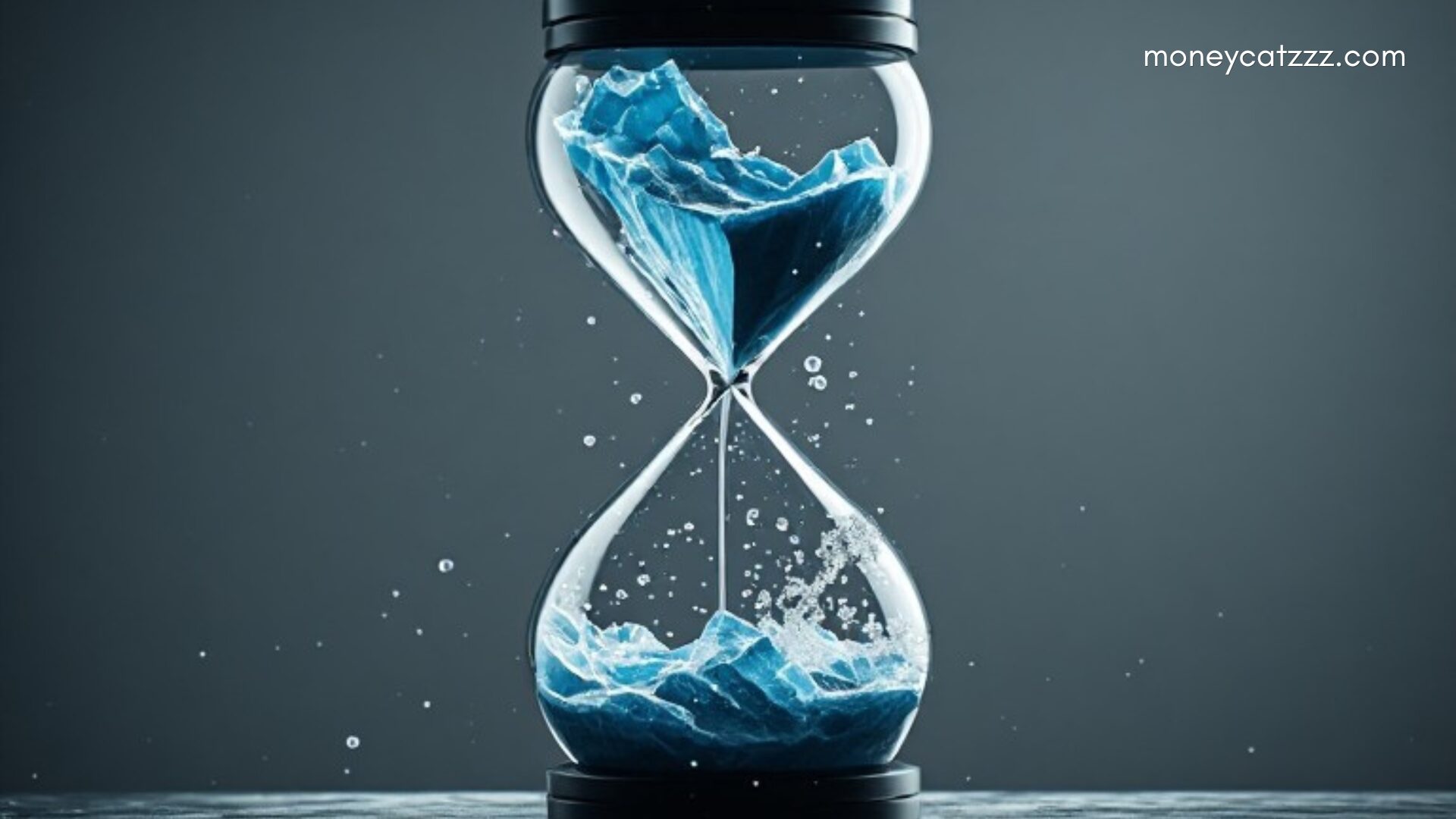
time - The Operational Matrix
[The Operational Matrix | moneycatzzz.com]

What I’m Actually Saying

You already know what’s failing in your life. The conversation you keep avoiding.


You can feel the crack before the fall. That low-frequency sound of something ancient giving way.


Delaying won’t make it easier. It will make it worse, then irreversible.


I’m not prescribing specific actions. I don’t know your glacier, your ice, your particular physics. But you do. You know exactly what I’m talking about. You’ve known for months, maybe years.


The question is whether you’ll act before the loss becomes total.

Greta Thunberg argues in No One Is Too Small to Make a Difference that individual action matters because it breaks paralysis. I’m less certain about the scale of impact, but certain about the psychological effect.


Doing something, even something small, disrupts the stagnation loop. It returns agency to you instead of to time, which doesn’t care about your readiness.

The Sound That Stays

I’ve been back from Patagonia for eight months. I can still hear that low-frequency crack—the sound of something ancient failing.


What stays with me isn’t the glacier melting. That’s physics. What stays is standing there, watching it happen, knowing we could influence the temperature and choosing not to. We’re spectators at our own decline. In the environment, in business, in relationships, in health.


The Bramble Cay melomys disappeared while we watched. The first mammal to go extinct due to climate change. Gone in 2016 while we waited for better data, political consensus, and more convenient timing.


The glacier disappears while we watch. Your partnership, your health, and your chance at the conversation that might save the relationship all disappear while you watch.

Tomorrow I’ll make different choices than I did yesterday. Smaller carbon footprint, more deliberate consumption. Will it matter at the glacier scale? Probably not. At the scale of my own relationship to structural inertia vs. execution? Definitely.


The ice is still falling. The sound still echoes.


You know what’s calling in your life. You can feel it.


Stop stalling. The convenient moment won’t come. The courage won’t arrive on its own. The problem won’t fix itself.


Act now with urgency or watch it fall.

“The trouble is, you think you have time.” — Jack Kornfield.

____________________________________

3 Books to Escape the Urgency Trap

71A1DuV YlL. AC UY218


No One Is Too Small …

by Greta Thumberg

Amazon Button

517wjaCYwdL. AC UY218


The Uninhabitable Earth

by David Wallace-Wells

Amazon Button

81QYEb6YnVL. AC UY218


Four Thousand Weeks

by Oliver Burkeman

Amazon Button

Disclosure: This post may contain affiliate links. We only recommend products we believe in, and we may receive a commission at no cost to you! Thank you for your support!
Acknowledgment: Cover Image by moneycatzzz.com

Disclaimer: The information is provided for general information only – moneycatzzz.com makes no representations or warranties in relation to the information, including but not limited to any representation or warranty as to the fitness for any particular purpose of the information to the fullest extent permitted by law. While every effort has been made to ensure that the information provided in this article is accurate, reliable, and complete as of the time of writing, the information provided in this article should not be relied upon to make any financial, investment, real estate or legal decisions. Additionally, the information should not substitute advice from a trained professional who can take into account your personal facts and circumstances, and we accept no liability if you use the information to form decisions.

Signup to our Newsletter for regular updates:

Marco Ban

Marco Ban is a 42-year-old, from sunny Spain bringing 7 years of experience crafting clear and engaging content in finance and digital marketing. A digital entrepreneur by trade, he brings vast experience in digital product reviews, financial blogging, and tutorials. A silky writer with a touch of a European flare, his postings are always engaging and informative.