
 Reading Time: 8 mins #
 This post may contain affiliate links.
A red car sped past us on a narrow road, engine growling, tires squealing just a little as it took the bend. I said it was reckless, a danger to everyone on that winding stretch of asphalt. My friend said it was beautiful, a machine finally doing what it was built to do.
Same car. Red color. Same speed.
Our judgment could not have been more different.
Neither of us was wrong; both of us were certain. I had the evidence of my ears—the late brake, the aggressive downshift. She had the evidence of her eyes—the clean lines, the confident arc through the corner. We were both right, and we were both wrong.
That is when I first noticed the glasses.
I am not talking about actual glasses. A filter. A lens I had been wearing for years without knowing it. Ten years earlier, I had been in a crash. It wasn’t my fault. A driver lost control on a curve just like that one. I walked away with a stiff neck and a quiet fear that never left. Every fast car after that was a threat.
My friend had no such history. She grew up watching rally racing with her father. The growl of an engine meant joy—not danger. She saw freedom where I saw an ambulance waiting to happen.
- The car was just a car. Our judgment reflected our scars, not the road.
A few blocks later, I admitted my bias. “I was in a crash years ago,” I said. “I see danger where you see joy.” She did not say I was wrong. She said, “Now I understand why you reacted that way.” By calling it out, the naming of the lens changed nothing and everything. The filter did not disappear. But for the first time—I saw it.
We kept walking. The sun was low, throwing long shadows across the pavement. I thought about how many arguments I had lost because I had never paused to ask what I was bringing.

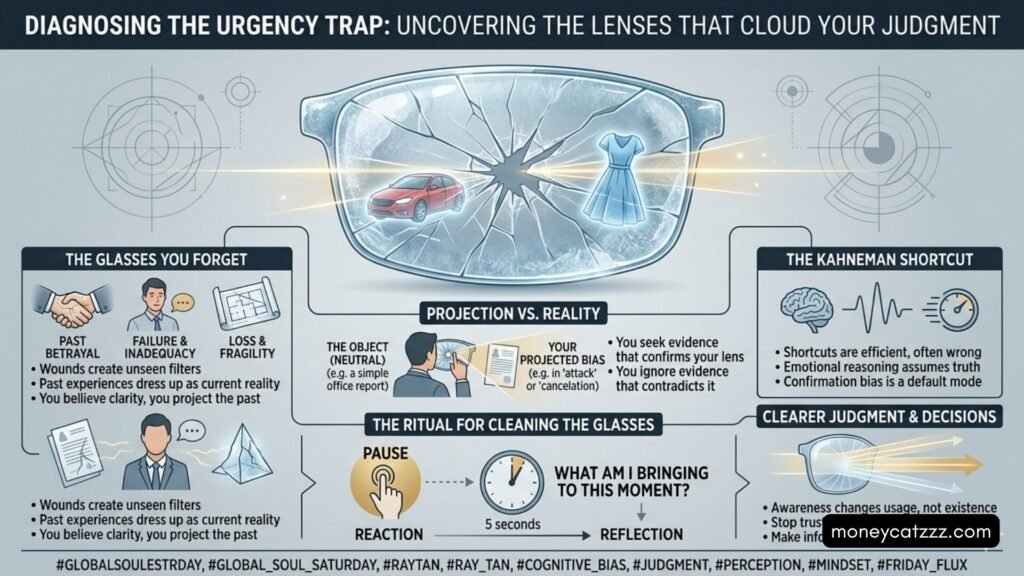
The Glasses You Forgot
You have glasses too. You put them on after a wound, and you have been wearing them so long you forgot they exist.
A past betrayal forces you to see distrust in every handshake. When an old failure follows, you start reading inadequacy into every casual glance from a colleague. Loss completes the distortion, tinting every new plan you try to build with sudden fragility.
This lens is never a conscious choice. It is simply a scar that hardened into a filter, quietly processing every fresh environment before you even have a chance to look. You believe you are evaluating the room with perfect clarity. In reality, you are just looking at the past, dressed up in the clothes of the present.
I watched a colleague react to neutral feedback as if it were a personal attack. His boss said, “Your report was thorough, but the conclusion could be stronger.” My colleague heard, “You are incompetent, and everyone knows it.” His lens was shaped by a previous manager who had used feedback as a weapon. The current manager was entirely different, yet my colleague missed the distinction completely. An old ghost clouded his judgment.
The ghost was real. The lens was real. The perception was not.
Another friend cannot accept a kind gesture. She was betrayed by someone who smiled as they lied. Now every smile looks like a weapon. Her filter keeps her safe from future betrayal. It also keeps her alone, suspicious, and exhausted.
These glasses are simply old. They require a thorough cleaning. Destruction is the wrong remedy.

[The Filtered Perspective | moneycatzzz.com]
The Research (Light Touch, but Present)
You seek evidence that confirms your lens. You ignore evidence that contradicts it, which cognitive science calls “confirmation bias.” If you believe people are untrustworthy, you will notice every late email and every forgotten promise. You will overlook the rides given, the deadlines met, and the kindness offered without thought.
Daniel Kahneman, in Thinking, Fast and Slow, describes how the brain takes shortcuts. These shortcuts are efficient. They are also often wrong. Emotional reasoning is another shortcut: you feel it, therefore you believe it is true.
A famous study on perception asked people to evaluate a job candidate. The same resume was given to two groups. One group was told the candidate was warm. The other was told the candidate was cold. Each group found evidence to support their assigned lens. The warm group noticed the candidate’s volunteer work. The cold group noticed the candidate’s job hopping. Same resume. Same facts. Different judgment.
The light enters when you notice the filter exists. The filter never disappears. But awareness of it changes how you use it. You stop trusting your first reaction. You start asking: What am I bringing to this moment?
“We can be blind to the obvious, and we are also blind to our blindness.” — Daniel Kahneman, Thinking, Fast and Slow.
The Argument That Was Not About the Facts
A family dinner. Two siblings remembering the same childhood. One saw favoritism in every family photo. The other saw normal attention, the ordinary ebb and flow of parental affection. The argument lasted an hour; voices rising, forks clattering against plates.
Both were wearing glasses.
The first sibling had been overlooked in other areas of life. Her ex‑husband had dismissed her opinions. Her boss had taken credit for her work. She projected that pattern onto her parents—seeing slights where none were intended. The second sibling had no such history. He saw what was actually there: two tired parents doing their best.
The fight ended when the first sibling said, “Maybe we are both remembering what we needed to remember.” She did not change her perception. She just stopped believing it was the only one.
That is the crack where the light enters.
Rumi wrote: “The wound is the place where the light enters you.” He was not referring to the healing or the closing. The wound itself. The crack in certainty. The moment you realize your lens is not the only lens.
Her wound was real. Her parents had not caused it, but the wound was still there. The light entered not when she forgave them, but when she saw that her judgment was shaped by something older than the dinner table.
The Blue Dress and the Gold Dress
In 2015, the internet argued about a dress for days. Some saw blue and black. Others saw white and gold. The fight was intense, irrational, and completely sincere. People were certain—their brains interpreted the same image differently depending on how they processed the lighting and shadows.
The dress was not the problem. The certainty was.
The same thing happens in every disagreement. You see red. They see blue. The object is neutral. The filter is not. The dress taught me something important: you can be certain and absolutely wrong at the same time. Certainty is not a measure of accuracy—it is a measure of how much you trust your lens. It was about the conviction that one perception must be wrong.
A Ritual for Cleaning the Glasses
Before reacting in a disagreement, ask: “What am I seeing, and what am I bringing?” One question for five seconds with no forced positivity—no need to change your mind. Just need to see your filter before it sees for you.
Last week, a client sent a short message: “Let’s touch base tomorrow.” My immediate reaction shifted straight to defensiveness. They are angry. They are going to cancel.
I paused to ask the question. That single layout check made me realize I was bringing a past client’s friction into a completely fresh interaction. This current client harbored no frustration at all. A hectic schedule had dictated the brief text, typed one‑handed while balancing a coffee.
My judgment had been clouded. The pause saved an unnecessary apology, a defensive explanation, a whole spiral of tension.
[Uncovering the Lenses | moneycatzzz.com]
Once a week, I also recall one moment I was certain I was right. Then I asked what lens was active. The answers are not always comfortable. They are always instructive. Last week, I remembered an argument with a partner about money. I was sure she was being irresponsible. The lens?
My father’s anxiety about debt, installed decades ago, has been running silently in the background.
Ask someone close to you to describe a shared memory, and listen for where your perception differs from theirs. Do not argue. Just note the difference. That difference is your filter at work.
The Crack in Certainty
My partner disagreed with a business decision last year, even though I was 100% certain. I had the data, experience, and confidence. I had spreadsheets, projections, and a PowerPoint with a lot of arrows. I was sure. I was wrong.
The data was incomplete. The experience was from a different context, and the confidence was my lens pretending to be evidence. I had been burned by a similar decision years earlier, and I had spent every year since building a case against ever taking that risk again. My judgment was not about the present opportunity. It was about the past failure.
I learned nothing from being right. After that mistake, I started asking for opposing views before making decisions, to see my filter before it saw for me. I hired a devil’s advocate for every major choice—someone whose job was to tell me what I was missing.
It was uncomfortable at the beginning, but by the tenth time, it was routine. The lens is still there. I know I am wearing it.

Your Glasses
Rumi was right. The wound is not the enemy. It is the opening. The glasses are still there. The wound is still there. The light is already inside. You know your glasses, you just forgot to look.
You feel them when you react with heat that does not fit the situation. You see them when you pause and ask where that reaction came from.
The wound that created the filter is real. The judgment it produces is not reality; it is a useful projection. A costly one, sometimes.
You do not need to remove the glasses. You need to remember they are there.
Before your next argument, ask:
“What am I seeing, and what am I bringing?”
The car was just a car. The dress was just a dress. The feedback was information. The sibling’s memory was exactly that, a memory. Your lens is not the truth. It is just a lens.
Rumi never promised that the wound would close cleanly, nor did he claim the illumination would feel comfortable. His insights focused entirely on how the light finds you directly through the fracture. That break splits open your rigid certainty. It tears through your defensive filter, finally exposing the deep spaces you have spent a lifetime hiding from yourself.
The old glasses remain intact alongside the persistent scar. Even so, the light is already operating inside.
You just forgot to look.
_____________________________________________
Resources to Identifying the Hidden Lens That Shapes Your Perception

The Guest House

Thinking, Fast and Slow
The Extended Mind



Disclosure: This post may contain affiliate links. We only recommend products we believe in, and we may receive a commission at no cost to you! Thank you for your support!
Acknowledgment: Cover Image by moneycatzzz.com
Disclaimer: The information is provided for general information only – moneycatzzz.com makes no representations or warranties in relation to the information, including but not limited to any representation or warranty as to the fitness for any particular purpose of the information to the fullest extent permitted by law. While every effort has been made to ensure that the information provided in this article is accurate, reliable, and complete as of the time of writing, the information provided in this article should not be relied upon to make any financial, investment, real estate or legal decisions. Additionally, the information should not substitute advice from a trained professional who can take into account your personal facts and circumstances, and we accept no liability if you use the information to form decisions.