 Reading Time: 8 mins #
 This post may contain affiliate links.
I walked my usual morning route yesterday. Same path I’ve taken for three years. Forty minutes through the neighborhood, past the creek, around the park. I returned home and realized I’d experienced exactly none of it. My body walked. My mind was somewhere else entirely, rehearsing a conversation that hadn’t happened yet, preparing for a conflict that might never arrive. Mindfulness wasn’t just absent. I was absent.
No memory of the trees. The sky. The specific quality of morning light that I supposedly love about this walk. I was physically present and mentally evacuated for forty minutes of my finite life.
That realization landed hard. This wasn’t the first walk I’d missed while being on it. Probably not even the first this week. How many meals had I not tasted? How many conversations had I not actually heard? The pattern became visible: I’ve been watching horror movies about tomorrow instead of living today.
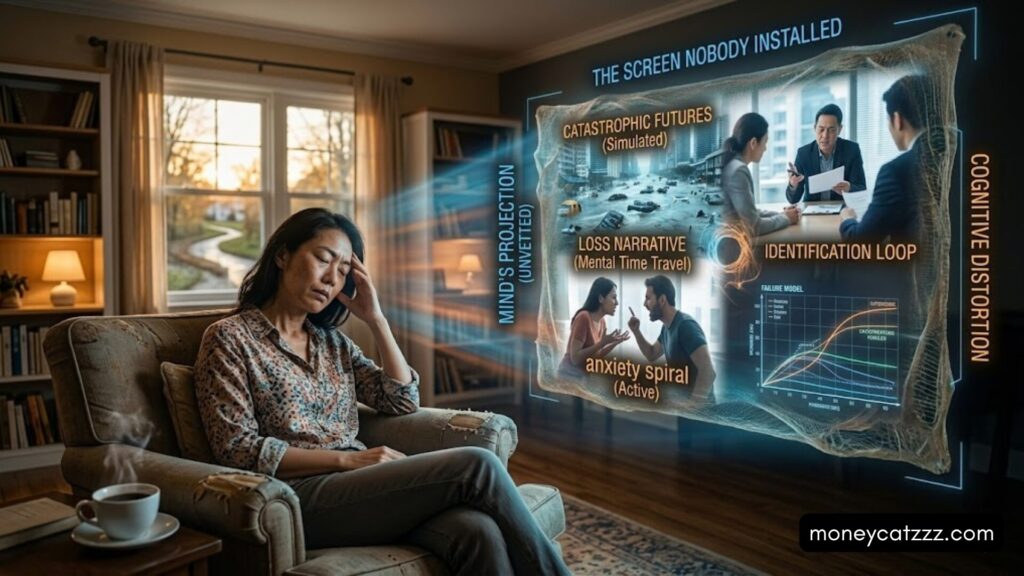
The Screen Nobody Installed
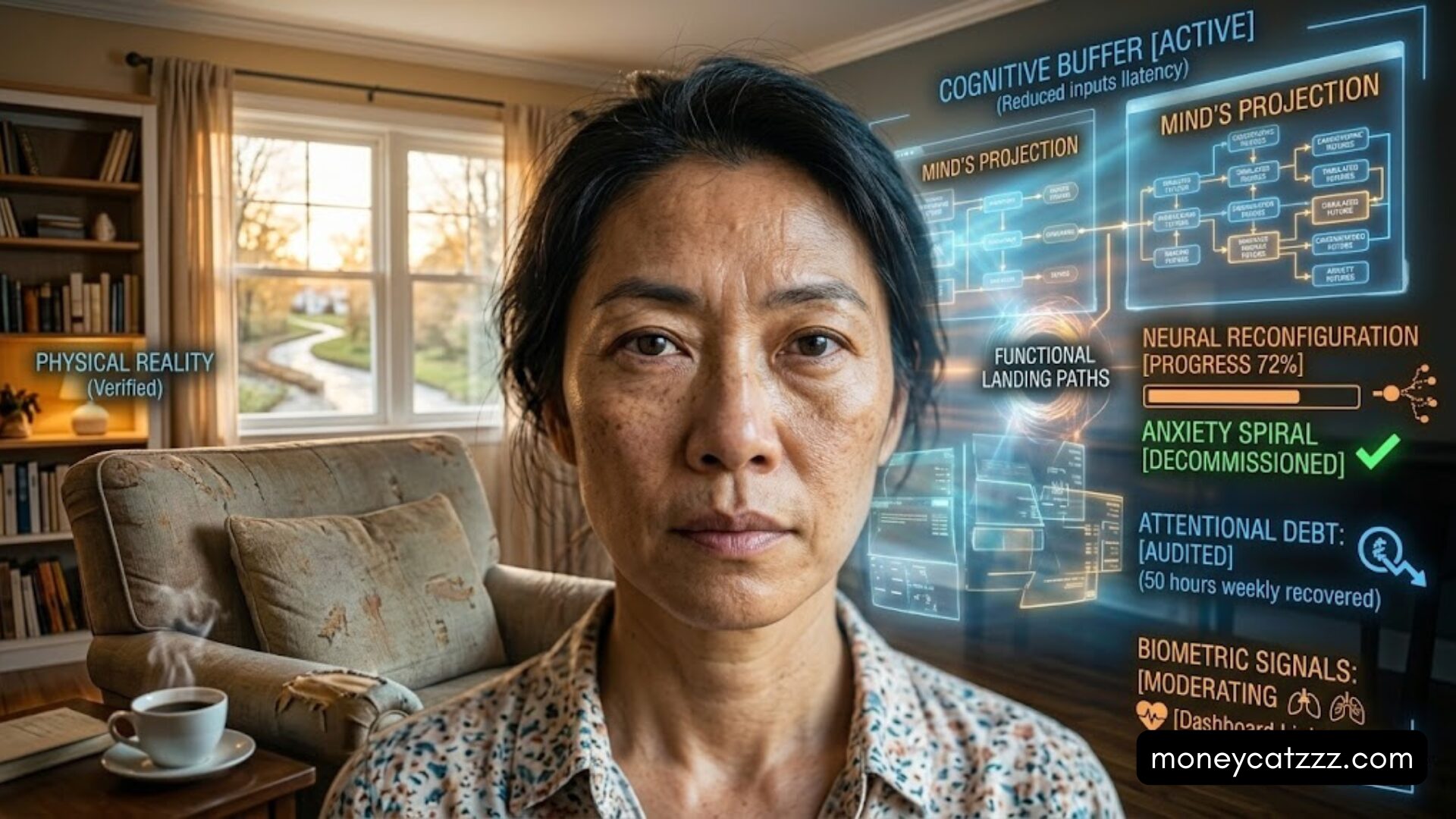
Your mind is a projection screen showing vivid futures while you sit in a room that’s actually fine.
The futures vary. Sometimes catastrophic: the client fires you, the relationship collapses, the health scare becomes real. Sometimes optimistic: the project succeeds, the conversation goes perfectly, everything finally aligns. Doesn’t matter which direction. Both keep you watching instead of living.
The projections feel incredibly real because your nervous system can’t distinguish between imagined threat and actual threat. Bessel van der Kolk spent decades studying trauma and discovered something that applies well beyond PTSD: your body keeps score of things that haven’t happened yet. The anxiety spiral you feel about next week’s presentation triggers the same physiological response as if the presentation is happening now and going badly.
Your amygdala, that primitive alarm center, doesn’t care about timelines. A bear attack and overdue invoice activate identical survival protocols. Fight or flight. Cortisol floods. Heart rate spikes. The system has evolved to handle immediate physical danger, making it spectacularly ill-suited for handling modern life’s slow-burning stressors.
So you sit there, body in emergency mode, responding to projected futures that may never materialize. The gap between your biology and your actual circumstances is where the anxiety spiral lives—your body is fighting wars that exist only on the projection screen.

What Gets Lost in the Watching
The calculations are easy but not precise. If I’m absent for 30% of my waking hours, lost in projection while actual life happens around me, that’s estimated to be 50 hours weekly. Over a year: 2,600 hours. 26,000 hours over a decade, where I was technically alive for but not actually present to experience. That’s 2.96 years.
That’s nearly three full years of consciousness spent watching previews of coming attractions instead of attending the actual show.
The cost isn’t abstract. It’s coffee that goes cold because you didn’t notice you were drinking it. Conversations where you realize you haven’t heard the last two minutes and have to ask them to repeat. Entire seasons are passing while you’re projecting futures through all of them. Spring happened. You have no specific memories of it.
[The Sensory Inventory Protocol as a Cheat Sheet | moneycatzzz.com]
Michael Singer’s conscious-witness book, The Untethered Soul, describes the “inner roommate,” that voice provides constant narration and projection. He asks a question that stopped me cold when I first read it: if you had an actual roommate who talked to you the way your mind talks to you, how long would you tolerate living with them? Five minutes? An hour?
We tolerate it for decades. We think that voice IS us, rather than recognizing it as one process the mind runs. The projectionist is not the person watching. Mindfulness is realizing you can separate from the projection.
What Actually Interrupts the Loop
The first time I successfully interrupted an anxiety spiral, it wasn’t dramatic. I was sitting at my desk, spinning through increasingly catastrophic scenarios about a project deadline, when I noticed my breath had become shallow and rapid.
That noticing created a gap. Small, maybe two seconds. But in that gap, something shifted.
The projection was still running. My mind was still generating catastrophic futures. The difference was that I’d become aware that it was happening. The thought patterns lost some of their power the moment I could observe them as patterns rather than experiencing them as reality.
Sam Harris’s secular approach to mindfulness doesn’t require spiritual belief or meditation cushions. His core insight is simple: you can be aware of thoughts without being controlled by them. Most people spend their entire lives identified with every thought that arises. They never realize that there’s a position from which thoughts can be observed.
I started practicing interruptions without any elaborate meditation sessions. Just brief moments throughout the day where I’d pull back from the projection and land in the present moment. The mechanism was almost embarrassingly simple—notice the breath.
Not control it. Not breathe deeply. Just notice that breathing is happening.
The breath serves as an interruption because it exists only in the present. You cannot breathe in the past or future. The present moment is the only place where breathing occurs. Attention on breath means attention has left the projection screen, even if just for a few seconds.
Those seconds accumulate, and the interruptions become more frequent. The gap between stimulus and projection widens. You catch yourself earlier in the spiral.
The Sensory Reset
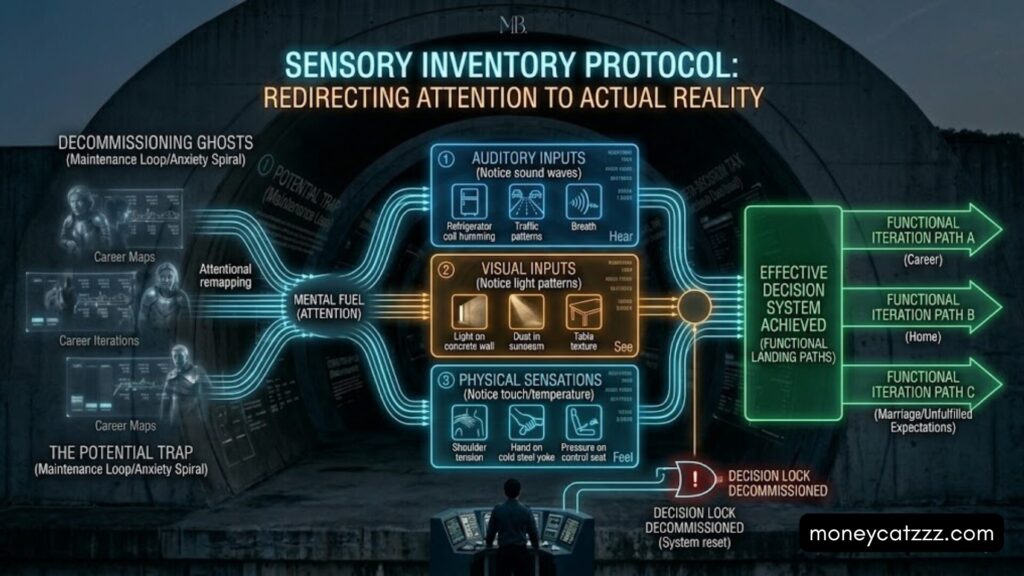
Another interruption method I discovered: the sensory inventory. When I catch myself deep in projection, I force myself to focus on immediate physical reality.
What do I actually hear right now? The hum of the refrigerator. Traffic outside. My own breath.
What do I see? Light patterns on the wall. Dust particles in a sunbeam—the texture of the table.
What physical sensations exist? Pressure where my body contacts the chair. Temperature of the air. Tension in my shoulders.
Research on mindfulness-based stress reduction shows that directing attention to immediate sensory experience activates neural networks distinct from those involved in rumination and projection. You’re literally using different parts of your brain. The anxiety spiral runs in the default mode network, which is the system responsible for self-referential thinking and mental time travel. Sensory attention activates present-focused networks that are largely incompatible with anxiety maintenance.
The inventory doesn’t eliminate anxiety. It interrupts the loop long enough that you can recognize you’re in a loop. Recognition creates choice—you can either return to the projection or stay with the sensation of actual life happening now.
The Muscle That Develops
Mindfulness isn’t a state you achieve; it’s a capacity you build through repetition.
The first week I practiced interruptions, it took hours to notice I was absent. Entire mornings were lost to projection before I remembered to audit my attention.
Gradually, the intervals shortened. Hours collapsed into minutes, then eventually into the immediate recognition of a starting projection. The thought patterns still arise; the hardware hasn’t changed. What changed is the latency: the speed of recognition and the subsequent power to redirect.
Research on present-moment awareness confirms that consistent practice literally restructures neural pathways. As regions associated with emotional regulation strengthen, the networks fueling the anxiety spiral atrophy through disuse. You aren’t fighting your mind; you are re-engineering its defaults through repetition.
I still lose entire walks to projection: absent from conversations, meals, and the reality occurring while I am mentally elsewhere. There’s no finishing line, but the difference is reduced latency: I catch the drift faster. The absence becomes a detectable system error sooner.
The ability to ‘notice’ is the core utility. You cannot choose presence if you don’t recognize absence. Mindfulness is simply about developing the sensor sensitivity to recognize exactly when the projection screen flickers to life.
[The Screen Nobody Installed | moneycatzzz.com]
What Changes and What Persists
The anxiety spiral didn’t disappear. That’s the first thing worth being honest about.
My mind still generates catastrophic futures. Still projects conflicts that might never happen. Still rehearses conversations that would go poorly if they were to occur exactly as imagined.
My relationship to the projection has shifted. The screen is still showing disaster films, but I finally realize I’m sitting in the theater, not living the plot. That realization creates a “buffer,” a vital gap between what happens and how I react.
Sometimes that gap is paper-thin. Other times, it’s wide enough that I can watch the projection without buying into it. The difference between “my mind is predicting a wreck” and “I am currently in a wreck” has never been clearer.
Emotional balance happens as a byproduct. When you observe anxiety instead of drowning in it, the fire loses its oxygen. The physical symptoms still show up—the racing heart, the shallow breath—but I’ve started seeing them as dashboard warning lights rather than the crash itself. They are just signals from my nervous system, not proof that the world is ending.
The projection screen turns on multiple times daily. Probably always will. The projectionist has been running these films for decades. Old habits in deep neural pathways don’t evaporate through intention.
What’s possible is catching it earlier, spending less time absent, and returning to the present moment more quickly when projection has pulled you away.

The Walk This Morning
This morning’s walk was different from yesterday’s. Same route, same duration, forty minutes through the neighborhood.
But I was there for twenty of those minutes. Present, in body and mind. Noticing the temperature shift where the sun hits the pavement. Hearing specific birds rather than generic bird noise. Seeing the exact color of new leaves.
The other twenty minutes? Lost to projection. Planning this piece, actually. Mentally drafting sentences while my body walked. The irony isn’t lost on me.
The difference is I caught it. Multiple times, attention drifted to the projection screen, and each time I noticed and redirected it back to the walk itself.
Twenty minutes of presence out of forty isn’t mastery. It’s just better than zero. Mindfulness isn’t arriving at permanent presence—it’s developing the capacity to return more quickly when you’ve left.
The projection screen is still there. The films are still vivid. The anxiety spiral still knows how to pull me in.
But I know I’m watching now. And that knowing, small as it seems, changes everything.
Watching the Film vs. Living the Disaster: Recommended Resources
Waking Up


The Body Keeps the Score

The Untethered Soul
Disclosure: This post may contain affiliate links. We only recommend products we believe in, and we may receive a commission at no cost to you! Thank you for your support!
Acknowledgment: Cover Image by moneycatzzz.com
Disclaimer: The information is provided for general information only – moneycatzzz.com makes no representations or warranties in relation to the information, including but not limited to any representation or warranty as to the fitness for any particular purpose of the information to the fullest extent permitted by law. While every effort has been made to ensure that the information provided in this article is accurate, reliable, and complete as of the time of writing, the information provided in this article should not be relied upon to make any financial, investment, real estate or legal decisions. Additionally, the information should not substitute advice from a trained professional who can take into account your personal facts and circumstances, and we accept no liability if you use the information to form decisions.