
 Reading Time: 8 mins #
 This post may contain affiliate links.
You want to know what drives me crazy? You might expect me to say “liars.” No, liars are easy. You catch them, you move on.
What drives me crazy is the person who thinks saying “I doubt that” makes them smart. That is not skepticism. That is a costume.
Let me drop Amanda into our equation. I don’t know her real name. She has been on my timeline for two years, and she has never once posted a source she actually read. Last week, a journalist shared election data from a nonpartisan research group. Amanda’s reply was a single word: “Doubtful.”
That is it. No follow-up. No specific question. Just “doubtful.” She got forty-seven likes.
The source was right there. She just wanted to look smart.
The Car Alarm Nobody Hears Anymore
Imagine a car alarm that triggers every time a leaf falls. First week, neighbors look. Second week, they glance. By the third week, nobody turns their head. When a real thief finally breaks the window, the alarm wails into empty silence.
That is what a knee-jerk reaction has done to professional trust.
Trusting everything without checking is lazy. So is distrusting everything without checking. Same laziness, different costume. The person who says “I doubt that” without a specific question is not very critical-thinking-oriented. They set off car alarms, and eventually, everyone learns to ignore them.
I have lost count of how many times I have witnessed this in meetings. Mary presented a market forecast. Peter said, “I have concerns about that methodology.” No follow-up. No request for clarification. Just concerns. Mary felt defensive, inadequate. Peter looked smart. Nothing was learned—where’s Paul when he is needed?
No objection, you could pin down—no data of their own.

The Performance Versus The Practice
Real skepticism is boring. I mean it. Quiet. It looks like opening a new tab, tracing a claim to its origin, and checking whether the source actually says what the headline claims. Takes time. Produces no applause.
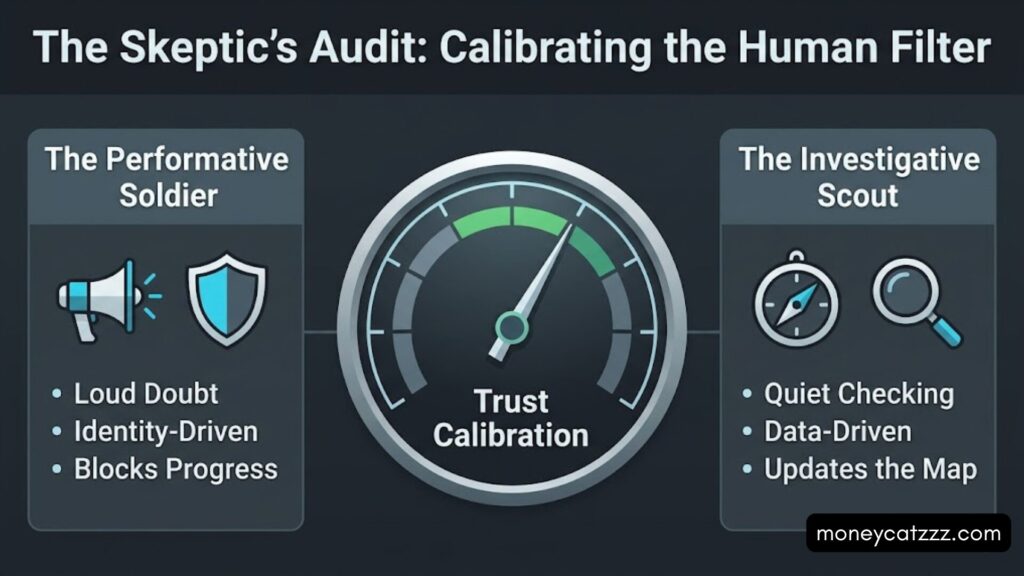
Julia Galef wrote a great book on the mind’s compass. She talks about scout mindset (map the territory as accurately as possible) versus soldier mindset (defend your position at all costs). Most performative skeptics are soldiers. They are not trying to learn. They are trying to win.
The scout asks specific questions. “What is the sample size?” “Who funded the study?” “Does this replicate?” The soldier says “doubtful” and moves on.
[Calibrating the Human Filter | monaycatzzz.com]
It’s no wonder this pattern kills good ideas. Someone shares useful data, and a performative skeptic says, “I am not sure I trust that.” No reason. Just… not sure. The room shifts. The idea wasn’t bad, but it died because someone raised doubts, and everyone else was too polite to ask “why?”
Verification fatigue sets in fast. Teams stop sharing useful information because the performance tax is too high. “Is it worth sharing if someone is just going to say ‘questionable’ without reading it?” Eventually, the answer becomes “no.” Information hoarding starts, and decisions get made with less data, not more.
What It Actually Costs
It is no surprise that this is where people often get wrong. They think performative skepticism is annoying but harmless. It is not harmless.
Legitimate expertise cannot get traction. The person who actually knows something gets the same response as the person who made something up. Both get doubted. Neither gets heard.
Good ideas die despite not being flawed. Death is fundamental because someone performed doubt, and everyone moved on. The cost to the performer is zero. The cost to the team, potentially valuable direction—gone.
Trust collapse follows. When trust calibration disappears, two things happen. Firstly, people stop trusting anything. Second, they start trusting the wrong things. The vacuum is filled by whoever sounds most confident; rarely the most accurate person.
Tom Nichols argues that the democratization of doubt has created a culture where everyone feels entitled to question everything without doing the work to understand anything. I fully endorse that thought, as the result is not better decisions—it is paralysis and noise.
The Consultant Who Cost Me a Month
Mark was a consultant I liaised with in a project a few years ago. He doubted every piece of data. “How do you know that is true?” “Who verified that?” “That seems convenient.”
For six months, he never offered an alternative number. Never produced a counter-source. Never did any verification himself. He just asked questions. His skepticism was a performance.
The team stopped taking him seriously. When he was actually right about something, nobody listened. The car alarm had gone off too many times. He trained everyone to ignore him.
You might also like:

Perfect Is a Trap Door: Why Finished Beats Flawless
Empty Promises Cut Both Ways
Mark cost me a lot more than anxiety, but financially, too. We were deciding whether to enter a new market. I had data. He performed doubt. The team hesitated. The opportunity window closed, and a competitor took the space.
I checked his sources later, quietly. The study he kept citing as “questionable” was from a peer-reviewed journal with a replication history. His doubt had no foundation—it was just a posture.
Post-truth as an afterthought is great foresight. Lee McIntyre made a brilliant case in distinguishing healthy skepticism from denialism. He summarizes that denialism looks like skepticism but rejects evidence regardless of quality. It is largely an identity—not a method.
Mark had built an identity around being the skeptic in the room. He forgot that the job was not to doubt. The job was to help.
The Time I Did It Myself
I have done this more often than I would have liked to admit.
Some years back, someone shared an article with me. I had not read it. I said, “I am skeptical of that source.”
They asked, “What do you know about the source?”
Nothing. I knew nothing. I had never heard of the publication. I just wanted to sound careful. I wanted to be the person who does not accept things at face value.
I felt stupid. Because I was. I had performed skepticism without doing the work. The person across from me had read the article. I had not. They asked one question, and my performance collapsed.
It was a lesson that cannot be learned in a seminar or at a course; that moment changed how I respond now. It was not immediate or profound, but I still catch myself.
So no, I have not solved this. I am just more aware of how easy it is to perform instead of practice.

[The Invisible Tax: When Performance Kills Participation | moneycatzzz.com]
What I Actually Do Now (Mostly)
There are two rules I often use, and I sometimes break them.
Rule one. Do not voice doubt without a specific question attached. “I doubt that because X” or “I doubt that unless Y” are acceptable. “I doubt that” alone is not.
Rule two. If you doubt something, name what would convince you. “I would trust this if I saw the raw data,” or “I need to know who funded the study.” If you cannot name what would change your mind, you are not skeptical—you are stuck.
These two rules have saved my reputation more than any performance ever could. They are boring. They take an extra few seconds. They produce actual answers instead of just friction.

Verification fatigue drops when people realize you are not going to perform doubt at them. They learn that your questions are genuine. They share more. They listen more. The car alarm gets calibrated.
Trust calibration is knowing when to trust, when to doubt, and when to do the boring work of checking—it is a practice, not a performance. It means you show up, fail sometimes, and try again.
The Room Is Still Talking
Someone just made a claim you do not fully trust. You can either perform skepticism, or you can do the quiet work: ask one specific question, open one tab, name what would convince you.
The performance is loud and empty. The practice is quiet and useful. One advances understanding. The other? Just noise.
I still mess this up. Old habits die hard. Last week, I caught myself doing it again. But I am getting better. Slowly.
Want to join me?
Beyond Performative Doubt: A 3-Book Stack for Critical Thinking
The Death of Expertise

The Scout Mindset
The Power Of Now
Disclosure: This post may contain affiliate links. We only recommend products we believe in, and we may receive a commission at no cost to you! Thank you for your support!
Acknowledgment: Cover Image by moneycatzzz.com
Disclaimer: The information is provided for general information only – moneycatzzz.com makes no representations or warranties in relation to the information, including but not limited to any representation or warranty as to the fitness for any particular purpose of the information to the fullest extent permitted by law. While every effort has been made to ensure that the information provided in this article is accurate, reliable, and complete as of the time of writing, the information provided in this article should not be relied upon to make any financial, investment, real estate or legal decisions. Additionally, the information should not substitute advice from a trained professional who can take into account your personal facts and circumstances, and we accept no liability if you use the information to form decisions.