
 Reading Time: 8 mins #
 This post may contain affiliate links.
The Moment Nobody Notices
There is a specific moment that happens in almost every professional meeting. Nobody talks about it afterward.
Someone drops a statistic—the room shifts. Shoulders relax. Pens move. The conversation advances on the assumption that the number is real. You probably nodded. Maybe you wrote it down. What almost nobody does, then or later, is check whether the figure actually exists.
That small collective agreement, at that moment, to trust without confirming, no verification, is where the problem lies.
The information environment did not collapse dramatically. It eroded. Slowly enough that most professionals kept their old habits while the ground underneath changed entirely. Default trust was a reasonable operating posture when fabricating convincing information was expensive and difficult. That world ended. The new one arrived without a memo. Most people are still behaving as if it did not.
“A lie can travel halfway round the world while the truth is putting on its shoes.” — Often attributed to Mark Twain.
The Default That Stopped Working
The previous information design relied on three high-friction barriers: the logistical cost of Physical Distribution, the regulatory filter of Institutional Gatekeeping, and the audit trail of Manual Traceability. Each of these served as a natural speed-limiter on misinformation, ensuring the signal-to-noise ratio remained within manageable operational parameters.
What changed was not just the popularity of social media, though that accelerated everything. The deeper shift was in the cost structure of deception. Fake news is ever more present. Generating convincing synthetic content, complete with plausible citations, realistic data visualizations, and authoritative tone—now costs nothing essentially, and takes mere minutes.
Most professionals built their judgment on the assumption that this was not possible. Most people have not updated that assumption. That is a problem with a measurable price tag.
The result shows up in decisions and not usually in a single catastrophic error.
More commonly, it is the slow accumulation of choices built on inputs that were slightly wrong, selectively framed, or quietly fabricated. Cognitive friction is the mandatory skepticism that now exists between incoming data and operational use. Treating it as optional is expensive. The cost rarely traces cleanly back to its source.

The Quarantine Nobody Installed
In the book Stolen Focus, there’s a section documenting how the attention economy undermines careful evaluation. Hari focuses mainly on attention itself rather than trust mechanics. The implication he does not fully draw out is that degraded attention and degraded information quality compound. You are reading faster, trusting more reflexively — in an environment specifically designed to exploit both tendencies at once.
Every piece of information now needs what systems people call a quarantine phase, a holding period before it earns operational status.
Paranoia? Strictly speaking, no. It is the mechanical response to an environment in which fabrication costs dropped to zero. The professionals who have internalized this are not walking around suspicious of everything—they have built lightweight verification habits that run quietly alongside their normal workflow. Those who have not are attributing decision errors to execution when the real failure happened much earlier, at the input stage.
The Bill Arrives Either Way
There is a version of this conversation in which cognitive friction is framed as a burden—another tax. Another thing on the pile. That framing is accurate. It is also completely useless.
The bill for operating in a degraded information environment arrives whether you open it or not. Ignore verification discipline, and you pay the price through bad decisions, misplaced confidence, and the occasional public embarrassment of having cited something fabricated. Build the habit, and you pay for it over the time it takes—neither option is free. The only real question is what you get in return.

[The Mandatory Quarantine: Filtering Signal from Synthetic Noise | moneycatzzz.com]
Cal Newport’s Deep Work contains a principle that transfers here better than Newport probably intended—systematize the repeatable so genuine cognitive capacity stays available for irreducible complexity. Verification is repeatable. The source check, the independence test, and the signal decay question: these can become almost automatic with enough repetition. What cannot be systematized is the actual judgment call at the end, the decision that the verified information informs. That is where the preserved capacity needs to go.
Most professionals have this backward. They apply casual evaluation to inputs and wonder why their judgment on outputs feels uncertain. The uncertainty is structural. Fix the inputs, and the judgment gets cleaner almost by itself.
A Case Study in False Corroboration
The Mistake I Actually Made
A few years back, I built a market analysis around a figure I had seen cited in three separate industry reports. Felt solid. Three sources, same number, looked like independent corroboration.
However, when I traced all three citations back to their origins, they led to the same single survey from a consultancy with a financial interest in the number being large. I had cross-referenced without checking independence—three sources, one well. The corroboration was an illusion.
The information design I use now came directly from that mistake. Not from any methodology I was taught. This explains why it actually works.
The Three-Stage Verification Filter
- Source hierarchy first: primary over secondary over aggregated, always, no exceptions, based on convenience.
- Independence test second: genuinely separate origin points, not outlets repeating the same underlying source with different formatting.
- Signal decay third: a study from four years ago in a fast-moving domain is not the same asset as one from last quarter, even when the numbers look identical.
And before any significant decision, one adversarial question: What would need to be false for my conclusion to be wrong? That question has caught more errors than everything else combined.
The Part Most Professionals Miss
Here is where the economic reframing gets genuinely interesting rather than just being correct.
In a market where default trust is still the operating assumption for most professionals, the person running systematic verification has an asymmetric information advantage. He possesses cleaner input signals over the competition. Over time, cleaner inputs produce better decisions that compound quietly. This is a structural edge on top of a productivity strategy.
Ray Dalio spends considerable time on believability-weighted decision making, calibrating how much influence someone’s judgment should carry based on their demonstrated track record. What he describes depends entirely on the existence of a reputation ledger, an accumulated record of verified outputs that others can actually evaluate. The ledger is what makes your judgment legible rather than merely asserted.
In a synthetic media environment, the reputation ledger becomes the only genuine trust instrument. You can manufacture a credential or even buy social proof, but what you cannot manufacture is a multi-year track record of accurate, verifiable outputs that people in your professional network can independently confirm.
Every time you circulate something unverified that turns out wrong, you make a withdrawal, and likewise, every time you catch an error before it spreads, you make a deposit. The balance determines how much your opinion is worth in high-stakes rooms.
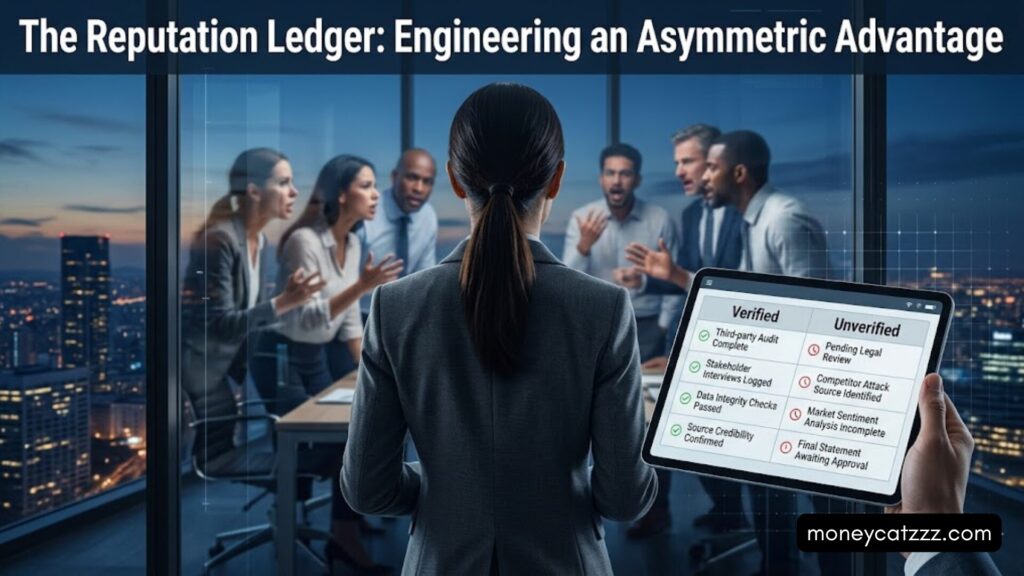
[The Reputation Ledger: Engineering an Asymmetric Advantage | moneycatzzz.com]
The Ledger Exists Whether You Manage It Or Not
The uncomfortable part is your track record of what you have claimed, and whether those claims held up, is already being evaluated informally by everyone who works with you regularly. The reputation ledger is not something you opt into. It is accumulating right now. The only choice is whether to build it deliberately or let it happen by accident.
Most people are letting it happen by accident and wondering why their professional credibility feels inconsistent.

What Winning Actually Looks Like
The professionals navigating the current information architecture most effectively share one characteristic that has nothing to do with intelligence or access to better sources. They updated their operating assumptions when the environment changed. They noticed that default trust mechanics stopped working and adjusted before the adjustment became painful, not after. That is it. No proprietary methodology or special access. A behavioral update: the majority of their peers have not made it yet.
Nassim Taleb’s Antifragile is worth sitting with here. Systems designed to handle volatility become more capable through exposure to it. The cognitive friction of running systematic verification habits is not friction to eliminate. It is the stress that builds the capability. Avoiding it protects you from exactly the practice that would make you better at operating in the environment you are already in.
The audit economy is not a future state. It is the current operating environment, and it will become more demanding, not less. Synthetic media is becoming increasingly sophisticated every quarter; Incentive structures that reward speed over accuracy are not going anywhere soon.
Meanwhile, most people are still nodding at statistics they have not verified. Building decisions on foundations they have not examined. Watching confidence and outcomes diverge and blaming execution. The gap between those two things has a name—it is an unverified input that nobody in the room thought to question.
You can keep nodding, or you can be the one who checks. Ultimately, that single habit separates the people with a reputation ledger worth something from the ones who are simply busy, frequently wrong and increasingly easy to read.
The meeting is still happening. The statistic just landed. What are you going to do with it?
The Competitor’s Edge: Deconstructing the Trust Mechanics

Principles

Deep Work
Antifragile
Disclosure: This post may contain affiliate links. We only recommend products we believe in, and we may receive a commission at no cost to you! Thank you for your support!
Acknowledgment: Cover Image by moneycatzzz.com
Disclaimer: The information is provided for general information only – moneycatzzz.com makes no representations or warranties in relation to the information, including but not limited to any representation or warranty as to the fitness for any particular purpose of the information to the fullest extent permitted by law. While every effort has been made to ensure that the information provided in this article is accurate, reliable, and complete as of the time of writing, the information provided in this article should not be relied upon to make any financial, investment, real estate or legal decisions. Additionally, the information should not substitute advice from a trained professional who can take into account your personal facts and circumstances, and we accept no liability if you use the information to form decisions.