 Reading Time: 8 mins #
 This post may contain affiliate links.
When The Soul Breathes In Incomplete States
Sintra isn’t a backdrop; it’s a physical confrontation. The fog doesn’t “set the mood,“ it invades your lungs, tasting of wet sugar and eucalyptus—a ghost breath that clings to the skin like a damp shroud. I sat on a stone bench, watching the Pena Palace loom through the gray. It is a candy-colored collision of towers that clearly gave up halfway to the sky. My chest tightened, then fractured. I had traveled 3,000 miles to understand why I felt so broken, only to find the answer in a room with no roof.
I was living in an incomplete state. I was waiting for a permission slip that was never printed, terrified that my jagged edges made me a ruin rather than a revelation. But as the dampness seeped through my coat, I realized that the palace wasn’t apologizing for its lack of a lid. It was just standing there, unapologetically unfinished, holding back the Atlantic mist with nothing but sheer, stubborn intent.
The Stucco Panic
This place is not picture perfect. It is a fever dream. They call it “Romanticism,“ but up close, it looks like a panic attack made of stucco. Gothic spires are glued to Moorish arches; Renaissance details are slapped onto Manueline windows. By all laws of design and physics, it should be a structural disaster, a monumental imperfection that collapses under its own ego. Yet, it is breathtaking. It is poetic precisely because it refuses to resolve.
I walked through the interior, my sneakers squeaking on tiles that have seen three centuries of Atlantic damp. The rooms don’t connect; they collide. We are taught that wholeness means smoothness, that a life well-lived is a polished marble floor. But Sintra? Sintra is all corners. It is the architectural equivalent of a “vacancy chain,“ where the gaps are the only places the soul can actually breathe.
There is an old idea that a house that is too perfect is a prison. We don’t love the finished room; we love the nook where the shadow falls. This beauty isn’t a flaw; it’s the only thing that lets the soul breathe. If this palace were a perfect cube, it would be a museum. Because it’s a glorious, unresolved mess, it’s alive. The building’s poetic nature lies in its refusal to be one thing. It is many things, all of them fighting for space, and somehow, that conflict creates a harmony that a “perfect“ building could never achieve.

The Weighted Blanket of the Atlantic
My body hates this palace. Not because it’s ugly, it’s actually stunning, but because it gives me vertigo. The floors are uneven. The ceilings are too high. The windows are placed where windows shouldn’t be, letting in light that hits you at the wrong angle, revealing the dust motes dancing in the cold air. It’s like walking inside a migraine.
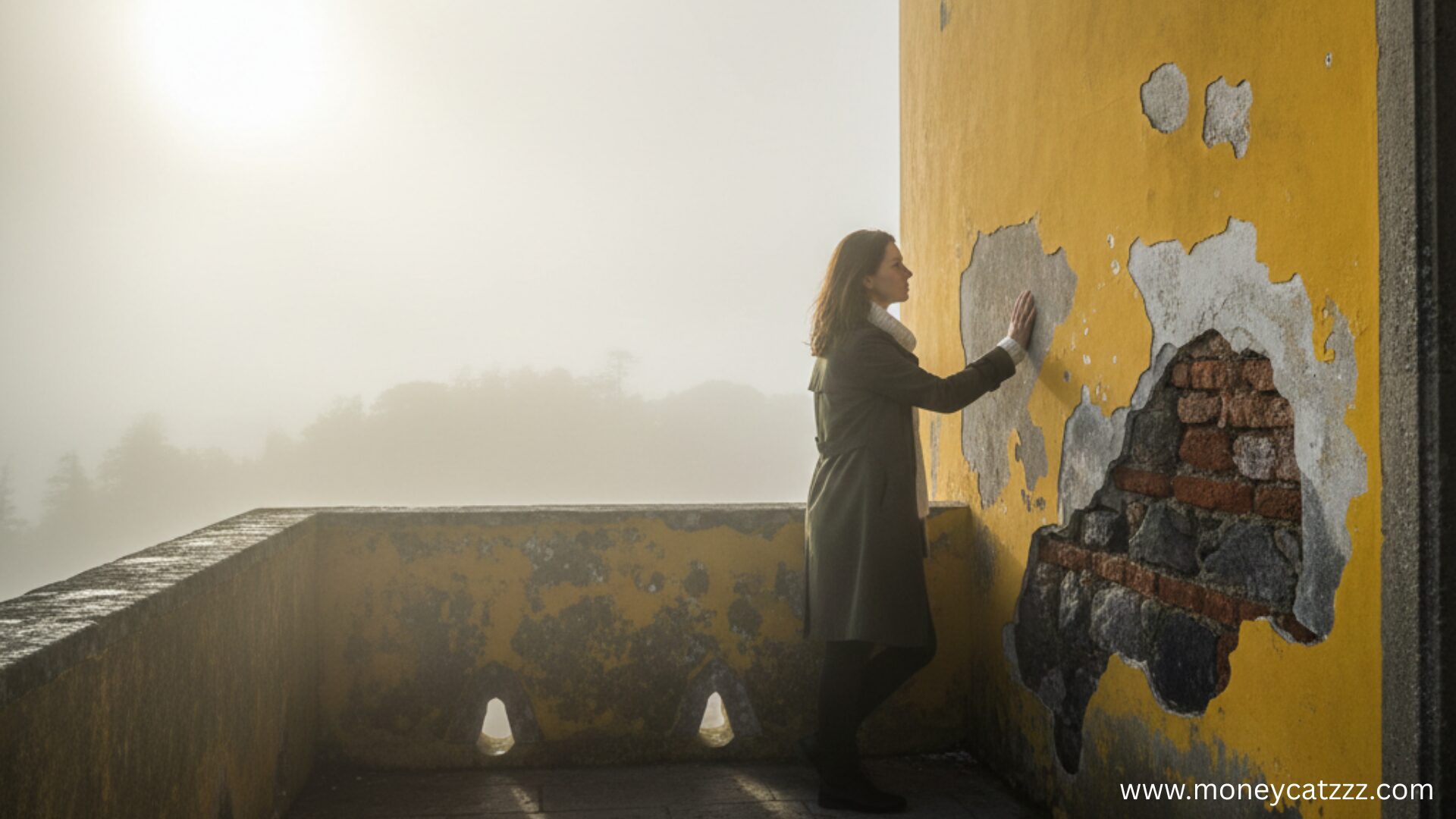
I leaned against a wall that was peeling like sunburned skin. My shoulder blade pressed into the rough plaster. It hurt. Good. The pain grounded me. For years, I’ve treated my anxiety like a renovation project. If I just meditate more, if I just fix my posture, if I just “heal,“ I will finally be a finished room. I’ve been trying to sand down my edges until I’m smooth enough to be a coffee table book.

[“Sintra, Portugal: The Story of the Incomplete State” – image courtesy of Klook]
But this wall… It’s crumbling. And yet, it’s holding up the entire west wing. It is an incomplete state that functions better than the most modern reinforced concrete. I closed my eyes and felt the humidity seep into my bones. It wasn’t oppressive; it was heavy, like a weighted blanket made of water.
I realized I’ve been running from weight my whole life. I want to be light. I want to be air. But air doesn’t hold shape. Air is nothing. I am heavy. I am incomplete. And maybe that’s the only reason I’m still standing. There is a specific kind of strength in the unfinished. It is the strength of a construction site that refuses to be cleared away.
Copper Pots and Black Grout
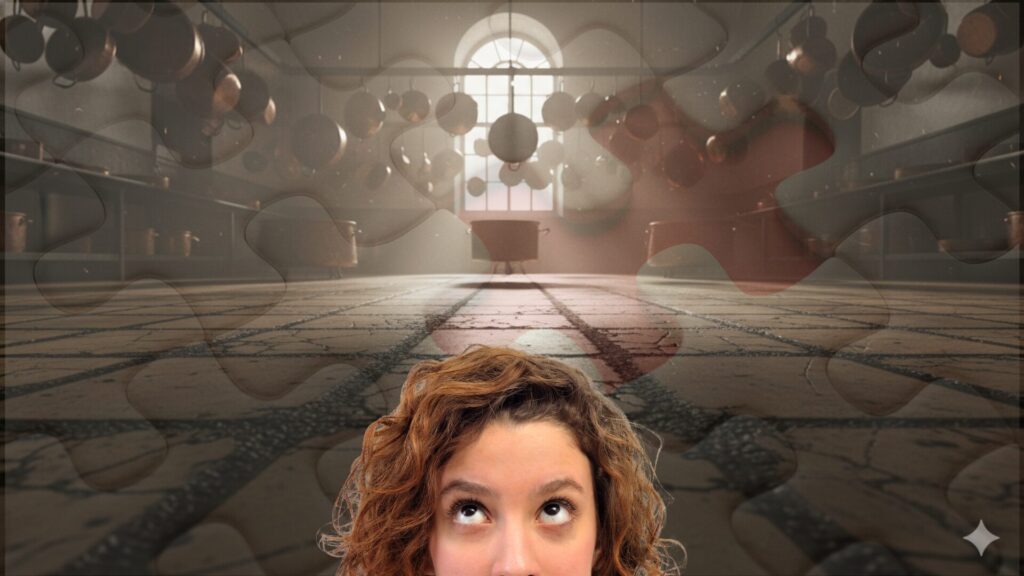
Forget the ballroom. The ballroom is a lie told in gold leaf for people who don’t want to see the plumbing. The real life of this palace lives in the kitchen. It is a cavernous space where huge copper pots hang from the ceiling like guillotines, and the air still tastes of woodsmoke and a century of trapped grease.
This is where the imperfection lives, not in the ballrooms, but here, where the floor tiles are chipped, and the grout is black with the dirt of a thousand meals. You can’t cook anything of substance in an IKEA showroom. You need the grease. You need the mess. The kitchen is the “heart of the house“ because it’s where you bleed.
The King who built this place didn’t care about the guests; he cared about the living. I sat there on a wooden stool, eating a queijada, a cheese tart so thick with sugar it felt like trying to swallow a lie. A peacock screamed at a cloud through the window, a raw, ugly sound that made more sense than the gold leaf upstairs. My “Global Soul” isn’t a marble floor. It is this mess. It is the grease, the smoke, and the jagged edges. I don’t need a finished room to be functional. I need to be here, holding up the roof in my own incomplete state.
The Shed vs. the Cathedral
“Ready“ is a myth. In engineering, nothing is ever “ready.” It’s just stable enough not to kill anyone. Perfectionism and self-worth are linked but inversely correlated. The more perfect you try to be, the less worth you feel because the gap between who you are and the ideal you becomes a canyon you can’t bridge.
Look at that archway. It’s lopsided. It is a masterpiece of imperfection. If the architect had waited for it to be perfect, it would still be a hole in the ground. He built it lopsided, and it worked. You need to be good enough. Not “great.“ Not “finished.“ Just good enough not to collapse on the people walking underneath you. Stop trying to be a cathedral. Be a shed. Sheds keep people dry. Cathedrals make people feel small.
I looked at the stucco peeling off the wall and thought about the high cost of being “precious.“ The second you try to make it perfect, the life drains out of the stone. This palace wasn’t built to be a masterpiece; it was built to be good enough to hold up the Atlantic sky. It’s holding. That is the only metric that matters. To accept being good enough is the most radical act of self-preservation available to us in a world that demands we be “finished.”

[“The Weight of the Spiral” – Image by moneycatzzz.com]
Flaking Angels and Spirals
Inside the chapel, the gold is so thick it feels like it is sucking the oxygen out of the room. It is a space designed to intimidate, to force a particular kind of holiness that feels more like a cage. I did not kneel to pray. I knelt because my knees hurt and I needed the world to stop spinning. I looked up at the ceiling and saw the angels. They are not perfect. They are flaking. Their wings are falling off in jagged, gray scales that drift down into the dust.
We are taught to pray for completion, to be a closed circle. But a circle is a dead end. Wholeness is a spiral. It is poetic and messy, overlapping itself; it returns to the same place, but higher up. The angels losing their wings is just gravity taking over. It is the cost of being real rather than put-together. It is a divine imperfection.
A seed is an incomplete state. It is only when it breaks open, violently, messily, that it becomes something else.
You don’t find your tribe by presenting a finished product; you see them when the facade cracks.
You see them in the rubble, looking for the same air.
The poetic truth of our existence is that we are never finished until we are dead. Until then, we are just flaking angels trying to find our footing on uneven floors.
The Happening
The sun broke through the fog, hitting the yellow walls and turning the damp stone into gold. The shadows were long, weird, and fractured. I pulled out my journal. The paper was wet. The ink smudged. I felt the weight of my own incomplete state and, for the first time, it didn’t feel like a burden.
I wrote:
I am not a ruin.
I am a construction site.
Ruins are history. I’m not history. I’m happening. I thought of the brutal logic of the audit: Be good enough. I thought of the biological cost: Feel the weight. I thought of the shadow in the corner.
We don’t need to be finished. We need to be here. Unresolved. Unpolished. In an incomplete state. And absolutely, breathtakingly enough.
The poetic irony of Sintra is that its most significant beauty lies in the parts they never finished. The same is true for me. The same is true for you. We are not failing at being complete; we are succeeding at being alive.
Forensic Resources: Navigating the Sintra Landscape
Parques de Sintra: The official portal for Pena Palace tickets and historical floor plans.
Visit Portugal – Sintra: A brief geographic overview of the cultural landscape and Atlantic climate data.
UNESCO World Heritage: Detailed architectural criteria for Sintra’s “Romanticism” designation.
Sintra Weather Portal: Real-time visibility and fog density reports for the high-altitude peaks.
Forensic Field Notes: Essential Reading for the Incomplete State
The Poetics of Space

The Gifts of Imperfection
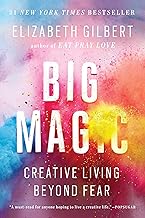
Big Magic
Disclosure: This post may contain affiliate links. We only recommend products we believe in, and we may receive a commission at no cost to you! Thank you for your support!
Acknowledgment: Cover Image by moneycatzzz.com
Disclaimer: The information is provided for general information only – moneycatzzz.com makes no representations or warranties in relation to the information, including but not limited to any representation or warranty as to the fitness for any particular purpose of the information to the fullest extent permitted by law. While every effort has been made to ensure that the information provided in this article is accurate, reliable, and complete as of the time of writing, the information provided in this article should not be relied upon to make any financial, investment, real estate or legal decisions. Additionally, the information should not substitute advice from a trained professional who can take into account your personal facts and circumstances, and we accept no liability if you use the information to form decisions.