 Reading Time: 8 mins #
 This post may contain affiliate links.
I took a two‑week stint in Verona on my way to Venice. I needed money, they needed a stagehand, and I had always wanted to see the Arena from the inside. That is how I live; a few weeks here, a few weeks there. Never the whole run. This kind of invisible work: arriving, fixing, leaving – follows me everywhere. Most of it goes unthanked, but that is not why I do it.
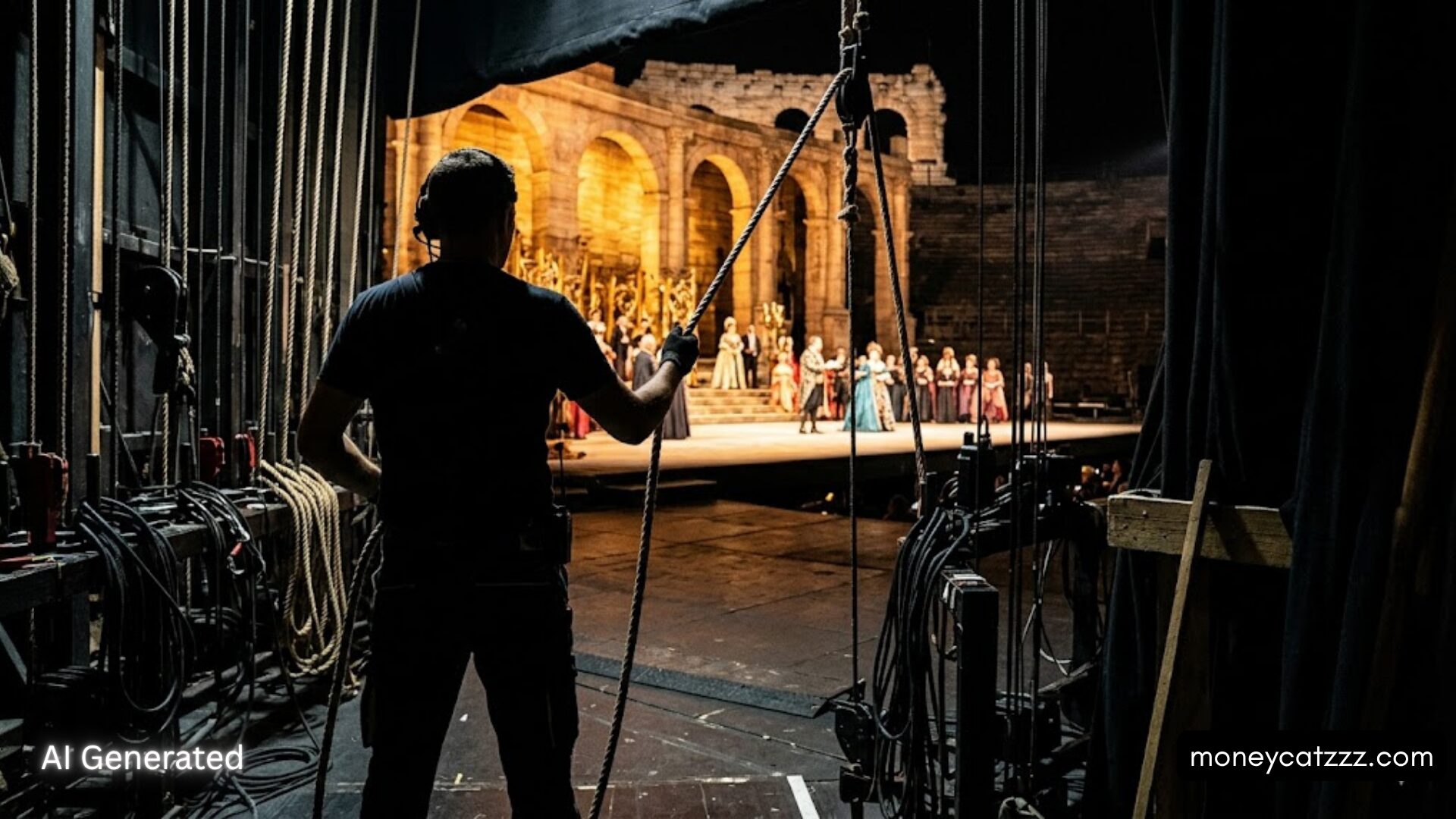
The Arena di Verona is old, from after 30 AD, older than anything I had ever touched. Gladiators fought there. Now Juliet dies there, once a night, for thirty nights. I worked backstage. The Arena breathes in silence before the show, and I breathe with it. The production manager handed me a black shirt. “Stay in the dark,” he said. “Don’t let the audience see you.” I thought he was being dramatic. Alas, he was not.
The First Nights
On the first night, I pulled the wrong rigging lines. The curtain dragged, and the audience saw a table being shoved into place. The actor froze. The director’s voice crackled in my headset, not loud, just tired.
The second night, I pulled it right. No one noticed. The show went on. The audience applauded. I stood in the dark, tied the lines, and felt nothing special. The audience saw a perfect illusion; my part was unseen.
A few nights later, I almost dropped a mirrored ball. The thing was supposed to catch the light when Juliet opened her eyes. My hand slipped, and the ball swung to the side, missing Juliet by inches. She did not flinch. The audience saw nothing. My heart punched my ribs for ten minutes. The labor of holding the rope, the ball, the silence – it added up.

No one said a word to me afterward. The production manager walked past. The actress smiled at someone else.
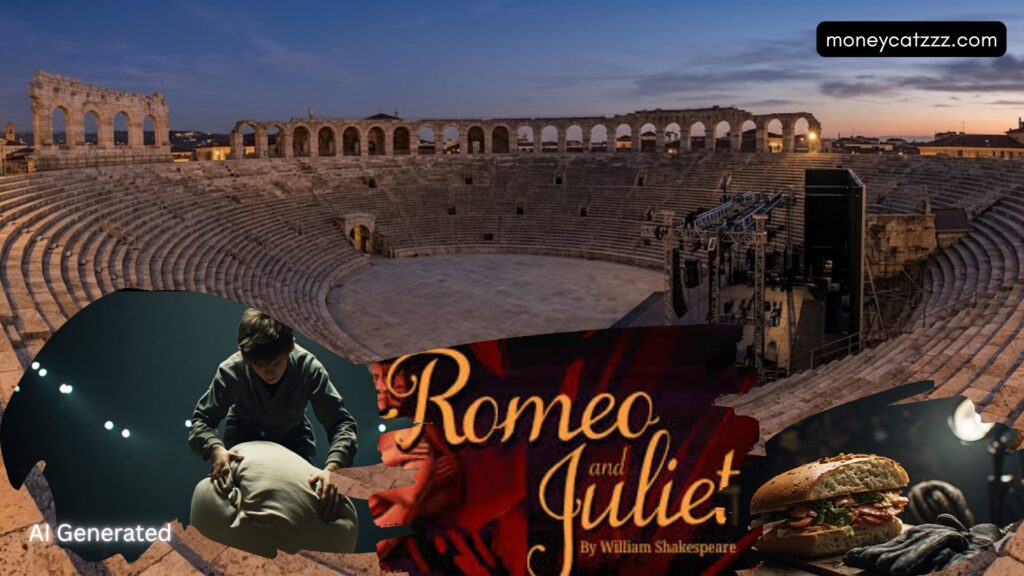
That night, I ate a cold panino on a crate backstage and thought about the unthanked effort. I had not known I was working for it. But there it was. And I would be gone before anyone learned my name.
[Life is a Stage | moneycatzzz.com]
The Wind Through the Roman Arch
The Arena in July is a furnace. The stone holds heat like a grudge. By the third week, the cast was sweating through their leather jackets. The orchestra was short‑tempered. The stagehands rationed water. I joined 10 days after the opening and would leave before the final performance.
One night, a breeze came through a gap in the Roman wall, a strong gust, cool and sudden. The director hated it because it messed with the microphones. The stagehands loved it because we were dying.
During the balcony scene, the wind picked up. Juliet’s hair blew across her face. She brushed it away without breaking character. The audience sighed. They thought the director had planned it. They never knew the invisible work of the stagehands who adjusted the lights to follow the wind. A silence fell while we worked; then the play continued.
Enzo
In the north wing, a stagehand named Enzo looked up. A lighting truss was swaying – not much, just enough. He grabbed a rope, tied it to a cleat, and held the truss steady. He did not pause to consider why; the truss was his responsibility, and it would not fall on his watch.
The scene continued. Romeo climbed the scaffolding. The truss did not fall. Enzo’s catch was urgent, invisible work. The audience stayed in the dark, unaware. The stagehands stayed in the wings, unseen. His labor was local, known, and staying for the whole run.
After the show, the production manager bought Enzo a beer. No one else said anything. Enzo drank the beer and went home on his scooter. The next night, he did it again.
I watched him. I will be gone in a week. No one would remember me. That is the unthanked life of a traveler: here, then gone. His labor was local; mine was transient.
The Trapdoor
Dress rehearsals are when everything breaks. Ours was cursed. I was told that the lead actor sprained his ankle during the first fight. The fake blood machine exploded, covering the Friar in red, and the trapdoor that Juliet uses for her death scene jammed shut.
I was on duty for the trapdoor. My job was to release the latch at exactly the right moment. Simple. But the latch had rusted after three days of production.
The actress was already on stage, pretending to drink poison. I yanked the latch. Nothing. I yanked again. Again nothing. She looked at the trapdoor, then at me. A few VIP guests, just the director, the producers, and some nine thousand paid audiences, watched Juliet die.
I hit the latch with an almighty punch. My knuckles hurt, and the trapdoor opened. Juliet sank into the dark. The lights came up. The audience applauded. The director complimented the actress on her timing. She smiled. She did not mention me. My inflamed fist, unseen, stayed in the shadows where invisible work lives. The silence after the applause was the loudest thing I heard all night.
I sat on a crate backstage and ate another cold panino that tasted like chalk. I went to my “pensione“ at two in the morning and slept for four hours. I woke up and repeated yesterday’s routine. In a week, I would leave. The trapdoor would rust again, and someone else would punch it open.
Mercutio’s Sandbag
There is a moment in Romeo and Juliet when Mercutio dies. The actor who played him was the funniest person in the cast. When he fell, you could hear the air leave the Arena.
I was in the wings during his death scene. The sword fight was choreographed within an inch of its life. Every thrust, every parry was timed to the music. The stagehands had marked the floor with tape so the actors would not trip on cables.
Mercutio fell. The lights shifted to blue. The audience, unaware that in the dark, a stagehand dragged a heavy sandbag offstage, in readiness for the next scene. The stagehand was young, maybe nineteen. He did not complain. He just dragged. No one saw him. That drag – that was invisible work in its purest form. He was unseen with pure physical labor that leaves no trace except a cleared stage. The audience grasped for Mercutio; the silence for the stagehand was total.
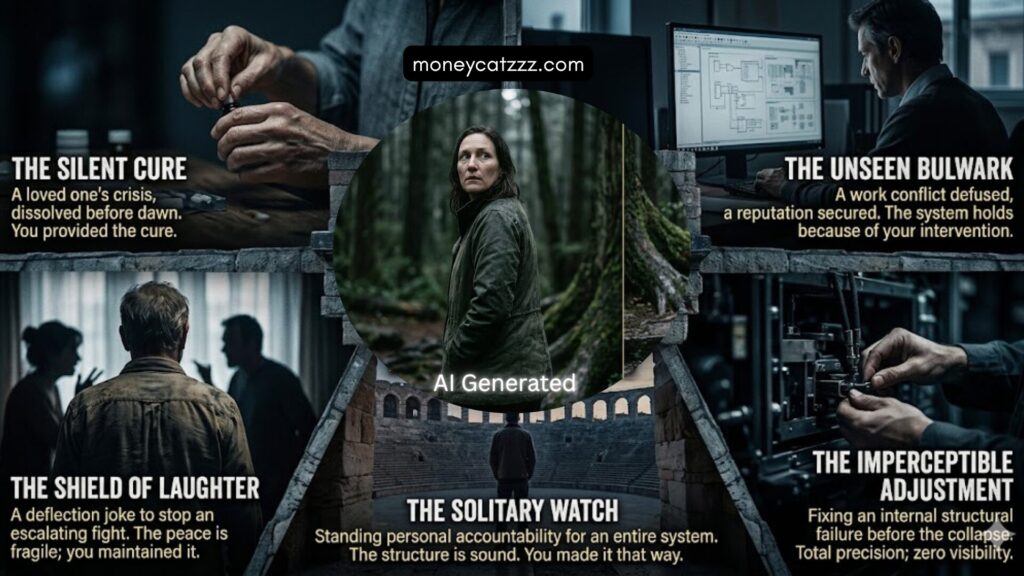
All those sandbags I had dragged without anyone noticing: a friend’s crisis on the phone, a family argument deflected with a stupid joke, a work problem fixed before my boss saw it. Then I left. Always left. No one thanked me, because I was never there to be thanked. That was fine. But I started to wonder what would happen if I turned around and watched myself once in a while.
[The Unthanked Ledger | moneycatzzz.com]
The Final Bow
After the final performance, the stagehands come out for a bow. The audience never sees us during the show. But on closing night, the lights come up, and we walk onto the stage, and the audience applauds.
Perhaps it’s just me, but I have never liked that tradition. The applause feels hollow. They are clapping for an idea, not for me. Unthanked again, by design. My exit was unseen, like my work. The labor of returning every night, even knowing no one would remember, was the real thing. Regardless, I would not be there for the final bow. I would be on a train to somewhere else.

But I stood on that stage for the performances I worked. The Arena was full. Ten thousand people. I smiled and bowed. Then I walked off.
Someone had told the production manager that I would be leaving in two days. He came backstage to shake my hand. ‘Good season,’ he said. ‘Same time next year?’ I grinned without replying to him.
At The End Of It All
The Arena has stood for two thousand years. The emperors are dust. The gladiators are bones. What held it together was not the famous names but the unremembered hands that replaced one stone, then another, then another. Juliet’s House is a short walk from here, eight minutes if you hurry, and you can still leave a lock on the gate as if love needs a padlock to last.
I have stopped trying to build amphitheaters. Instead, I keep a small ritual. Before sleep, I write down one thing I did that day which no one noticed: a conversation steered away from a cliff, a typo erased before anyone saw it, a glass caught mid‑fall. I do not do this for applause. I do it because proof matters when no one else is watching.
Last week, I caught a glass before it hit the floor. My friend said, “Good reflexes.” I said, “Thanks. I practice.” She laughed. She thought I was joking. I was not.
______________________


Disclosure: This post may contain affiliate links. We only recommend products we believe in, and we may receive a commission at no cost to you! Thank you for your support!
Acknowledgment: Cover Image by moneycatzzz.com
Disclaimer: The information is provided for general information only – moneycatzzz.com makes no representations or warranties in relation to the information, including but not limited to any representation or warranty as to the fitness for any particular purpose of the information to the fullest extent permitted by law. While every effort has been made to ensure that the information provided in this article is accurate, reliable, and complete as of the time of writing, the information provided in this article should not be relied upon to make any financial, investment, real estate or legal decisions. Additionally, the information should not substitute advice from a trained professional who can take into account your personal facts and circumstances, and we accept no liability if you use the information to form decisions.