
 Reading Time: 8 mins #
 This post may contain affiliate links.
Part of the Jack in the Systematic Box series.
The hardest decision in operational strategy is not abandoning a failed initiative; it is scuttling a working system.
Successful projects often become floating operational hazards that drain bandwidth and stall growth. To protect your core velocity, you must develop the structural courage to scuttle and mothball legacy workflows before their hidden operational debt drags down your entire organization.
The Internal Fleet Briefing: When “Working Systems” Become Hazards
The glass-walled conference room was quiet except for the low hum of the ceiling projector. It was Monday morning, 08:30 AM. On paper, the quarter looked flawless.
Julian, Head of Client Accounts, leaned back in his leather chair with an expectant smile as the financial dashboard rendered across the glass wall. “Project Triton generated thirty thousand dollars in recurring revenue again this month,” he noted, tapping his stylus against his tablet. “Three hundred and sixty thousand a year on auto-pay. 98% uptime, comfortable client relationships, zero client complaints. It is the definition of a clean, predictable cash cow.”
Across the table, Priya, Lead Infrastructure Engineer, didn’t share his satisfaction. She rubbed her eyes, pulling up the internal engineering telemetry on her secondary screen.
Margaret, Chief Systems Architect, stood at the head of the room. “It isn’t a cash cow, Julian,” Margaret said, her voice quiet, forensic, and unyielding. “It’s a gold-plated anchor. It looks brilliant on your ledger, but its structural weight is holding our entire fleet in harbor.”
“Project Triton is a ghost ship,” Margaret said, her voice quiet, forensic, and unyielding. “And as of Q3, we are executing a complete scuttle on it.”
Julian sat up straight, his smile vanishing. “Excuse me? Triton brings in thirty grand a month on auto-pay! The invoices are clear on the first of every month! You don’t scuttle a working system!“
“It floats, Julian,” Margaret replied, leaning her palms against the conference table. “Floating is not the same as serving our trajectory. Priya, walk us through the internal telemetry.”
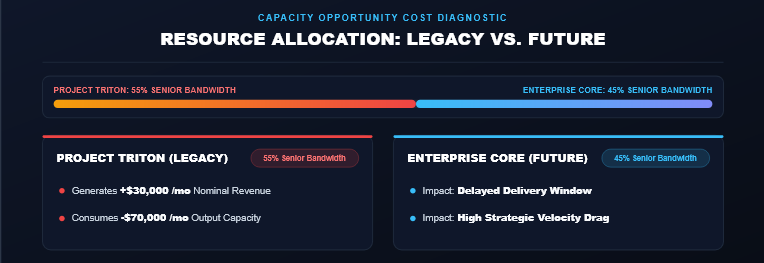
Priya tapped her display, casting a complex network graph onto the screen. “Triton runs on a custom, five-year-old monolithic architecture. Because we decommissioned that tech stack everywhere else three years ago, keeping Triton alive requires bespoke hand-coding for every single patch. Every database update requires manual database surgery. Because the original core libraries are deprecated, maintaining this ‘comfortable’ workflow consumes fifty-five percent of my senior engineering team’s weekly bandwidth. We are accumulating massive operational debt to keep the lights on for an account that hasn’t expanded its contract since 2023.“
Julian turned to Priya, exasperated. “Then hire a third-party contractor to maintain the legacy code! You don’t sink a boat that catches you fish.“

[MindValley Promo | Rewire your mind, transform life. | Nir Eyal]
The Precedents: 37signals, Adobe, and Systems Architecture
“You do if that ship is holding back the entire fleet,” Margaret countered directly. “Julian, Highrise was generating millions of dollars in annual recurring revenue when 37signals mothballed it. Campfire was profitable. Jason Fried and DHH didn’t put those product lines into maintenance mode because they were failing—they mothballed them because running four parallel platforms was stopping their engineering team from focusing 100% of their energy on Basecamp. Triton isn’t failing. It’s just a successful asset from three years ago that has become a structural anchor.“
Julian shook his head, shifting his defense. “Our oldest client stakeholders will panic if we alter this delivery framework. We’re going to disrupt workflows they’ve relied on for half a decade.”
“Fifty thousand users signed petitions when Adobe scuttled boxed software in 2013,” Margaret said smoothly. “Adobe didn’t eliminate perpetual licenses because customers stopped buying them—boxed software was their primary cash engine. They executed a clean scuttle of perpetual licenses because maintaining two-year monolithic release cycles was an operational anchor that dragged down their entire cloud architecture. They accepted short-term client friction to unlock a tenfold increase in strategic velocity. Speed is gained by carrying less, Julian.“
She clicked her pointer, displaying a passage on the main screen.
“System theorist Donella Meadows taught us in Thinking in Systems that the highest leverage point in any organization isn’t fixing individual parts; it’s redesigning the structural relationships between systems. Triton isn’t a broken part. It is a misaligned relationship. We are spending fifty-five percent of our highest-value engineering capacity optimizing a stagnant subsystem at the direct expense of our new enterprise platform launch.”
[The Resource Allocation Map | moneycatzzz.com]
The Sunk Cost Trap: Why High-Performers Protect Yesterday’s Wins
The High-Performer Paradox
In the landscape of forensic operational strategy, weak operators fail because they refuse to cut ties with broken, unprofitable projects. Master operators face a far more dangerous and subtle trap: they remain stuck, holding on to successful projects out of misplaced gratitude.
Overcoming the sunk cost fallacy is hardest when a system actually works. When a workflow, product line, or client relationship generates positive cash flow, executives treat it as immune to critique. They confuse historical profitability with present strategic alignment.
A ghost ship is not a failed venture; it is a successful asset that has outlived its utility. It still possesses a hull, a deck, and rigging. It still generates monthly invoices. But it no longer carries a strategic mission. By maintaining aging legacy systems simply because they “still work,” high-performing teams quietly trap themselves in yesterday’s output, sacrificing the velocity required for tomorrow’s growth.
As philosopher Byung-Chul Han highlights in his analysis of performance culture, organizations often suffer not from a lack of action, but from the inability to cease; a compulsive continuation that converts former achievements into self-imposed inertia.
The executive decision to scuttle a floating asset requires shifting your primary evaluation metric from absolute revenue to opportunity capacity. Every senior engineering hour spent performing manual patches on a legacy system is an hour stolen from future architectural leverage.
The Interactive Scuttle Protocol Simulator
The Scuttle Protocol Simulator
The $30k Revenue vs. $70k Drag Disparity
Traditional balance sheets are notoriously ill-equipped to measure operational debt, the compound interest paid in human fatigue and lost innovation by maintaining an organization’s past.
When Julian evaluates Project Triton, he sees a clean $30,000 monthly line item. But when Margaret and Priya run the forensic diagnostic, the true economic reality looks drastically different:
- Nominal Cash Inflow: $30,000 / month ($360,000 / year).
- Senior Engineering Draw: 55% of the three principal infrastructure engineers.
- Equivalent Payroll & Opportunity Cost: $70,000 / month in consumed talent output.
- Net Monthly Drag: -$40,000 in real economic value.
The Interactive Triton Disparity Simulator
The $30k Revenue vs. $70k Drag
The friction isn’t theoretical. Every time a security vulnerability is identified in the deprecated database layer, Priya’s team must pause active sprint development on the enterprise platform to execute emergency manual database surgery.
In Deep Work, Cal Newport emphasizes that the cognitive cost of context switching severely impairs high-value output; here, switching between ancient codebases and modern legacy systems destroys two full workdays of deep focus per engineer each week.
Furthermore, Bessel van der Kolk details that physical systems bear the cumulative strain of chronic stress. In an engineering organization, this somatic toll manifests as team burnout, turnover, and acute alarm fatigue caused by defending crumbling infrastructure.
The true cost of maintaining aging legacy systems is never the line-item expense. It is the exhaustion and stagnation of the senior team tasked with keeping a zombie system alive.
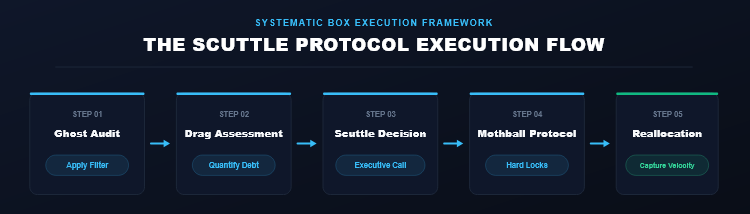
The Scuttle Protocol: A 5-Step Decommissioning Framework
Decommissioning requires a repeatable, surgical procedure that prevents organizational panic while reclaiming critical capacity.
Step 1: The Ghost Audit
Identify every workflow, client contract, service package, or product line that operates on pure inertia. Apply Margaret’s diagnostic filter across your entire operational portfolio:
“If this system did not exist today, would we spend capital and senior engineering bandwidth to build it from scratch?”
If the answer is no, the asset is immediately categorized as candidate code for the scuttle protocol. Evaluating aging legacy systems through this single question strips away historical nostalgia, eliminates sunk-cost paralysis, and forces leadership to confront their present utility.
Step 2: The Drag Assessment
Measure the total operational debt created by the target asset. You must look far beyond direct financial line items to quantify:
- Senior engineering hours spent on custom patches, hand-coded overrides, and bug fixes.
- The cognitive friction of context-switching between modern stacks and legacy codebases.
- Customer support bandwidth is dedicated to maintaining obsolete features.
- The strategic opportunity cost of delayed core initiatives.
Step 3: The Scuttle Decision
Executing a surgical scuttle requires clear, unapologetic leadership. Frame the decision to internal teams and external stakeholders not as a failure or abandonment, but as a deliberate reallocation of finite talent toward higher-value solutions.
Establish strict, non-negotiable end-of-life timelines. Communicate sunset dates with radical transparency, giving clients clear migration pathways while holding the line on resource reallocation.
[The Scuttle Protocol Execution Flow | moneycatzzz.com]
Step 4: The Mothball Protocol
For systems requiring data retention, legal compliance, or read-only access, implement strict mothball status with Hard Boundary Locks:
- Terminate all ongoing feature development and custom client requests permanently.
- Freeze all code repositories and restrict deployment access.
- Transition active users to self-serve, static, or maintenance-mode environments.
- Lock the infrastructure to prevent “zombie code” from drifting back into active production.
To mothball a working platform means placing it into low-overhead suspension, ensuring it consumes zero proactive engineering hours.
Step 5: Strategic Reallocation
The operational capacity liberated by decommissioning a legacy asset must be captured and redirected immediately. When you execute a clean scuttle on a legacy workflow, instantly reassign those engineering hours, budget lines, and executive review cycles to your primary strategic vector.
If reclaimed senior bandwidth is not aggressively assigned to core growth drivers, lower-value operational clutter will naturally expand to fill the vacuum.

[MindValley Promo | Rewire your mind, transform life. | Vishen Lakhiani]
Reclaiming the Fleet: Strategic Clarity Paid in Scuttled Hulls
The conference room was quiet as Margaret finished displaying the migration timeline on the glass wall.
Julian looked at the burn-down chart, then back at Priya’s engineering metrics. The initial defensiveness had left his posture, replaced by the clear, sober math of capacity allocation.
“If we sunset Triton over the next sixty days under the mothball protocol… how fast can we deploy the enterprise core?” Julian asked softly.
“We recover fifty-five percent of my senior team’s time overnight,” Priya replied. “We hit our enterprise launch deadline three weeks early, and we eliminated eighty percent of our weekend emergency calls.“
Julian nodded slowly, closing his tablet folder. “I’ll draft the transition notice for the client account team by two o’clock.”
The relief in executive strategy does not come from endlessly repairing aging infrastructure or patching legacy codebases. It comes from having the structural courage to free your highest-performing people from systems that no longer serve where the organization is going. Liberating your team’s capacity from sunk cost attachments is the fundamental price of organizational speed.
Your competitive advantage is directly proportional to your willingness to scuttle yesterday’s success to clear deck space for tomorrow’s fleet.
__________________________________________________
Jack in the Systematic Box: An editorial series and strategic framework exploring the friction between human agency and rigid structural constraints. The series addresses what happens when high-performing leaders, operators, and strategists find their focus and velocity locked inside bloated operational architecture.
Beyond Sunk Cost: The Courage to Mothball Working Systems and Kill Operational Drag

The Burnout Society


Thinking in Systems
Deep Work



Disclosure: This post may contain affiliate links. We only recommend products we believe in, and we may receive a commission at no cost to you! Thank you for your support!
Acknowledgment: Cover Image by moneycatzzz.com
Disclaimer: The information is provided for general information only – moneycatzzz.com makes no representations or warranties in relation to the information, including but not limited to any representation or warranty as to the fitness for any particular purpose of the information to the fullest extent permitted by law. While every effort has been made to ensure that the information provided in this article is accurate, reliable, and complete as of the time of writing, the information provided in this article should not be relied upon to make any financial, investment, real estate or legal decisions. Additionally, the information should not substitute advice from a trained professional who can take into account your personal facts and circumstances, and we accept no liability if you use the information to form decisions.