
 Reading Time: 8 mins #
 This post may contain affiliate links.
Part of the Jack in the Systematic Box series.
“It is not impermanence that makes us suffer. What makes us suffer is wanting things to be permanent, when they are not.” — Thich Nhat Hanh.
November 2021. Silicon Alley conference room on the sixteenth floor. The client sat across from me, a forty-one-year-old CEO named Daniel Reeves, founder of a Series C logistics platform.
His company had just lost its anchor partnership with Target. Eighteen-month contract. $4.7 million annual revenue. Gone in a three-paragraph email that arrived at 9:14 AM on a Tuesday.
Daniel wasn’t just distraughted. He was doing something worse. He was narrating his own autopsy while still breathing.
“This proves I never had what it takes,” he said, staring at the polished oak table. “Three years of building this partnership. Gone. I’m finished.”
I sat there, held a deep breath for 5 seconds, and didn’t offer comfort. I offered a clinical observation.
“The contract ended,” I said. “That’s a fact. The story you’re telling about the contract, that you’re finished, that you never had what it takes, is a construction. One is data. The other is attachment.”
Daniel looked up. His eyes were red-rimmed but sharp.
“What’s the difference?” he asked.
“The difference,” I said, “is that impermanence is the condition. Attachment to it is the error; the contract was never permanent. Neither is the loss. You’re treating a temporary state as a permanent verdict.“
He blinked. The autopsy stopped, temporarily.

[MindValley Promo | Rewire your mind, transform life. | Vishen Lakhiani]
Gains and losses are not permanent states. They are data points in a dynamic system. The pulse rises. The pulse falls. The body responds. The body stabilizes.
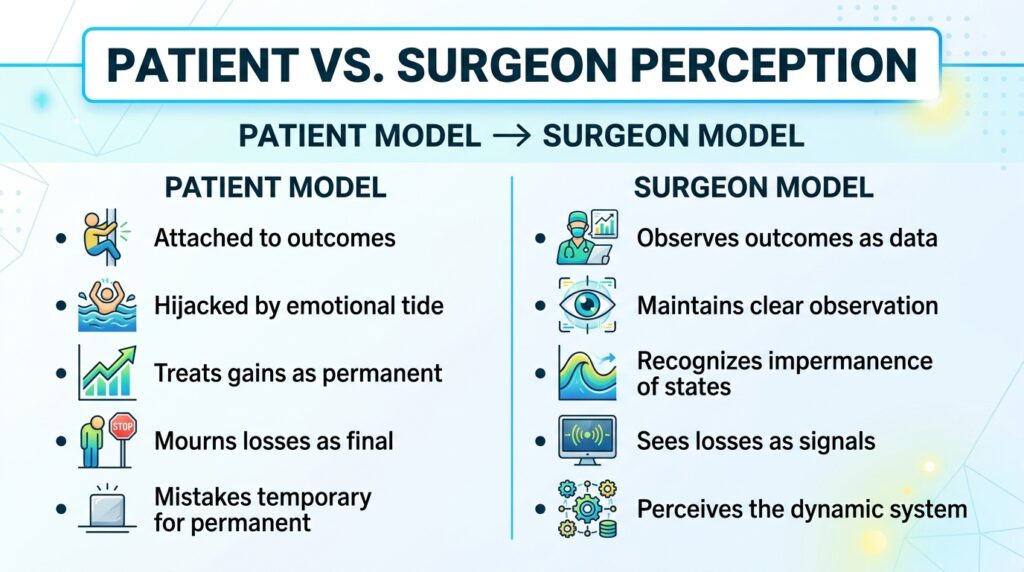
You are seeing yourself as the patient. You are not, you are the surgeon.
The operating table is not a place of comfort. It is a place of precision. The patient is alive, then under anesthesia, then recovering, then discharged. Each stage is temporary. The surgeon does not attach to any single moment. The surgeon observes, intervenes, and adjusts.
Why You Mistake Temporary for Permanent
The perceptual error is simple. You mistake a blip for a trend.
Daniel had been operating under a flawed assumption: the Target partnership was the foundation of his business. When the foundation disappeared, he concluded the entire structure had collapsed.
It hadn’t. Revenue from Target represented 31% of total annual income. The other 69% was still intact, but Daniel wasn’t looking at the bigger picture. He was responding to the narrative he’d constructed around the data.
The past is gone. The future isn’t here. As Eckhart Tolle writes about this in The Power of Now, the only observation point is the present. Daniel was mourning a contract that was already dead. He couldn’t change the past. He could only observe what was true now.
Acknowledging the truth is important: the contract ended. It was also true that the company still had 12 active partnerships generating $10.4 million in annual recurring revenue.
Two Clients, One Signal: The Mechanics of Attachment
I’ve watched this pattern repeat across industries. Two clients, same type of loss. Different outcomes.
Client A: June 2019. Lost a $680K consulting retainer with a pharmaceutical client. Spiraled for eight months. Blamed himself. Stopped prospecting. Revenue dropped 52% by year-end.
Client B: January 2020. Lost a $1.2M contract with a municipal transit authority. Recalibrated in eleven days. Adjusted pricing strategy. Landed two new contracts totaling $1.8M within four months.
The difference wasn’t skill. It wasn’t luck. It was perception:
Client A attached to the story: “I lost the contract because I’m not good enough.”
Client B observed the data: “The contract ended. The system will adjust.”
Research on attachment and loss from the American Psychological Association shows that people who attach to outcomes experience higher rates of anxiety and depression following setbacks. The attachment is the problem, not the loss.
[The Patient Vs Surgeon Perception Model | moneycatzzz.com]
The Signal vs. The Story: Separating Data from Narrative
Every gain or loss contains two distinct elements: the signal and the story.
The signal is the data. The story is the narrative you construct around the data.
Daniel’s signal: “Target ended the contract.”
Daniel’s story: “I’m not good enough. I never was. This proves it.”
I asked him, “Which one are you responding to?”
He paused. “The second one.”
“That’s the problem,” I said. “The signal is data. The story is attached. You’re responding to the attachment, not the data.”
This is how to stop being attached to outcomes. You separate the event from the interpretation.
The event: revenue decreased by $4.7 million annually.
The interpretation: “I’m finished.”
The Diagnostic Protocol: Isolating Signal from Story
The operational environment is rigid; the immediate human reaction is internal. It is the classic trap of Jack in the Systematic Box: one requires a forensic redesign of the box. The other requires nothing.
In The Art of Possibility, Rosamund and Benjamin Zander articulated that shifting your perception alters the distance between you and your outcomes. When trapped inside Jack in the Systematic Box, the contract was never the core problem; the internal narrative was.
To break through this structural inertia, I gave Daniel a forensic diagnostic exercise.
“Write down the signal,” I said. “Just the data. No adjectives. No conclusions.“
He wrote: “Target contract ended. Annual revenue impact: $4.7M. Remaining partnerships: twelve. Remaining annual revenue: $10.4M.“
“Now write the story you’ve been telling,” I said.
He wrote: “I’m not good enough. I never was. This proves I can’t build lasting partnerships. The business is collapsing.”
“Look at those two lists,” I said. “Which one is real?”
He stared at the paper for forty-three seconds.
“The first one,” he said quietly.
“Correct,” I said. “The second one is attachment. The first one is the signal.”
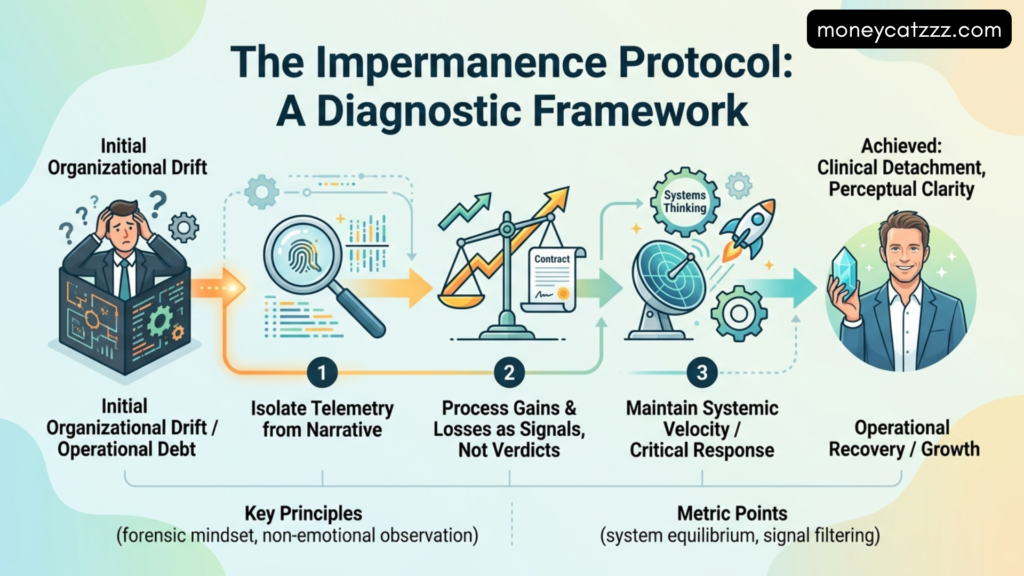
The Impermanence Protocol: A Diagnostic Framework
Clients do not benefit from comfort. They thrive by adopting a solid framework.
Daniel needed a mechanism to separate signal from story in real time. I walked him through three diagnostic checks.
Check One: The Signal Audit
Strip the emotion from the data. “I’m a failure” is not permissible. “The contract ended.”
Daniel practiced this daily for two weeks. Every time he felt the narrative creeping in (“This means I’m not good enough“), he wrote down the actual signal: “One partnership ended. Twelve remain.”
Check Two: The Attachment Scan
Ask: What am I attaching to? The outcome itself? Or the story I am telling about the outcome?
Daniel was attached to the story. The story was: “Losing this contract means I’m fundamentally inadequate as a leader.“
One is a verdict. The other is a data point.
Check Three: The Equilibrium Reset
The system will return to balance. That’s the nature of dynamic systems, as Nassim Nicholas Taleb describes in Antifragile. Gains and losses aren’t random. They’re signals. Impermanence is the condition that makes antifragility possible. You can’t gain from disorder if you’re attached to a single outcome.
I told Daniel, “The relief isn’t in preventing every setback. It is in knowing that system stability is always recoverable.”
[The Impermanence Protocol | moneycatzzz.com]
Research on clinical detachment shows that leaders who observe metrics without emotional reactivity make faster, more accurate strategic adjustments after a loss.
Detachment isn’t coldness; it’s operational clarity.
Daniel implemented a daily observation practice. Five minutes each morning. He wrote down one gain or one loss from the previous day. No story. No interpretation. Just the data.
Example entries from his journal:
-
- “November 18: Lost follow-up call with logistics client in Detroit. No stated reason.”
- “November 22: Signed $340K contract with e-commerce fulfillment company in Austin.”
- “November 29: Existing client reduced monthly retainer from $18K to $12K.”
No adjectives. No conclusions. Just signals. Pure data.
What Happens When You Observe Without Attaching
December 2021. Six weeks after the Target contract ended, Daniel signed two new partnerships. Combined annual value: $6.1M. Higher margin, lower operational complexity.
He did not celebrate. He observed.
“Two new contracts,” he noted. “Revenue impact: $6.1M annually. System returned to equilibrium in forty-four days.“
No story. Just data.
System Equilibrium and the Cost of Attachment
I faced my own reset in March 2018, losing my largest strategic advisory client ($290K annual value) via a seven-line email on a Friday evening.
Instead of spiraling into a narrative, I focused on the signal. Three new contracts began the following quarter. The system returned to equilibrium in 79 days.
Client A attached to his loss and spiraled for eight months. I observed the data, made the adjustment, and kept velocity. That is the difference.
Observing gains and losses without emotion is not about suppressing feelings. It is about tracking the underlying signal beneath them.

[MindValley Promo | Rewire your mind, transform life. | Nir Eyal]
The Operator at the Console
The Target contract is still gone. Daniel didn’t fix that. He didn’t bring it back.
Daniel’s company now generates higher revenue than before the loss. Yet the financial recovery is merely a byproduct of a deeper shift.
The true breakthrough was perceptual, recognizing that neither gain nor loss represents a permanent state.
You are not the patient. You are the surgeon.
The pulse rises. The pulse falls. The body stabilizes.
You cannot control the outcome. Your job is to observe, intervene, and adjust. Do not attach to a single moment.
Daniel still executes the signal filter, isolating telemetry from narrative. Recalibration is not a one-time resolution; it is an ongoing operational discipline. Friction recurs. Attachment attempts to re-establish itself. The market cycle remains continuous, bringing gains and losses in equal measure. The objective is not to halt the cycle, but to maintain operational velocity through it.
The relief isn’t in controlling the outcome. The relief is in perceiving clearly.
The operating table remains in place. The patient continues to breathe. The surgeon never looks away.
The question is whether you’re the patient or the surgeon.
_______________________________________________
Jack in the Systematic Box: An editorial series and strategic framework exploring the friction between human agency and rigid structural constraints. The series addresses what happens when high-performing leaders, operators, and strategists find their focus and velocity locked inside bloated operational architecture.
Clinical Detachment in Leadership: A Framework for Processing Gains and Losses

Antifragile


The Power Of Now

The Art of Possibility



Disclosure: This post may contain affiliate links. We only recommend products we believe in, and we may receive a commission at no cost to you! Thank you for your support!
Acknowledgment: Cover Image by moneycatzzz.com
Disclaimer: The information is provided for general information only – moneycatzzz.com makes no representations or warranties in relation to the information, including but not limited to any representation or warranty as to the fitness for any particular purpose of the information to the fullest extent permitted by law. While every effort has been made to ensure that the information provided in this article is accurate, reliable, and complete as of the time of writing, the information provided in this article should not be relied upon to make any financial, investment, real estate or legal decisions. Additionally, the information should not substitute advice from a trained professional who can take into account your personal facts and circumstances, and we accept no liability if you use the information to form decisions.