
Reading Time: 8 mins #
This post may contain affiliate links.

The conversation was ordinary. A colleague asked a simple question, and my chest tightened before I could form a response.
Â
That tightening has been a squatter in my nervous system for decades. The pattern wasn’t born in the room with my colleague; it was just triggered there. It was running on old, frayed wiring; a defensive loop firing off before I even had the chance to think.
Â
That friction, that split-second space between the trigger and the response? That is where the borrowed cringe lives. You inherited them. In truth, you won’t see how these past patterns shape your present until you stop building excuses for your reactions and start dragging them back into the light to see what they’re actually made of.
The Automatic Response
The first thing to understand about an inherited pattern: it does not ask for permission. It executes. The body triggers; the chest tightens, the throat closes, and only then does the mind arrive to construct a narrative justifying the response. The mind is not the pilot; it is merely the spin doctor, working overtime to convince you that the tightening was a choice rather than a reflex.
Â
I spent years building those stories. Each one was technically plausible and completely beside the point:
- The colleague had been dismissive before.
- The question carried an edge.
- The timing was bad.
The reaction was never about the colleague. It was about the script running beneath the interaction, an invisible current I had moved through for years without once stopping to examine the mechanics of my own response
Awareness isn’t a grand event. It is a quiet, data-driven realization that you have occupied this position before. Same knot. Different room. Same tightening. Different person. The event is simply the surface where the internal pattern breaks through the skin.
Â
I started paying attention without the intent to fix. Fixing demands a verdict, a judgment on whether the behavior is “good“ or “bad.” Awareness, however, requires only cold, honest observation, which is significantly harder than it sounds when you have spent your life explaining your reactions instead of simply witnessing them. That distinction is critical. Â
The Repeating Shapes
Once I stopped looking for explanations and started looking for repetitions, the shapes became impossible to ignore.
Â
Inherited patterns in relationships are clearest once you find the right lens. I had a type. Everyone I chose to be close to shared a specific quality I would not have named as a preference: they were fundamentally unavailable in some form. Physically present but emotionally absent. Generous in public, withholding in private. Warm at the start, unreachable once the initial frequency settled.
Â
I told myself each situation was different, but the script said otherwise.
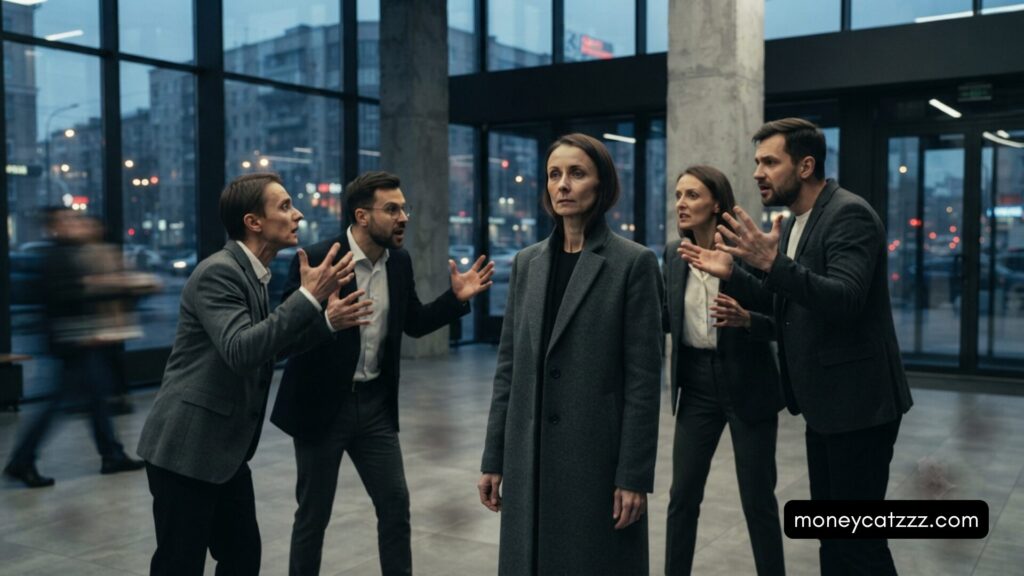
[Visualizing the Lag: The Moment of Cognitive Interruption | moneycatzzz.com]
The script was written long before I arrived at any of those relationships. It was drafted during the years when emotional unavailability was the only water I knew; when someone being partially present felt like a full commitment. I learned to navigate that constraint so thoroughly that I stopped recognizing it as a limit at all. I began selecting for it. The familiar masqueraded as compatibility. The echo masqueraded as recognition.
Â
Why do you keep stepping back into these traps? It isn’t a lack of willpower or some hidden desire to sabotage yourself. It is all about alignment.
Â
Your early years set the dials. You grew up learning that certain environments were ‘home,‘ so you spend the rest of your life moving toward those same temperatures without ever thinking about it. You aren’t making bad choices; you are following a map drawn by someone else long ago. Your pattern isn’t an error in your logic. It is proof that your original schooling was perfect.
What the Body Remembers
I was at a dinner party when someone touched my shoulder. Casual. Friendly. Completely unremarkable in context.
Â
I flinched before I knew I was flinching.
Â
The body carries the mapping in ways the mind cannot fully access or explain. That flinch wasn’t a choice; it was a ghost. It was the accumulated weight of every previous unpredictability, hardwired into your nervous system as a standing directive: contract first, assess later.
Â
The ghost of the past doesn’t announce itself. It operates through the body’s reflexes: the strange comfort you feel around fundamentally toxic people, and the misplaced sense of ease in rooms that replicate the emotional makeup of your childhood.
I smiled at that dinner party. I pretended nothing had happened. That act of pretending is a pattern in itself; it is the management of the fallout rather than the recognition of what caused the blast. The body knows what the mind has filed under resolved. The inheritance lives in the skin as much as in the thinking.
The Quiet Signal
Awareness has a texture that is different from analysis.
Â
Analysis produces explanations. Awareness produces recognition. They feel different in the body. Analysis is effortful, directed, and in search of the correct interpretation. Awareness is quieter. It arrives in the moment when you notice that something is familiar without being able to explain why immediately.
Â
I have learned to trust that quality of recognition, not as instruction, not as a guide toward a specific decision.I have identified a pattern in signals of presence and value before the automatic response executes. It is efficient in the short term, but over the years, that same efficiency becomes the reason you cannot locate the source of the bone-deep tiredness you can no longer name.
[The Vantage Point: Observing the Emotional Field | moneycatzzz.com]
The Anatomy of the Signal
I have not turned off the knot. It still registers; triggered by specific rooms, certain cadences of speech, or the subtle edge in a question that may or may not be objective. The utility of this recognition is not that it makes the sensation disappear, but that it changes the pattern of the reaction.
Â
When that specific tightness arrives, the signal no longer triggers a defensive override. Instead, it triggers a diagnostic scan:
- Stop: I interrupt the reflex’s momentum.
- Audit: I do not ask if the colleague is being dismissive.
- Observe: I ask why my nervous system is labeling this frequency as a threat.
The knot is no longer the event; it is the notification that a legacy protocol is attempting to bypass my executive function.
Â
The pattern is not erased; you cannot rewire an inherited system overnight. What changes is the lag; the interval between the automatic response and the moment you recognize the subscript. The script still activates, but you now read it before you perform it. That simple shift in sequence alters your entire relationship to the material, turning a compulsive reaction into an observable data stream.
Murray Bowen’s family systems theory calls this differentiation: the capacity to observe the emotional field you occupy rather than being entirely defined by it. The field does not vanish, and the inheritance does not dissolve. You reposition yourself from inside the reaction to slightly outside it, creating enough distance to choose a response rather than execute a hardcoded program.
Â
The shadow is borrowed, but the recognition is yours. The ultimate leverage is not found in the absence of patterns, but in the precision of your observation. You have moved from being the prisoner of an inherited script to the architect of your own responses, and that transition is the only threshold that defines true autonomy. The knot may still tighten, and the old rooms may still feel familiar, but you are no longer walking through them unthinkingly. You are now the one reading the map, identifying the traps, and choosing exactly where to step next.
Â
You stop being the script you were handed and become the reader who decides what happens next.
Â
___________________________________________________
Disclosure: This post may contain affiliate links. We only recommend products we believe in, and we may receive a commission at no cost to you! Thank you for your support!

Acknowledgment: Cover Image by moneycatzzz.com
Disclaimer: The information is provided for general information only – moneycatzzz.com makes no representations or warranties in relation to the information, including but not limited to any representation or warranty as to the fitness for any particular purpose of the information to the fullest extent permitted by law. While every effort has been made to ensure that the information provided in this article is accurate, reliable, and complete as of the time of writing, the information provided in this article should not be relied upon to make any financial, investment, real estate or legal decisions. Additionally, the information should not substitute advice from a trained professional who can take into account your personal facts and circumstances, and we accept no liability if you use the information to form decisions.