
 Reading Time: 8 mins #
 This post may contain affiliate links.
I was watching a pianist try to play jazz while solving a Rubik’s Cube. He wasn’t doing either. He was making noise and dropping stickers. The piano sounded like a falling ladder. The cube stayed unsolved. It was a spectacle of high-effort failure; a frantic attempt to defy the physics of the mind.
This is you. This is me. This is the entire modern economy.
We wear multitasking like a badge of honor. We put it on resumes. We brag about it in performance reviews. “I can handle the heat.“ No. You are just burning the kitchen down slower than the other guy. We have mistaken motion for momentum. We have mistaken attention fragmentation for systemic efficiency.
The lie is this: We are evolved to handle multiple streams of data. The truth is: We are not born to multitask. We are born to fracture.
To understand how we broke, we have to look at the last generation that actually understood the ingredients of a singular task.
The Accestral Hallucination
Let’s look at the baseline: the “Grandmother Benchmark.“
There is a pervasive myth that our ancestors were master multitaskers: the mother tending the hearth, shooing the goat, and weaving the cloth. My grandmother was the apex of this. She could fold laundry, feed the dog, whistle an opera, and dictate the grocery list to my aunt all at once. To the casual eye, she was a multitasking god.
She wasn’t. She was an Orchestrator.
Here is the mechanical reality: When she folded laundry, that task had been offloaded to the Basal Ganglia. This is the brain’s basement, the place where habitual motor patterns are stored. It requires zero conscious CPU usage. Her conscious mind, the high-rent real estate of the Prefrontal Cortex, remained singular. It was on the menu. She fully inhabited the laundry as a background process, then inhabited the menu entirely as an active one. She never focused on both.
Now look at the modern approach to ambition.
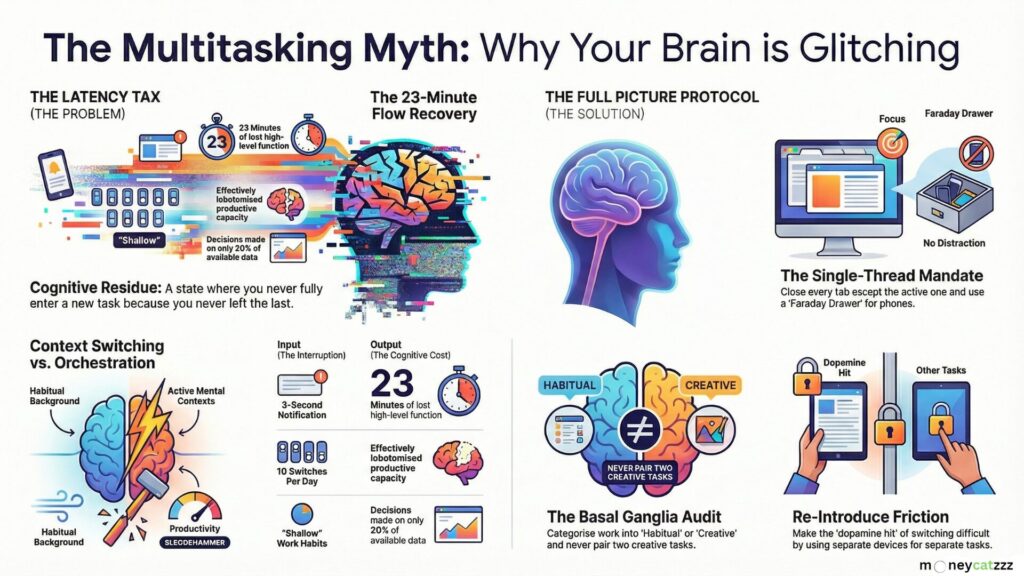
You are writing a quarterly forecast, and a Slack notification pings. You answer. A phone rings. You pick up. You are not “layering“ tasks like my grandmother; you are performing a Context Switch. You are taking a sledgehammer to your own hard drive. The human brain is a serial processor masquerading as a parallel one. We have one lane of traffic, but we keep trying to drive eighteen cars abreast. The result is a pile-up, and in the world of high-performance systems, every pile-up comes with a bill you can’t afford to pay.

[“The Grandmother Benchmark” – Image by moneycatzzz.com]
The Latency Tax (The ROI of Ruin)
In systems engineering, Latency is the silent killer of performance. It is the delay between input and output. When you “multitask,“ you aren’t saving time; you’re taking on high-interest debt.
Every time you switch from a spreadsheet to an email, your brain has to perform a “Data Dump.“ It purges the spreadsheet’s context and reloads the email’s requirements. Research into attention fragmentation suggests that this switch can take up to 23 minutes for your brain to regain its “Deep Work“ flow state.
Let that sink in. You check a “quick“ notification for 3 seconds. You lose 23 minutes of high-level cognitive function. If you do this ten times a day, you have effectively lobotomized your productive capacity for the rest of the afternoon. We are not born to multitask because our hardware cannot afford the tax.
This tax manifests as “Executive Dysfunction.” It is the slow, grinding rot of your ability to focus. You develop “cognitive residue,” a state where you never entirely leave the last task, so you never fully enter the next one. You become a “Productivity Zombie,“ moving fast but achieving nothing of depth. But this rot didn’t happen by accident; it was sold to us as an upgrade.

The Amenity Trap: Why We Broke
Why are we so bad at this? Because we are too comfortable. Modernity sold us on systemic efficiency but delivered cognitive overload. We have optimized for responsiveness, but agility without structure is just spasms.
Our environment no longer allows for the “Laundry Mode” of my grandmother. In her world, the laundry stayed laundry. It didn’t suddenly turn into a LinkedIn connection request or a breaking news alert. Her environment allowed for automation. Our environment demands a constant manual override.
We don’t multitask because we are good at it; we do it because we are addicted to the dopamine hit of the “New.” The brain craves the switch because the switch promises a reward: a new email, a new like, a new problem to “solve.” It’s a slot machine. This is not productivity. This is self-harm disguised as work.
By chasing the thrill of the “new,” we have sacrificed the power of the “deep,” and that sacrifice has redefined what it means to lead.
The Sociology of The Shallow Man
There is a social cost to this glitch. When we fracture our attention, we fracture our relationships and our leadership. A leader who is “multitasking“ during a one-on-one is absent. You are signaling that the person in front of you is less important than the notification in your pocket.
This creates a culture of Low-Resolution Leadership. Decisions are made on 20% of the available data because the other 80% of the brain is busy reloading a different window. We are building empires on the shallow end of the pool. The “Shallow Man“ skims ten ponds but never learns the depth of one. He knows everyone’s name but no one’s story. He has 5,000 connections but no allies.
The only way out of this shallow existence is to stop fighting your biology and start re-engineering your environment.
[“The Multitasking Myth” – Image by moneycatzzz.com]
The Geometry of Recovery: The “Full Picture” Protocol
You cannot fix this with willpower. Willpower is a biological resource that burns out by lunch. To fix the glitch, you have to fix the overall architecture. You have to stop the attempt to multitask and start designing for Serial Processing.
1. The Basal Ganglia Audit
List every task on your plate. Categorize them into “Habitual“ or “Creative.“ You can only pair a “Laundry“ task with another “Laundry“ task if you try to write code while on a conference call, you are failing at both.
2. The Single-Thread Mandate
Treat your brain like a single-threaded processor. Close every tab except the one you are working on. Use a “Faraday Drawer“ for your phone—the mere presence of a device on your desk, even if off, reduces your cognitive capacity.
3. Friction Re-Introduction
We multitask because it’s easy to flip a thumb. To stop, you must make the switch difficult. Use separate devices for separate tasks. Work offline for “Menu“ work. If you want systemic efficiency, you have to be okay with being slow to respond so you can be fast to achieve.

The Final Render: Can You Handle The Silence?
We are not born to multitask. We are born to dive. The myth of the multitasker is a marketing mask worn by the anxious.
Look at your screen right now. Look at the tabs. Look at the noise. That is not your work. That is your anxiety wearing a costume, trying to convince you that if you just move fast enough, the “Psychological Debt“ won’t catch up.
The geometry of success is simple. The line is straight. The focus is absolute. You have to kill the noise to hear the signal. You have to close the tabs to open the future.
Can you handle the silence? Or are you afraid of what you’ll find when you finally stop switching?
The Attention Ledger: Manuals for Hardening the Singular Mind
Deep Work

Thinking, Fast and Slow
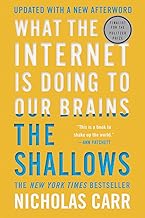
The Shallows
Disclosure: This post may contain affiliate links. We only recommend products we believe in, and we may receive a commission at no cost to you! Thank you for your support!
Acknowledgment: Cover Image by moneycatzzz.com
Disclaimer: The information is provided for general information only – moneycatzzz.com makes no representations or warranties in relation to the information, including but not limited to any representation or warranty as to the fitness for any particular purpose of the information to the fullest extent permitted by law. While every effort has been made to ensure that the information provided in this article is accurate, reliable, and complete as of the time of writing, the information provided in this article should not be relied upon to make any financial, investment, real estate or legal decisions. Additionally, the information should not substitute advice from a trained professional who can take into account your personal facts and circumstances, and we accept no liability if you use the information to form decisions.