 Reading Time: 8 mins #
 This post may contain affiliate links.
Nobody warns you about the shoes.
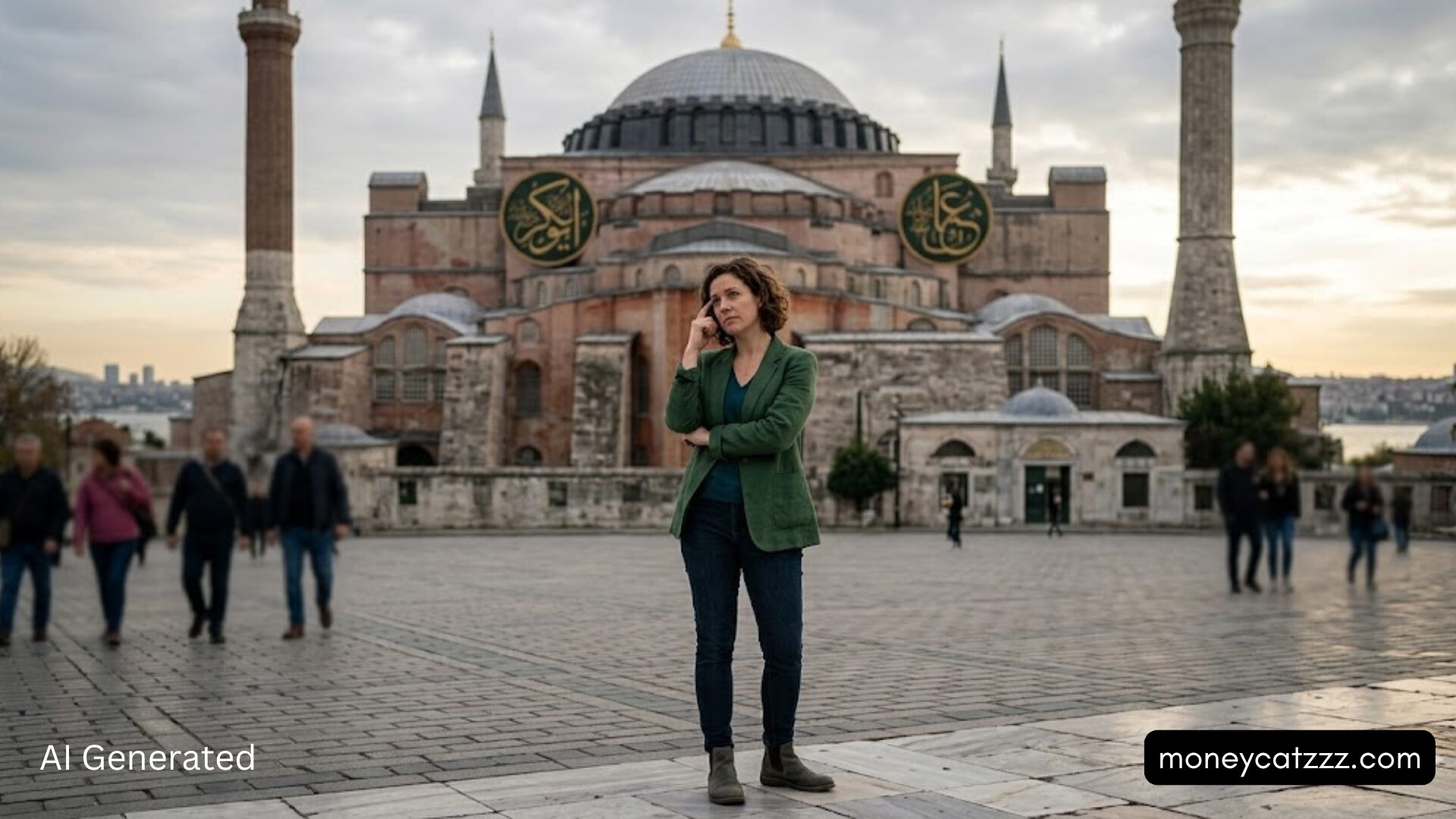
You know, instinctively, that you’ll remove them at the entrance. You’ve read the travel guides, seen the photographs, and done the respectful visitor research. But nothing prepares you for the specific vulnerability of standing in socked feet on Byzantine marble. Just when the call to prayer moves through the air above you, and the disorientation comes not as a thought but as a full-body sensation, the feeling that you have stepped into a space that exists outside the categories you brought with you.
I stood there for a long moment. Shoes in hand. No idea where I was.
The Building That Refused to Choose
The Hagia Sophia was built in 537 CE, and for the first 916 years of its existence, it was the greatest cathedral in Christendom. In May of 1453, Sultan Mehmed II rode into Constantinople on a white horse, walked into the cathedral, knelt on the marble floor, and prayed. The church became a mosque. But Mehmed, who was twenty-one years old and had just conquered a city that had held for a thousand years, did something that has always struck me as more interesting than the conquest itself.
He didn’t destroy the famous mosaics. Instead, he had them plastered over and covered, preserved, held in the walls like a breath the building was choosing not to exhale yet.
Five centuries later, in 1934, Atatürk converted the building into a museum, and the plaster came down. The mosaics were once again revealed in all their glory, intact, waiting with the patience of things that knew they weren’t going anywhere.
President Erdoğan signed the decree converting it back to a mosque in July 2020. The identity crisis the building had been managing for fifteen centuries became front-page news in forty countries. UNESCO issued a statement. Greece called it an act of hostility. The first Friday prayers were held on July 24, 2020, the Christian mosaics covered with curtains or bathed in colored light that made them recede without quite disappearing.
The building has been a cathedral, a mosque, a museum, and a mosque again. It has never, at any point, fully shed what it was before.
This is the most human thing I have ever seen a building do.

Fatih, and What Twenty Years of Explaining Teaches You
My first visit was chaotic with tourists, and my own overwhelm. Early Thursday morning in October in Istanbul, when the crowds were thin and the light through the high windows was doing something almost unreasonable, I met Fatih on my second visit.
Fatih had been a licensed guide at The Hagia Sophia for twenty-two years. He was, by all accounts, a regular guide, except louder, warmer, and in possession of opinions he had absolutely no intention of keeping to himself. He had explained this building to Christians who wept, to Muslims who felt they’d come home, to secular Europeans who treated it like a particularly grand art museum, to Turkish schoolchildren who were bored until they weren’t.
“Every person sees a different building,” he said, steering me toward the upper gallery with the authority of someone who knows exactly where the light is best at this hour. “This is the only place on earth where that is completely true.”
I asked him what he saw after twenty-two years.
He was quiet for a moment, which felt significant given that silence didn’t appear to be his natural state.
“I see a building that is more honest than the people arguing about it,” he said. “It holds everything. It apologizes for nothing. Most people cannot do this. They want to be one clean thing. The building says: why?”
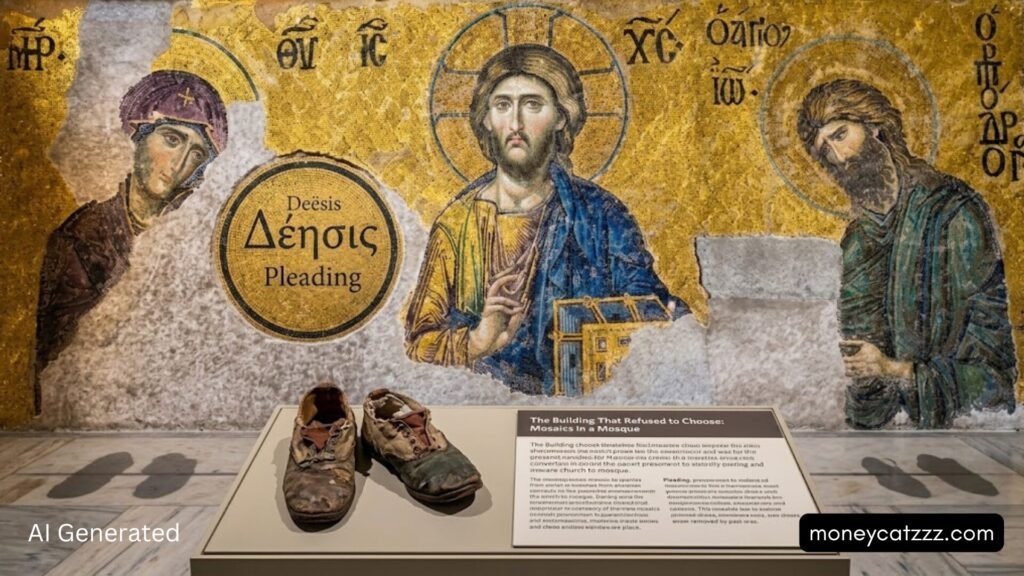
He left me in the upper gallery in front of the Deësis mosaic and went to collect another group. I didn’t move for forty minutes.
The Mosaic That Waits
The Deësis mosaic is tucked into a corner that requires some navigation to find, which means the people who reach it have usually earned it by that point. Christ at the center, the Virgin Mary on his left, John the Baptist on his right, all three rendered in gold tesserae with an emotional precision that Byzantine art isn’t always given credit for.
Christ’s expression is neither triumphant nor sorrowful. It’s something closer to witnessing. The face of someone who has seen everything and arrived at a particular quality of stillness on the other side of it.
During prayer times, a curtain covers part of the mosaic, though not all of it. Part. The building’s version of a compromise that satisfies nobody completely, which, in my experience, is often the most honest kind.
The mosaic doesn’t disappear when the curtain closes. It waits. There is a difference, and the difference is the whole point.
[The Mosaic That Waits: The Deësis mosaic | moneycatzzz.com]
The Disorientation Is Structural, Literally
Here is the detail that broke something open in me, and I’ve been turning it over ever since.
The mihrab, the niche in a mosque that indicates the direction of Mecca for prayer, sits at a slight angle to the building’s main axis. The Ottoman architects did not make an error; it was intentional. The building faces Jerusalem. It was designed and oriented for a different prayer entirely.
When the new prayer arrived, the architects made the adjustments they could, installed the mihrab as accurately as the existing geometry allowed, and left the slight ‘wrongness’ in place because the alternative was tearing down a building that had taken ten thousand workers five years to construct—adaptability at its finest.
The building also leans slightly. A structural disorientation.
I have never felt more understood by a piece of architecture in my life.
Inner conflict, the kind that comes from carrying multiple versions of yourself without resolution, isn’t a design flaw. It’s what happens when you’ve been built for one orientation and life has asked you to serve another, and you’ve done it, and you’ve done it faithfully, but the original axis is still in the walls. You can feel it in the proportions. You can feel it in the way certain rooms still pull you in directions the current floor plan doesn’t account for.
Reconciling the past doesn’t mean demolishing the original building. It means installing the mihrab, accepting the slight angle, and continuing to hold the prayers.
The Woman on the Byzantine Floor
During the afternoon prayer, I watched from the upper gallery as a woman in a pale blue headscarf performed her prayer in the main nave below. Her forehead touched marble that was laid in the sixth century for a different God, or the same God, or the same longing wearing different clothes, depending on which century and which theologian you consult.
She wasn’t performing. She wasn’t making a statement. She was praying, with the focused privacy of someone who had located something real and was attending to it.
The dome above her, engineered by the Byzantine architect Isidore of Miletus, to make a single human voice fill the entire space, held her prayer as it had held Byzantine chants for nine hundred years. The cymatics didn’t care. The dome amplifies what it receives. It always has.
I thought about the prayers I’d stopped saying because I wasn’t sure anymore which version of myself was doing the saying. Spiritual disorientation, the kind that comes not from losing faith but from outgrowing the specific container faith arrived in, had made me quiet in rooms where I used to speak. The dome of Hagia Sophia, fifteen centuries old and indifferent to theological argument, suggested that this was unnecessary.
Bring what you actually have. The space will hold it.
Çay, and What Fatih Said When the Tour Was Over
After the afternoon prayer, Fatih found me in a small çayhane (tea house) two streets from the mosque, one of those narrow places with four tables and a proprietor who brings çay without being asked, the small tulip-shaped glasses of black tea arriving as automatically as breathing in Istanbul.
He sat down across from me with the ease of someone who had nowhere else to be.
“You look like the building looked something up in you,” he said. The phrase wasn’t grammatically correct, but I understood him.
I told him about the mihrab, the slight angle. The sensation of recognizing the feeling.
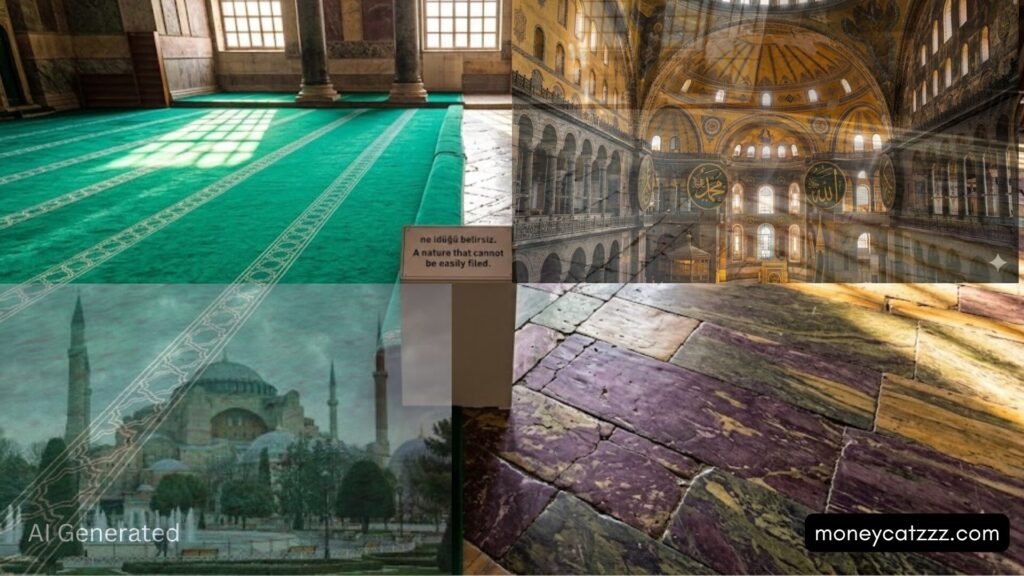
He nodded slowly, wrapping both hands around his glass. “In Turkish we say ‘ne idüğü belirsiz.’“ He paused. “It means something like: a person whose nature is unclear. Not as an insult. As a description. Someone who contains more than one thing and cannot be easily filed.”
He said it the way you say something that you’ve decided is actually a compliment, even if the world hasn’t caught up yet.
“Ayasofya (Hagia Sophia,)” he said, “is the most ne idüğü belirsiz place on earth. This is why people are angry about it. You cannot file it. It will not let you.”
He finished his tea and left. I ordered another glass and sat with the disorientation the building had handed me, turning it over, looking at it from the angle of someone who had finally stopped trying to make it into something tidier than it was.
[The Architecture of ‘Both’: Installing the New Orientation Over the Original Axis | moneycatzzz.com]
What You Carry Out That You Didn’t Carry In
Finding yourself after a change is the wrong frame of mind now. It implies the self was lost, suggesting it was a single thing that could be located and returned to its owner, like a found wallet.
Hagia Sophia is anything but. What you are is accumulated, layered, occasionally contradictory, and none of it is entirely gone. The cathedral is still in the building. The museum years are still in the building. The prayers of fifty generations of two different faiths are still in the acoustic dome, still reverberating at frequencies the human ear can’t quite catch.
According to William James, the religious impulse is primary, and the theological framework is secondary. He argues that the experience arrives first. The label comes after, and it is always slightly wrong, slightly off-axis, and installed at an angle to the original structure.
You are not confused or broken. You are disoriented because you are genuinely complex, and you have been living in a culture that finds complexity inconvenient and keeps asking you to simplify for the comfort of people who prefer their buildings to have a single, unambiguous purpose.
The Hagia Sophia has been refusing that request for fifteen centuries.
You are allowed to refuse it, too.

The Shoes, Again
I collected my shoes from the rack at the entrance on the way out. The marble was warm underfoot until the last moment, warmed by centuries of feet that arrived carrying different prayers and the same ache.
Istanbul was doing what the city does in October, a slight chill with that particular golden late-afternoon light that makes even the traffic look intentional. The Bosphorus was visible between buildings, the water the color of hammered tin.
I stood on the steps and thought about Fatih’s phrase. Ne idüğü belirsiz. A nature that cannot be easily filed.
Italo Calvino wrote in Invisible Cities that the city does not tell its past; it contains it like the lines of a hand. Hagia Sophia contains everything it has ever been in the geometry of its walls, the angle of its mihrab, the waiting patience of its mosaics, and the acoustic generosity of its dome.
I walked back toward the water, carrying my disorientation more lightly than I’d arrived with it, unresolved and untidy. Just held differently, the way you hold something once you’ve stopped pretending it’s simpler than it is.
The building had shown me that.
You don’t have to be one clean thing.
The greatest building on earth never managed it either.
Resources and Tools to Navigate Your Structural Disorientation

Varieties of Religious ..

Invisible Cities
Belonging: The Paradox of
Disclosure: This post may contain affiliate links. We only recommend products we believe in, and we may receive a commission at no cost to you! Thank you for your support!
Acknowledgment: Cover Image by moneycatzzz.com
Disclaimer: The information is provided for general information only – moneycatzzz.com makes no representations or warranties in relation to the information, including but not limited to any representation or warranty as to the fitness for any particular purpose of the information to the fullest extent permitted by law. While every effort has been made to ensure that the information provided in this article is accurate, reliable, and complete as of the time of writing, the information provided in this article should not be relied upon to make any financial, investment, real estate or legal decisions. Additionally, the information should not substitute advice from a trained professional who can take into account your personal facts and circumstances, and we accept no liability if you use the information to form decisions.