breakthrough moments cover

Breakthrough Moments: Why Your System Is Not Enough

imagesReading Time: 8 mins #

disclosure line icon vector This post may contain affiliate links.

I would be lying if I told you it was a great Tuesday. It wasn’t. Tuesdays are just last Tuesday replaying itself on a loop: the quiet, functional space after Monday’s wreckage. Then the phone rang.


I was right in the thick of my daily program. My routine was humming on schedule: inbox cleared to zero, metrics logged, revenue dashboard updated, calendar locked down. Tuesday looked identical to Monday; tomorrow would look like today. That was the point; the system was built for predictability, not ignition, lest breakthrough moments occur.


I almost let it ring.


The caller ID showed a name I hadn’t seen in two years: a former client who had abruptly pulled out of a joint venture. I had zero operational reason to answer. My framework rules were absolute: protect deep work, ignore unscheduled interruptions.

I picked up anyway.


That singular 12-minute conversation completely redirected my business.


It shattered my morning schedule, but that schedule was the only reason I was sitting at my desk when the call came in. The system didn’t generate the breakthrough moments, but it ensured I was present and prepared when they hit.

Mindvalley promo

The Floor Is Not the Ceiling

You run on routine: stack habits, shave friction, and execute daily. You are disciplined and relentless, yet you are still waiting for the needle to move.


You show up every morning and put in the work, but the tectonic shift you expected hasn’t happened. The issue isn’t your routine. The routine is doing exactly what you designed it to do: maintain stability.


The real problem is what you tune out while executing it.


Recognizing breakthrough moments requires active presence. It forces you to navigate uncertainty, interpret strange signals, and take uncalculated risks. Routines don’t demand presence; they only ask for checkmarks. You aren’t failing your process; you’re just blind to the exact moments the process was built to serve.

The Limit of Habit Frameworks

Productivity culture preaches a familiar gospel: build tighter habits, fix the inputs, and let consistency win. Or, as James Clear famously put it, “fall to the level of your systems.“


It’s sound advice, but it stops halfway down the track.


A tight workflow prevents backsliding. It builds a concrete floor beneath your feet. But a floor does not create a ceiling. The ceiling gets built during erratic, unscripted moments: a sudden decision to pivot, an uncomfortable conversation, or an unscheduled call answered off-script.


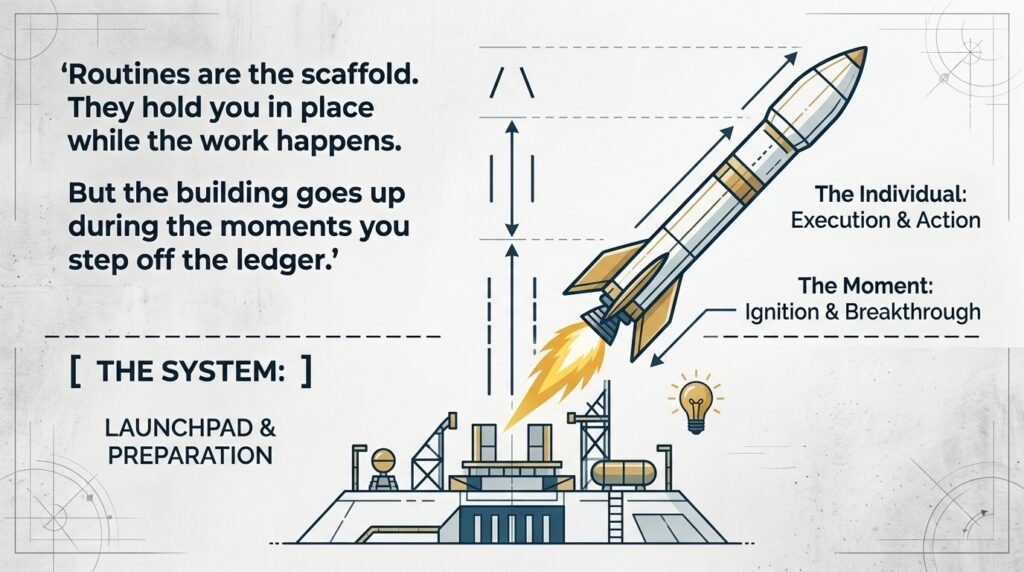
Routines are the scaffold that holds you in place while the real work happens. The structural expansion occurs only when you step onto the open frame without a safety net.

Routine vs Breakthrough: The Rocket and the Launchpad

Picture a Saturn V rocket sitting on Pad 39A.


The system is everything leading up to T-minus zero: fuel pressure checks, trajectory calculations, atmospheric modeling, and telemetry tests. It is precise, tedious, and non-negotiable. Without it, the rocket remains an expensive metal tube resting on the grass.


But the launchpad doesn’t reach orbit. Orbit happens when the engines ignite and burn through the atmosphere. Your routine is the launchpad. Breakthrough moments are the ignition sequence.


You may have constructed a pristine launchpad, but you are still sitting on the tarmac because you haven’t fired the engines.

breakthrough moments: The Floor Is Not the Ceiling
[The Floor Is Not the Ceiling | moneycatzzz.com]

Why Systems Fail When They Run Perfectly

I spent three years obsessed with optimization. Every morning started at the same desk at 6:30 a.m. Process checks were tight, output was tracked on spreadsheets, and progress was graphed. I was the most disciplined founder in my network, but I was also completely stuck.


My routine was ticking along; it wasn’t broken. It was generating the exact, incremental output I programmed it to produce. I was asking a static, linear process to generate dynamic, non-linear breakthrough moments. Systems don’t work like that.


The turning point came on a rainy Wednesday afternoon in Greenpoint. I was completely off-schedule, sitting across a scratched wooden table from a product manager named Julia.

She looked at my over-engineered roadmap and asked one unscripted question: “What would you build if you weren’t trying to scale it?”


That question wasn’t on my dashboard. The answer wasn’t tracked in my task manager. It stopped me cold, exposing a massive strategic blind spot I didn’t know existed.


The daily rhythm didn’t produce the insight. It kept the business stable enough, so I could afford to sit in that coffee shop and hear it.

How to Recognize Opportunity When Routine Says No

In his research on deliberate practice, psychologist Anders Ericsson showed that structured, repetitive effort builds high-level capability. But Ericsson also noted that elite performers continually adjust their practice based on immediate, dynamic feedback. Static repetition creates plateaus.


Research on cognitive insight confirms that creative breakthroughs rarely hit during focused execution. They hit when the brain relaxes its tight grip: during downtime, long walks, or unscripted detours.

David Epstein points out that major discoveries rarely come from narrow specialization or rigid repetition. They come from cross-domain connections and recognizing unexpected patterns. James Clear tells you to build the launchpad, while Epstein tells you to watch the horizon. You need both if you want to catch breakthrough moments before they pass.


The 9:47 a.m. phone call wasn’t on my calendar. The Greenpoint coffee meeting wasn’t in my weekly plan. A random Friday-afternoon email from an old conference acquaintance didn’t fit my communication batching rules.


Those interruptions became our largest growth vectors; far more impactful than any morning metrics check or team sync.

breakthrough moments: The Scarffold
[Breakthrough Moments: The Scaffold | moneycatzzz.com]

Consistent people stick to the schedule no matter what. High performers use the schedule to clear the baseline, then break it the moment a real breakthrough moment appears. You can’t schedule breakthroughs on a task list. You can only keep your head up, so you notice them when they hit.

Knowing When to Trust Intuition Over Rules

The daily routine keeps the operation from decaying and sharpens your capabilities. The unscripted moment is what you built those capabilities for in the first place.


If you’re doing everything right and still feel stuck, you are likely optimizing for predictability while ignoring presence. You’ve tuned your processes so tightly that you filter out signals coming from outside the system.


If you’ve been wondering how to stop over-relying on routines, the answer isn’t to burn your calendar. The calendar is preparation, not the outcome.


Over time, you learn the pattern. You notice when a conversation strays off the script, or when a stray question makes your chest tighten. That tension is your signal to step away from the checklist and pay attention.


Your routine is the floor. Breakthrough moments build the ceiling.


I still run my morning process: the start time, task checks, and metrics remain intact. But I answer the phone now, even when it disrupts the schedule.


The system keeps me sitting at the desk. Recognizing breakthrough moments is the only reason I sit there.

_________________________________________________

Recommended Reads for Breakthrough Moments

61DoCSs1lXL. AC UY218


The Road To Excellence

by K. Anders Ericsson

Amazon Button

71FYAS27dQL. AC UY218


Range

by David Epstein 

Amazon Button

81kg51XRc1L. AC UY218


Atomic Habits

by James Clear

Amazon Button

Disclosure: This post may contain affiliate links. We only recommend products we believe in, and we may receive a commission at no cost to you! Thank you for your support!
Acknowledgment: Cover Image by moneycatzzz.com

Disclaimer: The information is provided for general information only – moneycatzzz.com makes no representations or warranties in relation to the information, including but not limited to any representation or warranty as to the fitness for any particular purpose of the information to the fullest extent permitted by law. While every effort has been made to ensure that the information provided in this article is accurate, reliable, and complete as of the time of writing, the information provided in this article should not be relied upon to make any financial, investment, real estate or legal decisions. Additionally, the information should not substitute advice from a trained professional who can take into account your personal facts and circumstances, and we accept no liability if you use the information to form decisions.

Signup to our Newsletter for regular updates:

Marco Ban

Marco Ban is a 42-year-old, from sunny Spain bringing 7 years of experience crafting clear and engaging content in finance and digital marketing. A digital entrepreneur by trade, he brings vast experience in digital product reviews, financial blogging, and tutorials. A silky writer with a touch of a European flare, his postings are always engaging and informative.