
Reading Time: 8 mins #
This post may contain affiliate links.

It was the first Blue Day of the month, the kind of late-March day in Chicago where the relentless gray erases any memory of the sun.
I was sitting at the kitchen table with a mug of black Folgers. The blue mug with the chip on the rim. The one I always use. Gus was on the windowsill, tail twitching at something I couldn’t see. The laundry was folded. The bills were paid. Nothing was wrong.
.
But when I went to lift the mug to my mouth, my arm felt like lead.
It wasn’t paralysis or clinical despair. It was just a quiet, immovable heaviness, like someone had filled my chest with wet sand and expected me to carry on as if it weren’t there.
I tried to name it.
Sadness? Not quite. Grief? For what? Loneliness? I wasn’t alone. Anxiety? About what?
I sat there for five minutes trying to find the word. The feelings wheel I’d printed out months ago was somewhere in a drawer. I couldn’t muster the strength to pull it out. I already knew it wouldn’t help.
The word never came.
The Checklist You Run
You wake up, and something is off. Not wrong, exactly. Just off.
You go through the checklist. Did something happen? No. Are you sick? No. Did someone hurt you? No. Is there a reason?
No, none whatsoever.
But the weight is there: settled in your chest, heavy in your limbs, thick in the air between you and the rest of the world.
You try to name it. You scroll through articles. You text a friend: “I’m just feeling weird today.” You Google: why do I feel sad for no reason.
The internet tells you it’s depression, burnout, or unprocessed trauma. Seasonal affective disorder. A hormone imbalance. A vitamin D deficiency.
Maybe it’s all of those. Maybe it’s none of them.
The real frustration isn’t the weight. It’s the conviction that an emotion without a name is an emotion you’re failing to manage.
Some feelings don’t carry names, and some emotions refuse to be named. That is simply how certain weights exist; not as something broken, but as part of the weather.
The Water Table
Imagine a body of water deep beneath the ground, an aquifer sitting in the dark, held in pockets of stone you’ll never see or touch.
The Blue Day is when the water rises.
The water rises, pressing steadily against the underside of your life. You feel the constant pressure long before you ever see the source.
There is nothing to drain and nothing to name. There is only the steady, quiet pressure rising from below.
The water isn’t an issue to be fixed; it’s simply part of the terrain. It has always been there, rising on some days and receding on others. The weight you carry isn’t a leak in your life; it’s just the water table shifting.
[Sitting with the Unnameable | moneycatzzz.com]
The Years I Spent Trying to Fix It
I spent years trying to fix the Blue Days.
I did everything the books recommended: meditated, journaled, saw a therapist twice a week for a season. I loaded my mind with the right vocabulary: dysregulation, dissociation, unprocessed grief, somatic experiencing; as if naming the storm would make it pass.
I became fluent in the catalog of human emotion: labeling anger, fear, shame, sadness, longing — with the precision of a scientist taking inventory.
Yet the Blue Days resisted every single label. They existed somewhere deeper, a quiet weight beneath the visible surface.
Long before a feeling finds language, it lives in the body. I came across that idea while reading Bessel van der Kolk‘s work on body memory and thought: maybe the Blue Day is just unnamed trauma. So I went after the physical imprint: somatic therapy, EMDR, breathwork, tapping against my collarbone while repeating words I didn’t believe.
Some of it helped, but the Blue Days kept coming regardless.
The Question That Changed It
My therapist, Dr. Patel, once asked me, “What if the feeling doesn’t need a name?“
I looked at her like she’d just suggested I stop breathing.
“But if I can’t name it, how do I process it?”
She didn’t answer right away. She just sat there. The clock ticked. Gus knocked something off the counter in the other room.
Finally, she said, “What if processing it means letting it be nameless?“
I wanted to argue, to pull out the research and cite every expert who insists that naming a feeling tames it. I wanted to defend the language I’d spent years memorizing: the idea that if you can label the weight, you can process it.
I didn’t. Somewhere beneath the noise, I knew she was right.
The Blue Day wasn’t a problem to solve; it was simply a situation to inhabit. A quiet sign that something was shifting far beneath the surface.
What the Blue Day Is Telling You
A Blue Day isn’t depression, though it borrows the same heavy coat: the flatness, the silence, the familiar exhaustion.
But depression, in my experience, has a kind of narrative. It tells you stories. You’re not enough. You’ll never be enough. Nothing will change.
The Blue Day doesn’t tell you stories. It just sits. Heavy and quiet and nameless.
It’s not grief in the traditional sense. You can’t point to a funeral or a broken relationship; the slate looks entirely clean on paper.
I kept thinking of a line from Francis Weller about the hidden gates of grief: the sorrow for everything we expected to receive, but never did.
But there’s a sixth gate he doesn’t name. The grief that has no origin. The grief that just is.
The Blue Day lives in that gate.
It’s not anxiety. Anxiety wants something from you. It wants you to prepare, to plan, to solve.
The Blue Day doesn’t want anything. It just is.
So what is it?
I don’t know. And I’ve stopped trying to figure it out.
The Blue Day is simply the body speaking in a language you haven’t learned yet. And maybe you never will. That may be okay.
How to Sit with the Unnameable
You stop trying to fix or label it. No Google query unlocks an unnamed feeling, and no seven-step blueprint can process a weight with no origin.
You just let it be heavy.
For me, it was small and unspectacular.
The weight arrived in the late afternoon, just as the light was fading. I was folding laundry. Gus was on the couch. Nothing was wrong.
I didn’t try to name it or text anyone. I didn’t open my journal to excavate the root cause across three pages.
I just sat on the floor. Held a towel. Let the weight sit in my chest.
It stayed for an hour. Maybe two. Time moves differently on Blue Days.
I didn’t cry or reach a sudden revelation. No deep, repressed memory came to light.
I just sat, let the water rise, and eventually, it settled. The blues did not disappear entirely—they just grew lighter.
[Guide to Nameless Emotions and The Water Table | moneycatzzz.com]
It’s less of a discipline and more of a surrender: not to the sadness itself, but to the reality that some feelings exist beyond language.
Psychology calls it alexithymia, the inability to put feelings into words, and usually treats it like a defect to fix. But some emotional states aren’t broken; they exist in a register language was never built to reach.
The Blue Day is one of them.
The Relief That Isn’t Relief
Relief doesn’t come from naming it, but from abandoning the search altogether. It comes from accepting that a persistent weight isn’t always proof of damage; sometimes it’s just the water table shifting.
The peace is in letting the Blue Day be what it is: nameless, heavy, and temporary.
I used to equate a nameless feeling with personal failure: a lack of self-awareness, poor emotional intelligence, or an inability to manage my own life.
Now I see it differently.
The Blue Day isn’t a flaw in my self-awareness. It’s just a reminder that not everything inside us is meant to be categorized, analyzed, or dragged into the light. Some things exist, quiet and untouched.
The Days the Water Rises
The Blue Days still return with no set schedule: a random Tuesday in March, a calm Sunday afternoon when nothing is out of place. The tide comes in, quiet and unbidden.
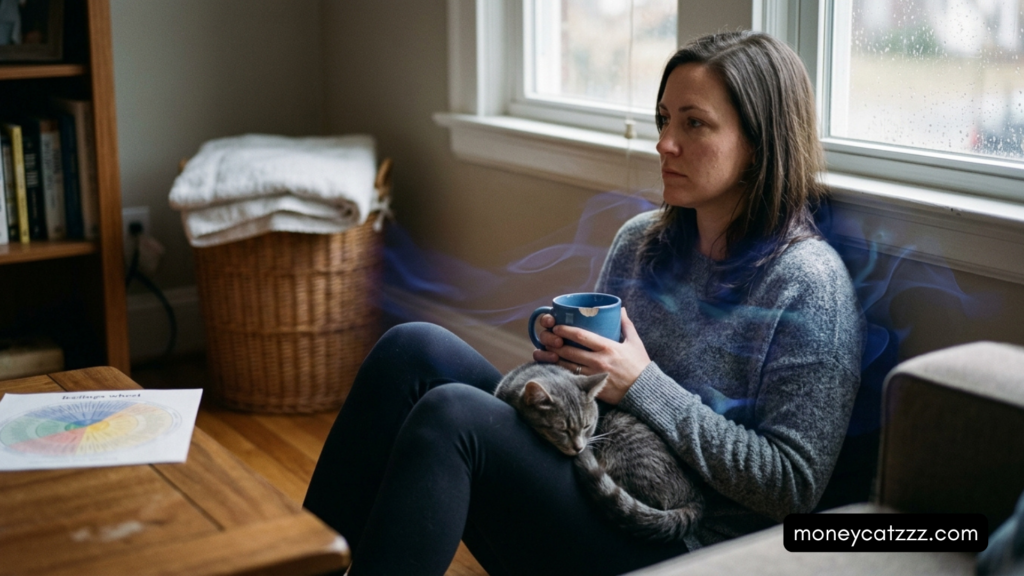
I stop fighting it. There is no feelings wheel, no phone call, no search for root causes. I sit on the floor with my blue mug, let Gus climb into my lap, and feel the weight on my chest until the water table finally shifts back down.
The Truth You Carry
You don’t need to name every feeling, fix every sadness, or excavate a nameless ache to turn it into a story. Some emotions are simply the tide turning inside you.
The Blue Day is a natural state; it’s an internal shift happening below the surface. You don’t need to understand the motion; you only have to let it move.
I don’t know when the next one will come, or if it will ever carry a title. But I know the weight isn’t a punishment. Some days, the water rises. That’s just the natural order of things.
_________________________________________________
Disclosure: This post may contain affiliate links. We only recommend products we believe in, and we may receive a commission at no cost to you! Thank you for your support!
Acknowledgment: Cover Image by moneycatzzz.com
Disclaimer: The information is provided for general information only – moneycatzzz.com makes no representations or warranties in relation to the information, including but not limited to any representation or warranty as to the fitness for any particular purpose of the information to the fullest extent permitted by law. While every effort has been made to ensure that the information provided in this article is accurate, reliable, and complete as of the time of writing, the information provided in this article should not be relied upon to make any financial, investment, real estate or legal decisions. Additionally, the information should not substitute advice from a trained professional who can take into account your personal facts and circumstances, and we accept no liability if you use the information to form decisions.