 Reading Time: 10 mins #
 This post may contain affiliate links.
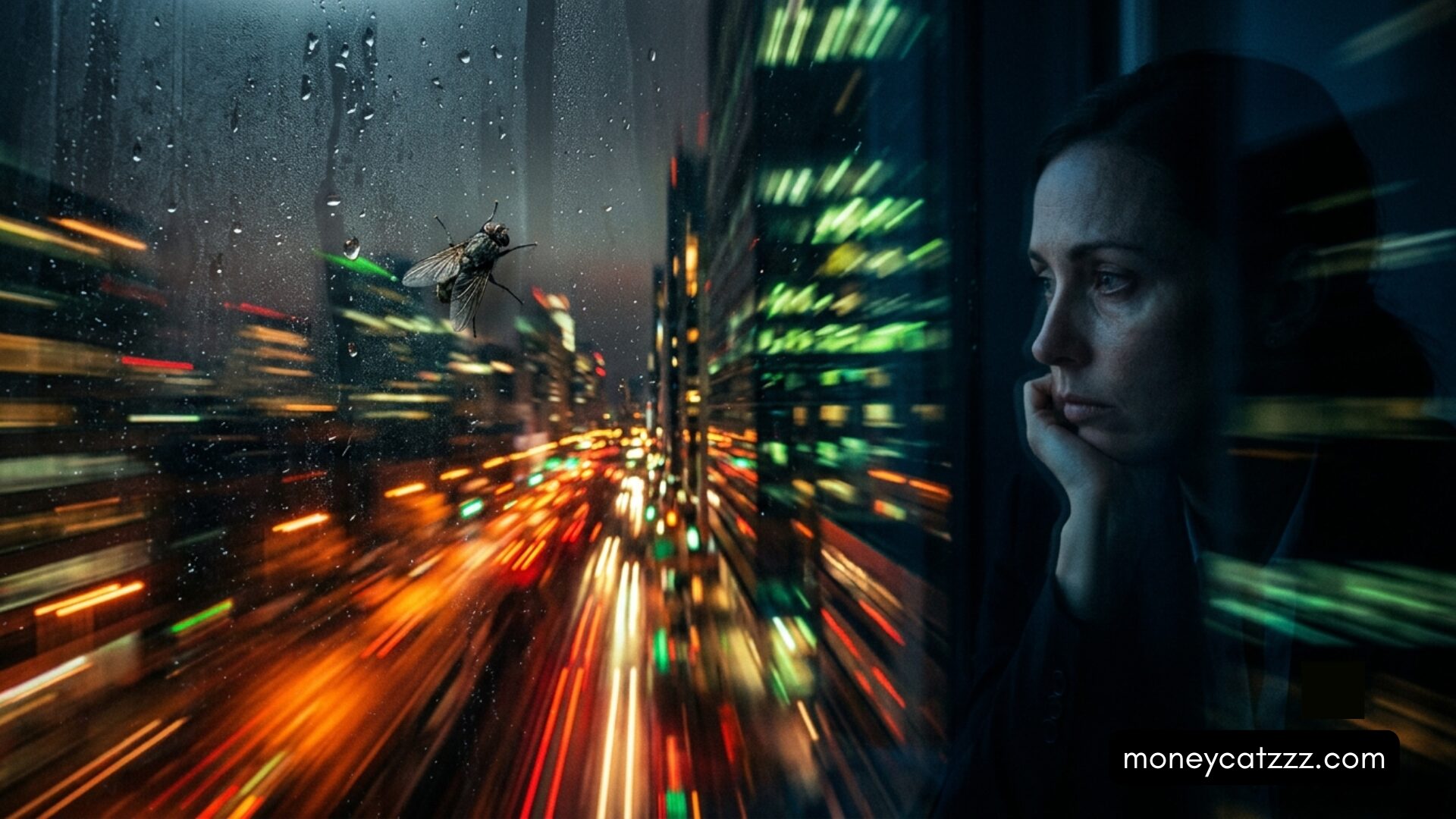
The true lifespan of a fly is a brutal mirror, stripped entirely of soft, comforting illusions.
A common housefly is biologically wired to navigate the open world for fifteen to thirty days. Yet, when that same creature enters the artificial perimeter of a human room, it systematically beats its own body to death against a glass pane within forty-eight hours.
It does not run out of natural time. It runs out of environment.
To look at a trapped fly is to witness a countdown driven entirely by systemic friction. It is a high-octane machine operating inside a sterile desert. I watched one this morning on the cracked, peeling white paint of my windowsill. Glass. Light. Exhaustion.
We look at insects buzzing frantically against a clear pane, and we rewrite their panic as a natural clock ticking down. This is a protective lie we tell ourselves to avoid looking directly at our own surroundings.
The biological reality is far more damning: the indoor environment operates as an engine of pure, unyielding stress. The insect panics. It flies erratically into transparent walls in a desperate bid to reach the light, burning through its energy reserves until it collapses from sheer exhaustion.
The Self-Imposed Waiting Room
Meanwhile, I stood there with a mug of lukewarm coffee, staring at a flashing cursor on my laptop screen.
I was aggressively calculating the exact minutes remaining before I had to surrender my attention to an administrative client call. I was trapped in my usual exhausting rhythm, completely paralyzed, waiting for the next obligation to dictate my worth.
The contrast was humiliating.
I possess decades of potential, yet I am voluntarily occupying a self-imposed waiting room, treating my life force as something entirely provisional.

When a driven builder enters a toxic or misaligned infrastructure, the outcome mimics the window pane. You do not lose your capability; you lose your runway. You mistake the transparent boundaries of your current business model or client list for the literal edge of the world, charging hard into structural barriers until your central nervous system burns out.
“Your lack of talent doesn’t define the cage. It is defined by the friction of the seat you choose.”
The Inventory of Ghost Loops
The Silent Exit and Calcified Obligations
Before the Chicago studio, I ran a silent undercurrent of avoidance for two full years.
My notebook sat open, pen balanced, the door technically closed on a relationship that had calcified into obligation. I sold myself the lie that heavy silence was maturity, and that an absence of conflict meant an absence of damage.
I was hiding in the quiet, terrified to speak an honest word, pretending that standing still inside a dying dynamic was preservation. I spent months waiting for an external disaster to break the loop. It was a slow, ambient haunting.
John Bowlby spent decades mapping how humans respond to attachment after physical separation, proving that emotional bonds do not dissolve when a body leaves a room. The internal circuit stays active. You stop looking at the connection, yet the loop keeps drawing current, eating up processing power you don’t realize you are spending.
The quiet following my avoidance was not peace. It was a suffocating pressure in my chest every morning; a low, unresolved hum I mistook for career ambition.
I moved fast to fill the calendar. I manufactured an artificial sense of purpose, but none of it touched the psychological blueprint or brought presence to my days.
Avoidance doesn’t close a connection. It archives the unfinished, where it continues to pull.

[The Wing-Beat Motion (The Adrenaline Blur) | moneycatzzz.com]
The Chicago Stagnation
This internal paralysis dictates exactly why we waste time despite knowing it is limited.
We treat our reality as a provisional rehearsal, looking at the open horizon and manufacturing a complex, intellectual loophole to delay the terrifying vulnerability of current execution. I know that exact dance because I tried to outrun my patterns by swapping my geography.
I remember a suffocating third-floor studio apartment in Chicago during a dead August heatwave.
The window air conditioning unit was rattling itself to pieces, throwing out nothing but stale humidity and the metallic scent of burning dust. I sat at a cheap plastic folding table, staring at a half-finished website layout for a corporate digital client that felt utterly hollow to my soul.
I had spent the previous spring packing heavy cardboard boxes, telling myself that moving to a new city would automatically reset my internal patterns.
It was a complete delusion.
You can swap the grid coordinates of your prison, but you cannot outrun the psychological bone structure you carry inside your own skull.
I wasn’t building a life. I was merely swapping one air-conditioned waiting room for another, throwing my weight against the same transparent barriers until my spirit began to starve. The total weight of that unlived potential felt heavier than the August humidity pooling at my lower back.
Material Anchors and Trapped Decades
The physical objects we leave behind or hide away in storage units are not neutral decor.
A heavy coat smelling of woodsmoke in a dark closet you no longer open, annotated books stacked in a box that has moved across three separate cities without ever being unpacked, an old camera you stopped using the exact year your world shifted: these are not simple keepsakes. They are active open circuits with concrete mass.
This material trail serves as a temporal anchor, drawing your attention back to an era your conscious mind claims is finished.
Moving past your twenties takes more than flipping pages on a calendar. That decade carries a specific texture, a quality of believing everything is still provisional and adjustable.
When you leave that era without fully inhabiting its ending, the tall grass where the trail died stays waist-high in your memory, bending in a cold wind you can still feel.
Every incomplete departure demands an eventual return to the exact moment you bypassed out of fear. You run a fractured system because you refuse to close the circuit, carrying the heavy baggage of unfinished business into every new room you enter.
Sterile Starvation and the Modern Cage
Go back to the glass for a second.
Flies run on a frantic metabolism; remove their fuel source, and they starve within days. Pair that with an air-conditioned room stripped of standing water, and the modern home becomes a dehydrating desert. The insect buzzing against your window pane isn’t running out of natural time. It is trapped in a sterile box, burning through a lifetime of energy reserves until it collapses from sheer exhaustion.
When you are trapped in a toxic structural grid, your ambition experiences the same dehydration. You burn massive amounts of energy each day trying to force your way through boundaries that lack oxygen. You aren’t running out of years on the calendar. You are burning a thirty-day lifespan in forty-eight hours because you refuse to step away from a window that will never open.
We run ourselves ragged trying to master our schedules, but Four Thousand Weeks exposes the trap. That frantic drive to optimize our time is the exact mechanism that ensures we remain its slaves.
We carry the burden of knowing how much time you have, and we use that ledger to measure our unworthiness. True presence only arrives when you stop treating your hours as a resource to be hoarded, managed, and saved for some imaginary future self.
The anxiety doesn’t dissolve because you finally master a clinical productivity routine. It dissolves when you drop the performance of constant readiness and step out of the trap entirely.
This realization reveals why we envy creatures that do not count hours. A wild animal has no calendar to curse, operating in a state of absolute, unvarnished presence that frees it from the ghost of regret.
The Cleanup Crew
By twilight, the glass is quiet.
The fly lies curled in the chalky dust of the sill, not spent by time, but hollowed out by the perimeter. Even in ruin, it clings. The microscopic claws stay hooked into the peeling paint, anchoring an empty, defensive posture to the wood long after the spark has evaporated into the stagnant air.
Then the floor belongs to the line.
A black thread of ants begins charting the white trim with mechanical precision. There is no malice in the harvest, only economy. A stalled life is merely an unallocated asset left out on the counter; the ecosystem refuses to let a resource sit idle.
They dismantle the shell piece by piece, carrying the carcass back into the room’s dark corners. Stagnation is never a state of frozen safety; it is an active liquidation. The world doesn’t pause to mourn your paralysis. It simply begins to chew.
The scavenger tax of modern existence operates on the same cold math. When you choose to stand still inside a toxic infrastructure, your days do not wait for you. They are claimed. Carved up by other people’s habits, eaten away by administrative noise, and distributed among minor obligations you never chose, until your entire momentum is ground down to an unrecognizable powder.
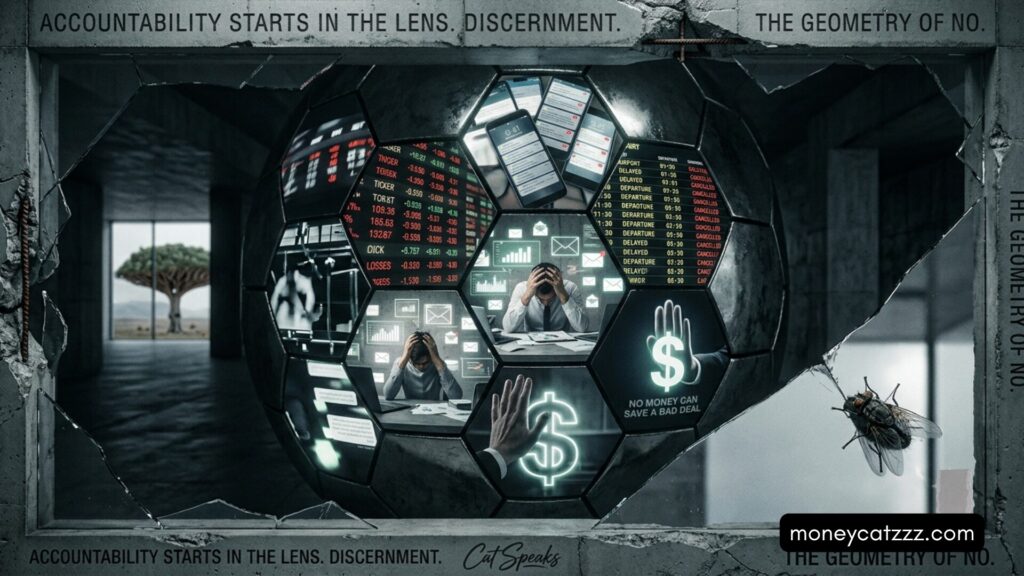
[The Compound Perspective (The Overstimulated Lens) | moneycatzzz.com]
Dismantling the Default Script
Two thousand years ago, Seneca laid out the exact indictment we still refuse to face: life isn’t inherently short; we just make it that way by squandering our inventory. We spend the bulk of our active energy reserves staging elaborate dress rehearsals for a future we may never live to see.
We treat our immediate runway as something entirely provisional while optimizing for a tomorrow that doesn’t exist, yet. It is the ultimate administrative delusion: meticulously planning a life we are too paralyzed actually to claim
I watched the ants finish their work on the windowsill, leaving nothing but a space where the struggle had occurred. I didn’t sweep them away. I let the reminder stay raw.

I cannot copy the unthinking mechanics of an insect, nor can I erase the complex, heavy consciousness I carry. We must fight for freedom from the weight of time by refusing to let a closed room dictate our capacity for current action. Yet that massive expanse becomes a suffocating weight if we use it to measure our unworthiness.
The fly did not lack time. It lacked an environment capable of sustaining its native velocity. It executed a flawless, high-octane performance inside a space that could only offer suffocation.
The exit doesn’t require a violent shattering of the glass. It demands a quiet pivot of the heel. Stop looking for a horizon you can only view through a barrier, trading your central nervous system for a view of a world you aren’t permitted to touch.
“Staring at the outside world does not make you a part of it. The cage only holds you because you refuse to turn your back on the view. Stop fighting the glass. Walk out of the waiting room and begin.”
________________________________________________
The Productivity Trap: Why Time Optimization Builds a More Efficient Cage
Bowlby

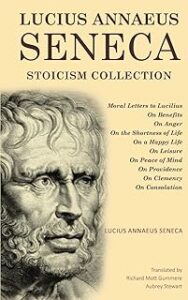
The Collection
The Power Of Now


Disclosure: This post may contain affiliate links. We only recommend products we believe in, and we may receive a commission at no cost to you! Thank you for your support!
Acknowledgment: Cover Image by moneycatzzz.com
Disclaimer: The information is provided for general information only – moneycatzzz.com makes no representations or warranties in relation to the information, including but not limited to any representation or warranty as to the fitness for any particular purpose of the information to the fullest extent permitted by law. While every effort has been made to ensure that the information provided in this article is accurate, reliable, and complete as of the time of writing, the information provided in this article should not be relied upon to make any financial, investment, real estate or legal decisions. Additionally, the information should not substitute advice from a trained professional who can take into account your personal facts and circumstances, and we accept no liability if you use the information to form decisions.