
 Reading Time: 12 mins #
 This post may contain affiliate links.
Her name was Dr. Miriam Osei, and she ruined networking for me forever.
I met her at a conference in Toronto where everyone was doing that familiar dance. You know the one. You stand physically in a conversation while your mind composes the exit strategy. One eye stays on the person talking. The other eye scans the room for someone more useful to talk to. Both hands wrap around a drink you are not actually drinking. It is a prop, not a beverage.
I was mid-sentence about my “exciting work in the content space.” That is what I say when I want to sound important without saying anything specific: that I have presence. Then Dr. Osei just looked at me.
It was not a glance; she was not checking the door behind me or sneaking a peek at her phone. She looked at me with what I can only describe as her full attention. The stare has dead weight, so intense, you can actually feel it landing on your skin like a warm hand.
It was not a glance; she was not checking the door behind me or sneaking a peek at her phone. She looked at me with what I can only describe as her full attention. The stare has dead weight, so intense, you can actually feel it landing on your skin like a warm hand.
I stopped talking mid-sentence. Actually stopped. Being truly seen, rather than politely observed, was so unfamiliar that my brain interpreted it as a danger.
“You were saying?” she said.
“I don’t remember,” I said. That was the most honest thing I had said all conference.
That is a presence that surpasses any charisma or personal branding. Move beyond any thousand-dollar coaching program that promises to make you magnetic. Just someone being completely uncomfortable here. In a room full of people performing their best professional selves, it was the most alarming thing I had ever encountered.

The Performance Loop We All Live In
I used to be devastatingly effective at manufacturing a convincing simulation of focus. I had cataloged every tactical trick in the market: locking eye contact, dropping calculated follow-up prompts, and memorizing names within seconds of contact. I had consumed the psychological literature, deconstructed the mainstream lectures, and mapped out micro-expressions in bedroom mirrors like a political strategist prepping for a televised debate.
But there was a deeper blueprint I refused to revisit. I was running an expensive, high-powered algorithm of curated interest, entirely preoccupied with how my own posture was landing.
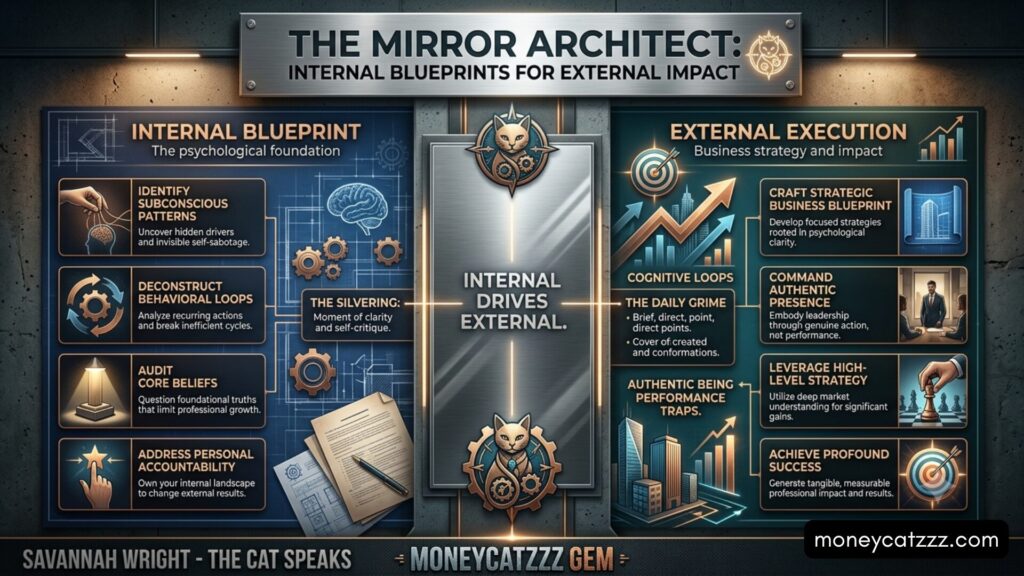
Behavioral researchers categorize this structural blind spot as the performance loop. It is the invisible social theater that dictates almost every human interaction. You operate simultaneously as the lead actor and the critical critic. You project an identity while actively calibrating its reception in real time. You try to force a projection of presence while watching yourself from the nosebleed seats.
This psychological split-screen is exhausting for the same reason running a con is: it splits your processing power between two competing planes of reality. There is the unvarnished truth of what is happening, and there is the polished fiction you want people to buy. This constant friction makes an authentic connection impossible to ignore when it actually pierces through the noise.
Data on clinical social anxiety proves that the average professional burns an immense amount of mental bandwidth managing external impressions rather than processing real data. We are so consumed by the exhausting split of performing vs being that we never actually arrive in the room.
In his framework on “deep work,” Cal Newport isolates focus as a finite, high-value asset. While he applies this to cognitive production, the same mechanics govern human attention. When you replicate a state of focus while remaining emotionally checked out, you are trading currency you do not possess. It is high-level relational fraud disguised as professional courtesy.

[Mirror Life Framework | moneycatzzz.com]
The Mirror Problem
Here is the uncomfortable truth about Dr. Osei and the rare individuals who operate like her. They are deeply destabilizing, not because they exhibit bizarre behavior, but because they flatly refuse to participate in the collective fiction.
When someone operates with absolute presence, they become a literal mirror. I do not mean this in a soft, therapeutic sense. I mean it as a cold, mechanical fact. Their stillness and unblinking focus reflect every frantic micro-move you deploy to avoid the current moment:
- The way you execute that involuntary glance at your phone screen.
- The way your mind frantically scripts its next line instead of processing the raw data landing in real time.
- The way this nervous energy forces you to settle for the bloodless theater of performing listening rather than facing the stark weight of authentic presence.
We always assume these micro-moves are invisible, but the mirror never lies.
Standing before Dr. Osei felt like being a low-resolution, blurry photograph hung in a gallery of high-definition prints. She was not executing any extra maneuvers. She was completely there—that singular reality made my own lack of depth suddenly visible, and the visibility was entirely exposing.
This level of authentic presence aggressively breaks the invisible social contract most of us unconsciously sign. The terms of that contract are simple: I will perform interest if you reciprocate, and we will both quietly pretend this simulation constitutes a real connection. It is the ultimate loop of performing vs being. Someone who actually shows up, who skips the theater entirely, destabilizes the entire arrangement. You suddenly forget your lines because they refuse to follow the script.
The High-Definition Screen and the Tree
There is a distinction worth sitting with for a moment. It is the difference between a high-definition screen showing you a tree and actually looking at a tree. The screen can be beautiful, technically perfect, even more vivid than reality. But there is something the screen cannot do that the tree does without trying. The tree is the thing itself. The screen is just a representation.
Most of our interactions now happen on screens, and I do not mean Zoom. I mean the screen of performance. We offer representations of connection that are technically correct but lack the quality that makes a connection feel real.
Individuals who possess authentic presence function exactly like trees in a landscape of digital projections. They are not attempting to engineer a superior simulation, nor are they deploying polished mechanics or synthetic charm to capture the room. Instead, they remain, undeniably anchored at their exact coordinates.
In a hyper-curated culture of high-definition screens, that raw reality feels almost supernatural.
Brené Brown writes in Daring Greatly about vulnerability as the foundation of genuine connection. I think she is describing a symptom of something deeper. Vulnerability is what becomes possible when you stop performing and are genuinely present. When you stop filtering, what comes through is actually you. That is vulnerable almost by definition.
The distinction between performing vs being matters because it determines the kind of impact you actually have. A performance of presence creates the impression of connection. Actual presence creates connection. One is forgettable the moment the performance ends. The other stays in the room even after you have left it.
The Practice of Arriving
I began practicing presence the way a person learns to swim after years of pretending they already know the strokes. It was an awkward, humiliating ordeal with far too much water in my face.
The initial test occurred during dinner with my oldest friend, Rachel. For years, our relationship had degenerated into a series of parallel monologues, each person simply waiting for their turn to speak rather than processing the other person’s reality. I forced myself to stop the internal engine. I listened with a raw, uncomfortable focus, completely abandoning the urge to formulate a clever counter-response.
The impulse to interrupt was almost physical. I wanted to hijack her narrative and tie it back to my own experience. I wanted to steer the conversation back to a predictable, safer domain. The internal friction grew so intense that I had to anchor my hands beneath my thighs to stop my automated behavioral habits.
Suddenly, Rachel stopped mid-sentence.
“Are you okay?” she asked.
That was the exact moment I confronted the deceptive nature of performing vs being. My standard simulation of interest was so deeply hardwired into our dynamic that its sudden collapse felt instantly alarming to her.
“I am trying actually to hear you,” I told her.
She started crying. Neither of us had anticipated that level of emotional friction.
Data on human connection indicates that individuals feel genuinely understood so rarely that the raw experience can trigger an intense psychological shock wave. Modern professionals are profoundly starved for human attention that is completely unmediated by social theater. When actual focus finally arrives, we frequently lack the cognitive tools to process it.
What You Stop Needing
The brutal benefit of developing authentic presence is the immediate elimination of social overhead. When you operate with absolute focus, the scripted theater evaporates. The calculated opening line drops away. The manufactured vulnerability you engineer to seem relatable proves redundant. The desperate follow-up email sent to prove you were engaged while actually tracking the exit becomes entirely useless.
When you actually anchor your focus, the room inherently senses the shift. You do not have to market the fact because the data speaks for itself. It registers the exact details you recall from three minutes prior, rather than pivoting to your preferred talking points. It reflects in structural questions that can only be generated by deep processing, and in the heavy silences you are secure enough to hold without scrambling to perform.
[Understanding the Mirror Life Framework: Psychology, Strategy, and Accountability | moneycatzzz.com]
In Man’s Search for Meaning, Viktor Frankl isolates the fundamental drive to confirm that our existence carries weight for another human being. True presence satisfies that void without the need for theatrical gestures or highly polished vocabulary. It requires nothing more than the radical execution of undivided, unmediated human attention.
This is precisely why these individuals become completely impossible to ignore, despite rarely being the loudest or most polished operators in the environment. They are frequently quiet, occasionally awkward, and completely unfiltered. Yet, when you exit their perimeter, you realize an authentic transaction just occurred. In a marketplace dominated by the exhaustion of performing vs being, this unvarnished exchange is deeply disorienting.
The Subtraction That Changes Everything
I have stopped trying to accumulate tactical layers to make myself memorable. I no longer polish my talking points or curate personal narratives for maximum transactional impact; completely abandoning the artificial calibration of engaged body language.
Instead, my execution relies entirely on subtraction. I strip away the social theater, the hidden agenda, the divided focus, and the instinctual glance toward the exit frame. The objective is to show up in an environment as an unvarnished reality rather than the curated avatar I usually deploy in my place.
Some days this structural shift succeeds. Phone screens remain dark, and ideas materialize organically rather than through forced collaboration: other days, the legacy blueprint returns. I catch myself running the standard simulation, projecting a counterfeit presence while my mind operates entirely elsewhere.
Adjusting the mirror itself is progress. I notice the exact microsecond I abandon the room while my physical frame remains anchored in the chair. I can detect when my human attention is genuinely unmediated, versus when I slide back into the exhausting loop of performing rather than being. That acute notice is precisely how subtraction begins, creating a baseline clarity that ultimately becomes impossible to ignore.

The Uncomfortable Conclusion
Dr. Osei and I had coffee the next morning. I asked her point-blank how she executed that specific, mechanical calibration of her presence. I wanted to understand the unmediated focus that had completely derailed my pre-programmed narrative sequence.
She looked genuinely confused for a moment. Then she said, “I just listened to you.”
Just listened. There was no tactical approach, no rehearsal, and no deliberate cultivation of magnetic personal-branding metrics. It was simply the radical decision to remain fully locked into her current coordinate space rather than calculating the next room she needed to occupy.
I realized then how deeply corrupted my own daily communication blueprints had become.
Ultimately, authentic presence is not a competitive skill you acquire through executive coaching. It is an exhausting theater performance that you finally choose to stop giving. It is the unvarnished asset that remains when you grow tired of scattering your focus everywhere else and allow yourself to be here. This rare psychological clarity is precisely what makes an individual impossible to ignore in a marketplace built on superficial metrics.
The tree does not expend energy trying to project a more vivid simulation than the high-definition screen. It simply exists completely in its environment. That unmediated reality is the only currency the digital simulation can never replicate, demanding absolute, focused human attention from anyone entering its perimeter.
When did someone’s raw presence fundamentally alter your behavioral trajectory? When did you last afford someone yours?
______________________________________________
The Paper Trail of Actual Attention
Deep Work


Daring Greatly

Man’s Search for Meaning



Disclosure: This post may contain affiliate links. We only recommend products we believe in, and we may receive a commission at no cost to you! Thank you for your support!
Acknowledgment: Cover Image by moneycatzzz.com
Disclaimer: The information is provided for general information only – moneycatzzz.com makes no representations or warranties in relation to the information, including but not limited to any representation or warranty as to the fitness for any particular purpose of the information to the fullest extent permitted by law. While every effort has been made to ensure that the information provided in this article is accurate, reliable, and complete as of the time of writing, the information provided in this article should not be relied upon to make any financial, investment, real estate or legal decisions. Additionally, the information should not substitute advice from a trained professional who can take into account your personal facts and circumstances, and we accept no liability if you use the information to form decisions.