
 Reading Time: 8 mins #
 This post may contain affiliate links.
The choice to keep all your options open isn’t a strategy. It’s a holding pattern disguised as sophisticated planning.
I spent five years, between the ages of 27 and 32, maintaining three parallel career paths. Consulting work that paid the bills and kept the corporate track viable. A side business that preserved the entrepreneurial option. Writing projects that maintained creative legitimacy. Each path required active maintenance. Networking. Skill updates. Relationship management. The appearance of commitment without the reality of it.
People called this strategic. Smart. Keeping doors open.
What it actually was: a refusal to land the plane.
The Holding Pattern Burns More Than You Think
I calculated it once, after I finally shut everything down except one path. The mathematics were brutal.
Fifteen hours weekly on maintaining optionality across three paths, not doing the work, and maintaining the infrastructure to keep the work possible. That’s 780 hours annually, over five years: 3,900 hours spent on options I never actually took.
For context, 3,900 hours is two full working years.
Two years of my life spent not on building something but on preserving the theoretical ability to build multiple things someday—the potential trap in its purest form.
The choice paralysis wasn’t about big decisions. I’d made those.
Consulting, business, writing: all chosen. The paralysis was in the refusal to un-choose the others. Because what if I was wrong? What if I needed a backup? What if the path I committed to didn’t work out?
Barry Schwartz wrote The Paradox of Choice in 2004. Twenty years ago. The jam study is famous now. Everyone cites it at dinner parties. Sheena Iyengar’s research on how too many options reduce decision quality has been public for decades, and yet here we are, still convinced that unlimited choice represents freedom rather than a specific kind of imprisonment.
The holding pattern feels like progress because there’s activity. You’re doing things, attending events, taking calls, and updating skills. But the plane isn’t going anywhere. It’s just burning fuel.

The Meta-Decision Tax
Before I could do any actual work on any of the three paths, I had to make four meta-decisions daily:
Which path gets priority today?
How much time is allocated to each?
Which relationships to maintain for which option?
Which skills to develop for which future?
Four decisions before the work even started, every single day.
Over a year: 1,460 meta-decisions that existed purely because I refused to close doors. That’s decision fatigue at scale—a tax I was paying without realizing I’d agreed to it.
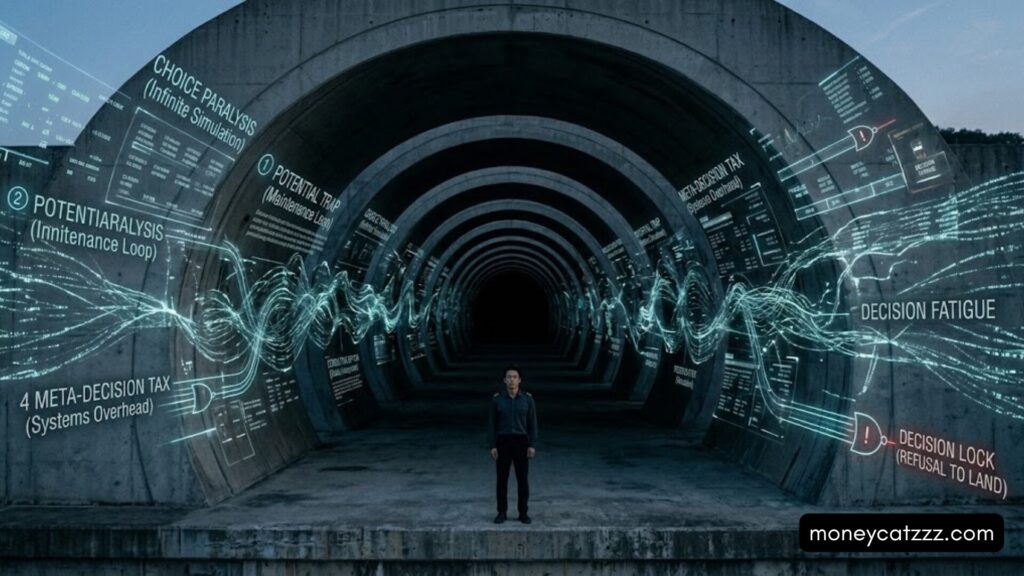
[A Diagnostic Schema of Decision Decay | moneycatzzz.com]
Bill Burnett devised a useful framework, though he’s more gentle about it than I’d be. He stressed that you can’t design a life while maintaining every possible version of it simultaneously. Design requires commitment and you’re not choosing the perfect life from an infinite catalog. You’re choosing a direction, then making that direction work through iteration.
I wasn’t iterating. I was maintaining inventory.
Maximizers and the Myth of Thoroughness
Schwartz divides people into maximizers and satisficers. Maximizers need to examine every option before choosing, convinced that the perfect choice exists if they look hard enough. Satisficers establish criteria, find something that meets them, and stop looking.
I was a textbook maximizer. Still am in some domains, though I’ve learned to recognize it and force myself toward satisficing when the stakes don’t justify the search cost.
The maximizer tells themselves they’re being thorough, careful, and responsible. They’re actually avoiding commitment under the guise of due diligence.
There is no perfect option. All options contain tradeoffs. The thorough search for the best choice is often just an elaborate mechanism to avoid making any choice at all.
Here’s what maximizers miss. Every hour spent evaluating options is an hour not spent building competence in any of them. The person who commits to a good-enough path and iterates for five years will outperform the person who spends those five years searching for the optimal path. Not because the path was better. Because five years of iteration beats five years of searching.
Research on decision-making strategies consistently shows that satisficers report higher life satisfaction than maximizers, not because they make objectively better choices but because they don’t torture themselves with counterfactual thinking about the options they didn’t take.
The Door I Actually Closed
I shut down the side business on year five of the holding pattern. I stopped attending networking events for corporate roles. Killing the optionality felt strange inside the first 48 hours.
There was no immediate relief. Panic duly arrived first—the fear of commitment I’d been managing by maintaining options hit me all at once. What if this was the wrong call? What if I needed those options next year? What if I just made a catastrophic error?
The panic lasted about 36 hours. Then something shifted.
The mental load dropped. Measurably. I wasn’t tracking three separate futures anymore. I wasn’t managing relationships for paths I might take someday. I wasn’t making meta-decisions about which option to prioritize.
The relief wasn’t emotional. It was structural—the removal of systemic load.
My working memory, previously occupied with maintaining three parallel tracks, suddenly had space. The choice paralysis that had been operating in the background for five years dissolved because there was nothing left to be paralyzed about. The choice had been made. The other options were dead. There was only the path.
I got more actual work done than I had in the previous month in that first week after closing doors. It wasn’t because I was suddenly more disciplined or focused. It was because I’d eliminated the overhead of maintaining optionality.
What Only Became Possible After
Depth.
That’s the capability that emerged only after I stopped maintaining breadth.
When you’re keeping three options alive, you can’t go deep in any of them. Depth requires sustained attention over years. You’re always splitting focus, always keeping skills current across multiple domains, always networking in three directions at once.
After closing the other doors, I could finally go deep in one direction. The expertise that developed over the next three years wouldn’t have been possible while maintaining the holding pattern. Not because the time wasn’t technically available. Because the mental architecture required for deep work is incompatible with maintaining multiple potential futures.
Bill Perkins argues in Die With Zero that you should spend your life energy, not hoard it. I’d been hoarding choice. Saving up options for a future where I’d use them all. That future doesn’t come. You die with a warehouse full of unused potential. Zero depth. Zero commitment. Zero return on the years spent maintaining optionality.
The specific capabilities that emerged:
Pattern recognition that develops only through sustained exposure to a single domain. The ability to see second-order implications that I’d missed when I was splitting attention. Relationships that deepened because I was actually building something rather than keeping the option alive. A reputation that accumulated in one area rather than being thinly spread across three.
None of this was dramatic. It was gradual, emerging over quarters and years. But it only became possible after I stopped burning fuel in the holding pattern.
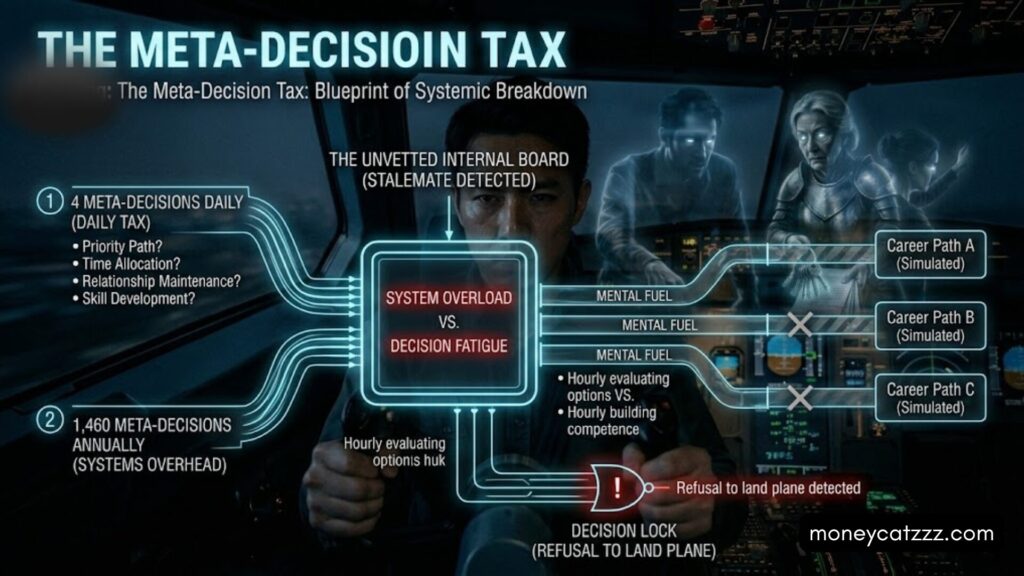
[The Meta-Decision Tax | moneycatzzz.com]
The Honest Cost
Immeasurable things was lost by closing doors. Obviously.
The corporate path that might have led somewhere. Could have, should have, unknowns remain. The business could have scaled. The optionality itself, which felt like security even when it was actually a burden.
Regret? Not even slightly.
I won’t pretend there weren’t tradeoffs though. Every choice eliminates other choices. That’s not a flaw in the decision. That’s the definition of deciding.
The question isn’t whether closing doors has costs. The question is whether maintaining open doors incurs higher costs. For me, it did. The potential trap was more expensive than the commitment turned out to be.

The Runway Runs Out Either Way
You’re in a holding pattern right now. Maybe not with careers. It could be with relationships, cities, or identities. With versions of yourself you’re keeping alive just in case.
The fuel is finite. The runway gets shorter every year.
The holding pattern ends either through choice or through running out of fuel. Your call, which?
I’m not going to tell you that closing doors feels good immediately. It doesn’t. The fear of commitment is real, and it arrives loudest the moment you actually commit.
But the decision fatigue from maintaining infinite optionality is also real. The choice paralysis from refusing to unchose is real. The years spent on maintenance instead of depth are real.
You can keep circling. The plane doesn’t care. It’ll fly the pattern until the fuel runs dry.
Or you can pick a runway and land on it.
What happens after landing isn’t perfect. It’s just real, which turns out to be better than spending your life maintaining the theoretical hope of landing somewhere better someday.
The theoretical option doesn’t compound. Depth does.
Your move.
Field Manuals for the Potential Trap: Resources for a Hard System Reset
Die With Zero

Designing Your Work Life
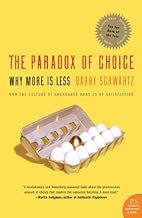
The Paradox of Choice
Disclosure: This post may contain affiliate links. We only recommend products we believe in, and we may receive a commission at no cost to you! Thank you for your support!
Acknowledgment: Cover Image by moneycatzzz.com
Disclaimer: The information is provided for general information only – moneycatzzz.com makes no representations or warranties in relation to the information, including but not limited to any representation or warranty as to the fitness for any particular purpose of the information to the fullest extent permitted by law. While every effort has been made to ensure that the information provided in this article is accurate, reliable, and complete as of the time of writing, the information provided in this article should not be relied upon to make any financial, investment, real estate or legal decisions. Additionally, the information should not substitute advice from a trained professional who can take into account your personal facts and circumstances, and we accept no liability if you use the information to form decisions.