
Reading Time: 8 mins #
This post may contain affiliate links.
My college roommate Maya texted me last spring after three years of silence, inviting me to grab a casual coffee. I stared at the screen for forty-seven seconds before archiving the message, convinced that offering second chances to people who once burned you was pure foolishness.
Â
Anger did not flare. There was no dramatic internal monologue either. I held a quiet, granite conviction; once a door shuts, it stays bolted.
Â
She had flaked on my wedding, borrowed $400 for rent, and ghosted. She walked away from our shared apartment, leaving behind two months of unpaid utilities and a note scribbled on the kitchen counter: “Sorry, things are complicated right now.”
I had long since stopped feeling angry about the money. I assumed I had forgiven her. I just had zero desire to reopen the door.
Â
When my husband asked why I didn’t write back, I gave him a lecture on personal boundaries. He listened patiently, then called my bluff: “You aren’t protecting your energy. You’re just punishing her.“
Â
His words stung because they hit the truth. I was far too stubborn to admit it.
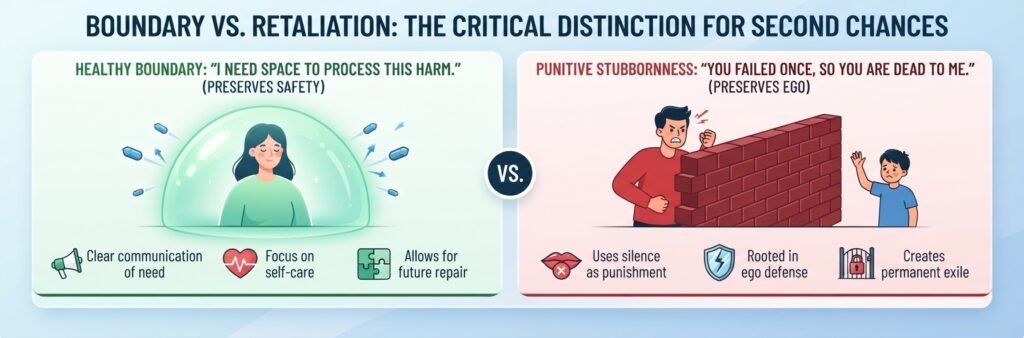
The Difference Between Boundaries and Retaliation
Online pop culture loves to label every hard stop as a healthy boundary. We cut people off, block numbers, and call it high self-regard. Yet our cultural conversation around second chances has been warped by an extreme view of self-preservation. Sometimes an absolute boundary is necessary for safety. Other times, it is just petty retaliation for wearing an expensive coat.
Â
Standing firm felt like wisdom, but in reality, it was a refusal to negotiate.
Mistaking Emotional Immobility for Strength
When someone breaks your trust, your brain notes the threat. It builds a defensive wall around that specific person to ensure you never feel that particular sting again.
Â
The danger lies in letting a temporary shield harden into a permanent frame. It is easy to mistake emotional immobility for strength. You tell yourself that withholding second chances keeps you safe, blind to how much air you are cutting off in the process.
[MindValley Promo | Rewire your mind, transform life. | Vishen Lakhiani]
The Neural Shortcuts of Evolutionary Paranoia
There’s a pattern called cognitive rigidity in Neuroscience, in which the brain forms strong neural pathways around past hurt. Alternative perspectives get blocked. The mind acts like a sponge left out in the West Texas sun. It dries up so completely that when you finally submerge it in water, it floats on top instead of soaking anything in.
Â
That is precisely what stubbornness in relationships does to our capacity for grace, rendering the emotional mechanics of second chances almost impossible to execute. We calcify around our old wounds.
Â
Research conducted by Dr. Michael McCullough at the University of Miami’s Forgiveness Research Lab (2006) on the mechanics of holding grudges explains this reaction. The brain builds high-speed defensive shortcuts to bypass fresh evaluation. It wants to save energy by assuming that old threats remain active forever.
Â
An evolutionary logic drives this reflex. Your nervous system exists to keep you alive, not to help you coordinate pleasant coffee dates. I had allowed evolutionary paranoia to convert every personal disappointment into permanent exile. By letting primitive survival shortcuts dictate long-term friendships, I turned minor friction into an unappealing verdict.
Â
I was acting like that dry sponge, entirely unable to absorb new information about an old friend.
[Weaponizing Boundaries to Protect the Ego | moneycatzzz.com]
Weaponizing Boundaries to Protect the Ego
Unpacking personal pride is uncomfortable because pride looks remarkably like good judgment.
Â
Sitting across from my therapist, I brought up Maya’s message as a casual footnote, pretending it carried no real weight. She listened quietly, then asked a direct question: “What would it actually cost you to answer her?”
Â
“My self-respect,” I replied without hesitation.
Â
She leaned forward. “Look deeper. What would it tangibly cost you today?” I sank back into the chair.
Â
The honest answer was embarrassingly small. An awkward hour at a coffee shop, at the most. The mild annoyance of another flaky excuse.
Â
Above all, it would cost me the comfortable victim narrative I had nurtured for three years.
The Armor of Righteousness
Brené Brown observes how easily we armor ourselves with moral righteousness when we are secretly terrified of vulnerability. She is right in every sense. We pretend we are taking a high road when, in truth, we are just hiding behind a fortress so we do not have to risk getting hurt again.
Â
I had highlighted that exact chapter months earlier, yet I completely missed how I was using righteousness to dodge Maya.
Â
Armor feels protective. Brown is right that popular culture often misinterprets what vulnerability actually demands. Refusing legitimate second chances does not make you invulnerable. It just means your fortress is successfully locking out things you actually want.
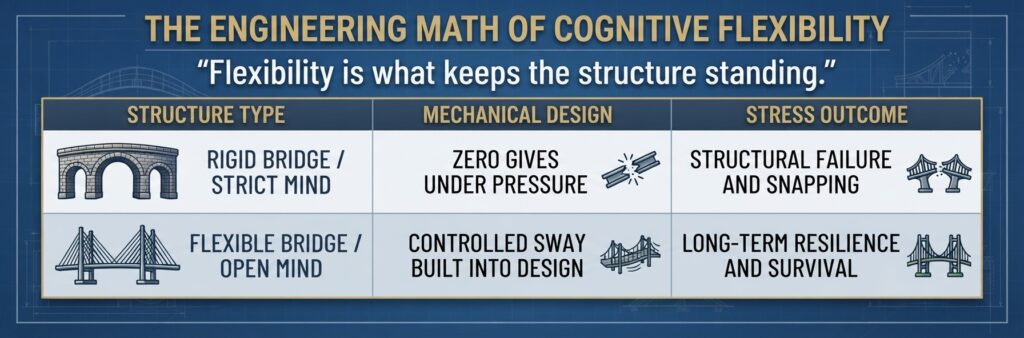
The Engineering Math of Flexibility
A friend of mine who designs infrastructure once walked me through the physics of suspension bridges. She explained how giant steel structures are built to sway several feet in high winds. If an engineer built a completely rigid bridge with zero give, the entire span would snap under heavy stress.
Â
Flexibility is what keeps the structure standing.
We fail to apply this engineering truth when calculating how to forgive someone who hurt us. When we evaluate second chances for people who disappointed us, we default to bad math:
- You broke my trust once.
- Therefore, your trustworthiness is zero forever.
It feels clean. It feels absolute. It is also completely unrealistic.
Overestimating Repeat Betrayal
I had treated Maya’s past mistakes like a permanent blueprint for her future. Assuming she would inevitably hurt me again felt like smart self-defense, but it was really just lazy thinking. I had taken one bad period of her life and turned it into an unappealing lifetime sentence.
Â
Meanwhile, I conveniently forgot how often I had needed grace. I had been late, self-absorbed, and flaky on plenty of occasions. Whenever I screwed up, I hoped people would judge me by my intentions rather than my worst moments. The double standard was undeniable.
Reopening the Door Without Relinquishing Boundaries
Six weeks after receiving her text, I pulled up the archived thread. I typed a short reply: “Still around?“
Â
She wrote back four minutes later.
Â
We met at a small diner downtown. The interaction started awkwardly, filled with long pauses and stiff small talk over lukewarm drip coffee. Slowly, the air softened.
Â
She did not offer smooth excuses. She talked openly about going to therapy, sorting through her chaotic family background, and finally receiving an ADHD diagnosis that helped explain her history of executive dysfunction. She was clear that her diagnosis explained her past actions without excusing the money she owed or the wedding she missed.
Â
I didn’t walk out of that diner trusting her with my life savings. I still don’t. But I realized that giving someone a second chance doesn’t mean pretending the past never happened. It just means making enough room for who they are today.
[The Armor of Righteousness | moneycatzzz.com]
Gathering on New Terms
Priya Parker argues that every meaningful human interaction should be treated as a distinct event rather than a continuation of old history.
Â
Her framing changed my perspective. That coffee meeting was not a formal trial regarding our college apartment. It was simply an hour spent catching up with someone I used to share a life with.
Â
Lowering the stakes cleared the air. We are not close friends today, and we likely never will be. We text every few weeks and catch up for lunch twice a year. She is different. I am different—the dynamic works fine on its new terms.
Applying Growth Mindset Beyond Personal Relationships
Refusing to give people room to change was a habit I had practiced throughout my entire life without realizing it. We rarely discuss second chances in the context of our creative or professional pursuits, but the same mechanics apply:
- Abandoned a draft novel after three standard agent rejections.
- Quit a weekly yoga practice after a minor muscle strain.
- Dropped a career shift after one uninspiring informational interview.
My stubbornness was an all-or-nothing filter. If something failed once, I wrote it off as a total dead end.
[MindValley Promo | Rewire your mind, transform life. | Nir Eyal]
Treating Creative Iteration as System Maintenance
In Mindset: The New Psychology of Success, Carol Dweck outlines the difference between fixed and growth mindsets. I understood her concepts intellectually, but I failed to see how my fixed mindset in relationships and creative projects was quietly sabotaging my progress.
Â
Dweck focuses heavily on learning from personal failure, but growth also means accepting that failure is rarely a permanent condition for others or for projects. Revisions are always possible.
Â
The most important moment came when I stopped withholding second chances from my own unfinished ideas and pulled out that abandoned manuscript six months later. I restructured the core narrative, removed two weak chapters, and resubmitted it. An independent press picked it up eight months after that.
Â
Softening up was not an act of surrender. It was an act of basic structural maintenance.
Cultivating Cognitive Flexibility
Nobody gains anything from rigid stubbornness except ego.
Â
Holding onto absolute grudges will not protect your future. It just keeps you trapped in an old story, walled off from unexpected growth and repaired connections.
Â
Findings from the long-running Harvard Study of Adult Development (the 75-year longitudinal study led by Dr. Robert Waldinger and Dr. George Vaillant) demonstrate that psychological resilience and relational flexibility are among the strongest indicators of long-term health and emotional well-being. Cultivating the perspective required for second chances isn’t about naive optimism or blanket forgiveness. It is about keeping your mind adaptable enough to process reality as it updates.
Â
True discernment knows when to hold a line and when to let the tension go. Sometimes, the strongest thing you can do is let the dry sponge sit in the water long enough to remember how to absorb.
________________________________________________
Disclosure: This post may contain affiliate links. We only recommend products we believe in, and we may receive a commission at no cost to you! Thank you for your support!

Acknowledgment: Cover Image by moneycatzzz.com
Disclaimer: The information is provided for general information only – moneycatzzz.com makes no representations or warranties in relation to the information, including but not limited to any representation or warranty as to the fitness for any particular purpose of the information to the fullest extent permitted by law. While every effort has been made to ensure that the information provided in this article is accurate, reliable, and complete as of the time of writing, the information provided in this article should not be relied upon to make any financial, investment, real estate or legal decisions. Additionally, the information should not substitute advice from a trained professional who can take into account your personal facts and circumstances, and we accept no liability if you use the information to form decisions.