
 Reading Time: 8 mins #
 This post may contain affiliate links.
You’re meeting someone for the first time. The conversation flows effortlessly. You find yourself nodding simultaneously, leaning in when they do, even chuckling in unison. It’s not coincidence or chemistry—it’s the psychological dance of Matching and mirroring.
Matching and mirroring isn’t about mimicry or manipulation—it’s about resonance. It’s how we silently say, “I see you. I understand.” From coffee shop chats to high-stakes boardrooms, Matching and mirroring can quietly transform the quality of our relationships—personal, professional—even internal.
“People will forget what you said, people will forget what you did, but people will never forget how you made them feel.” – Maya Angelou.
In this article, we’ll explore how this skill works, the neuroscience behind it, real-life applications, and how to use it authentically and ethically across cultures, relationships, and self-awareness.

The Psychology Behind Matching and Mirroring
Humans are wired for connection. One of the most profound ways we achieve it is through our brain’s mirror neuron system—cells that fire when we act and observe someone else performing the same action. This neurological response creates the building blocks of empathy.
When you subtly reflect someone’s tone, posture, or gestures, your brain signals: “I relate to you.” That familiarity breeds trust.
In his groundbreaking book Influence: The Psychology of Persuasion, Robert Cialdini describes how we’re likelier to say “yes” to those we perceive as similar. Matching and mirroring activate that similarity instinct, creating a sense of shared rhythm—often without a single word exchanged.

[“Matching and Mirroring” – Photo by Kampus Production]
Cultural Intelligence: Mirroring Across the Globe
While Matching and mirroring are universally human, their expression is deeply cultural. What feels like a connection in one culture can feel invasive in another.
Key Considerations:
- Eye contact may feel respectful in the West but aggressive in some Asian cultures.
- In hierarchical cultures—mirroring a superior’s posture or tone may be seen as presumptuous.
- Collectivist societies often value group harmony over individual resonance—changing how rapport is built.
How to Adapt Thoughtfully:
- Research first: Understand cultural customs around body language, speech patterns, and emotional expressiveness.
- Observe before acting: Let the other person set the rhythm, then gently join it.
- Be flexible: Respect and adapt to what creates comfort—not just connection.
- Lead with empathy: Your intent matters more than technique.
Matching and Mirroring becomes a powerful bridge-builder—not just a social tool when used with cultural sensitivity.
Creating Deeper Bonds: Mirroring in Personal Relationships
Ever feel like someone wasn’t listening? We all have. That hollow feeling comes from a lack of attunement—something Matching and mirroring can mend.
When you align with someone’s energy, whether joyful or low, it sends an unspoken message: “I’m here. With you.”
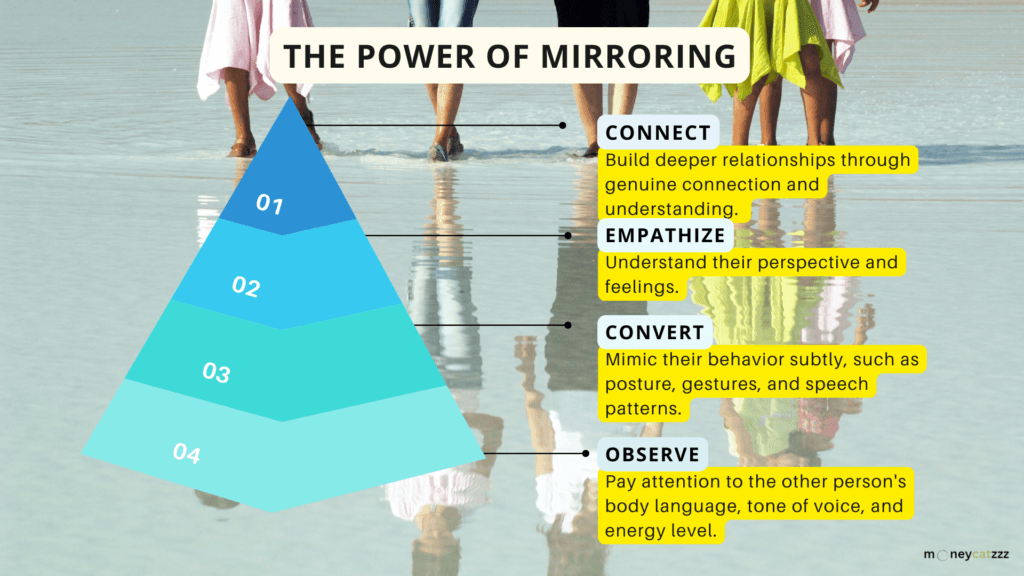
[“The Power of Mirroring” – moneycatzzz.com]
My Story:
I recall sitting with a friend who was emotionally drained from a breakup. Usually, I’d jump in with advice. Somehow on this particular time, I mirrored her slumped posture, slowed my speech—sat in discomfort with her.
Hours later, she said, “That was the first time I felt heard.” I hadn’t said much. But my presence, my rhythm, spoke volumes.
In Conflict:
When emotions run high, Matching and mirroring defuse tension. Reflecting someone’s intensity—not to escalate, but to validate—helps them feel understood. From there, dialogue can begin.
Professional Presence: Mirroring in the Workplace
Matching and mirroring become your silent edge in interviews, negotiations, and daily work dynamics.
Case Study – The Sales Win:
A seasoned account executive, Emily shared how she mirrored a reserved client during a high-stakes pitch—she matched his contemplative pace, paused where he did, and adopted his structured speech. He later told her, “I felt you understood exactly what I needed.” That meeting turned into a long-term contract.
In Leadership:
Leaders who practice Matching and mirroring aren’t just liked—they’re trusted. Mirroring a team’s enthusiasm fosters momentum. Mirroring calm during a crisis creates stability. It’s how emotional intelligence translates into action.
Curious about the negotiation psychology behind this? Never Split the Difference by Chris Voss explores real-world tactics rooted in rapport and mirroring.
The Ethics of Emotional Influence
Like any powerful tool, Matching and mirroring carries risk. Use it unethically, and it slips into manipulation.
Guardrails to Stay Grounded:
- Be authentic: Don’t perform. Align.
- Lead with intention: Connection—not control.
- Be transparent: If you’re building rapport, let it be mutual—not a tactic.
Actual influence doesn’t require deceit. When used sincerely, mirroring invites trust—not to close deals, but to open hearts.

[“The Miracles of Matching and Mirroring” – Photo by Barbara Olsen]
The Mirror Within: Aligning with Your Inner Self
What if you turned Matching and mirroring inward?
You start to catch patterns when you observe your reactions—your energy, posture, and thoughts. Are you unconsciously mirroring toxic energy at work? Are you echoing stress signals in relationships?
Self-mirroring reveals not just how we connect—but who we’ve become.
Practice for Reflection:
- Pause during your day and ask: “Who am I matching right now?”
- Notice your breathing, your pace. Is it your own, or are you absorbing someone else’s?
- Return to alignment with your values—mirror your ideal self—not just your surroundings.
In “The Power of Now“, Eckhart Tolle reminds us that presence is the deepest connection. Mirroring that presence back to yourself? That’s inner alignment.
Brand Mirroring: How Companies Build Trust
Let’s zoom out for a moment. Matching and mirroring don’t stop at individual interaction—they scale.
Starbucks: A Case Study in Everyday Mirroring
Walk into a Starbucks, and you’ll find baristas who match your mood. Quiet and reflective? They lower their tone. In a rush and buzzing? They match your urgency.
Their environment mirrors customer preferences—customizable drinks, soft lighting, and communal seating. That’s mirroring on a brand level. And it’s one reason their loyalty is legendary.
👉 Explore how Starbucks designs for human connection. Read it here.

Small Shifts, Big Ripples: Daily Practices to Try
Want to integrate Matching and mirroring into your life without feeling robotic? Start simple:
- Match tone and tempo: Let your voice join the rhythm of the person you’re with.
- Align posture subtly: If they lean in—you lean in. If they pause—you pause.
- Listen with full attention: Sometimes, the real mirror is silence.
- Use shared language: Repeat a keyword or phrase they use—it signals you’re tracking.
These micro-moments of reflection build macro-level trust.
Why This Matters More Than Ever
The rarest currency in a world of constant noise is “presence.” Matching and mirroring don’t require fancy tools, certifications, or tech. Just attention. Intention. And a willingness to meet people where they are.
Whether deepening a relationship, leading a team, or anchoring yourself, this practice helps you tune into what matters: connection.
As Dale Carnegie said:
“You can make more friends in two months by becoming interested in other people than you can in two years by trying to get them interested in you.”
Let that interest become a mirror. A silent invitation—I see you. I’m with you. Let’s meet in the middle.
So, what will you mirror today?
Maybe it’s your child’s enthusiasm—a coworker’s careful pause. Or your own quiet need for rest. Whatever it is—meet it—match it. And start creating ripples—one interaction at a time.
Disclosure: This post may contain affiliate links. We only recommend products we believe in, and We may receive a commission at no cost to you! Thank you for your support!
Acknowledgement: Cover Photo by Werner Pfennig
Disclaimer: The information is provided for general information only – moneycatzzz.com makes no representations or warranties in relation to the information, including but not limited to any representation or warranty as to the fitness for any particular purpose of the information to the fullest extent permitted by law. While every effort has been made to ensure that the information provided in this article is accurate, reliable, and complete as of the time of writing, the information provided in this article should not be relied upon to make any financial, investment, real estate or legal decisions. Additionally, the information should not substitute advice from a trained professional who can take into account your personal facts and circumstances, and we accept no liability if you use the information to form decisions.