Reading Time: 8 mins #
This post may contain affiliate links.

An hourglass sits on my desk. At $49, it was not there as a decoration. I bought it after a sixty‑hour workweek that left me with no memory of joy. The sandglass was to remind me that time falls whether you watch it or not.
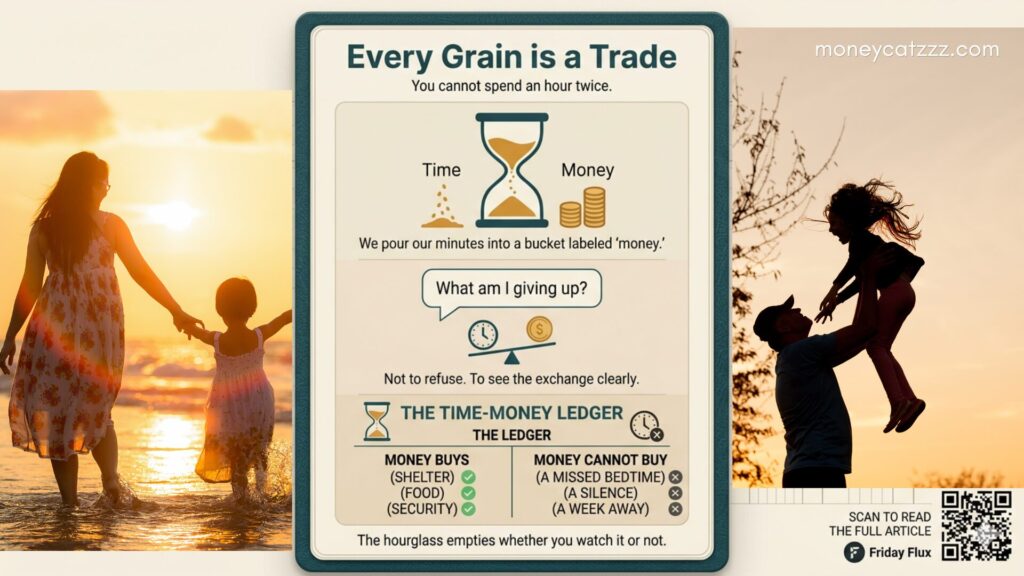
Each grain is a second, a minute. We pour our time into a bucket labeled “money.” The bucket fills, the hourglass empties, then we flip it again.
Last week, forty hours were traded. The money arrived in my account, a clean, certain amount. Those time grains did not come back. What did they buy? Settling a bill here, a coffee there. I have been paying for a subscription I never use. I am tired. Fatigued.
Twice last week, my daughter’s bedtime passed while I was still typing. “Just this once,” I told myself. The once became a pattern. The money bought comfort. The absence brought distance. I felt both.
There is a line from Off the Clock that stuck with me: “You cannot save time. You can only spend it.” I want to disagree with her, but the hourglass does not judge; it just falls. Every grain that drops is a trade you made.
The Trade You Did Not Count
My father worked double shifts for years. He bought us a house. He also missed my piano recitals, my school plays, and the night I learned to ride a bike. He was proud of the house, and he should have been, but I would have traded the house for one recital.
He is gone now, and the house remains. The time does not.
We unknowingly commit to trading time that no one counts. The money is visible. The hours are traded until you look back and see the empty spaces.
I made the same sacrifice: a freelance project devoured a Saturday. The money was good. My daughter wanted to bake cookies. “Later,” I said. Later came. I bought the cookies the next day, but the mother-daughter moment cannot be bought.
A study on “time affluence” found that people who prioritize time over money report higher well‑being. The effect is relative. A small mindset shift that values time over money leads to greater happiness. My father valued the house. He was not unhappy. But I often wonder if he would have chosen differently, knowing what I know now.
I wonder the same about myself.
[The trade you do not count | moneycatzzz.com]
The Myth of “Just a Little More”
The trap in believing that just a little more money will finally make you safe is a fallacy.
There’s always one more promotion to reach. The quest for one more side hustle or more freelance clients never ends. Extra income feels like progress. Extra time feels like a sacrifice. Temporary becomes permanent without a vote.
My friend Erica, a graphic designer, took on a third client last year. She worked nights and weekends, paid off her debt, and stopped sleeping, exercising, and seeing friends. “Grinding,” she called it. “Disappearing,” I called it.
Erica quit the third client, and the debt took longer to vanish. Her normal self returned. She decided presence was worth more.
Our obsession with productivity is a defense against the anxiety of finitude. Oliver Burkeman claims that we try to cram more in because we are terrified of running out. But the running out is not the problem. The problem is spending the time that is running out on things that do not matter.
I had a similar dilemma with a travel project that offered a significant financial reward. The cost was a week away from my partner. The paycheck arrived, but so did a strange distance between us. We repaired it. I have learned that money can buy many things, but it cannot buy back a week of silence.
The Hourglass Almost Empty
How we spend our allocated time is subjective. My aunt Gretchen worked as a nurse for forty years, saved diligently, and planned for travel and gardening. She was diagnosed with a degenerative illness six months after her retirement at sixty-two.
She had the money, but money cannot buy time. Her savings went to treatments, not trips. A neighbor now cares for her garden.
The hourglass empties whether you watch it or not. Aunt Gretchen would have worked for ten more years because she loved her job. The question is: what are you pouring your grains into?
The concept of “opportunity cost of time” is well known in economics. Every hour spent earning is an hour not spent resting, connecting, or creating. The market does not track that loss. It only shows the gain. We have to keep our own records.
[Every Grain is a Trade | moneycatzzz.com]
A Ritual for Conscious Trading
A systemic approach to balancing time over money does not involve a budget or spreadsheets. Just a question:
“What am I giving up?”
The objective is not to refuse every time, but to see the exchange clearly.
Last week, a last‑minute consulting call landed in my inbox. The fee was generous. The trade-off was my evening walk that untwists my spine after a day of sitting. I took two minutes to question and consider. I took the job knowing what I was trading.
The Grain That Fell
There is probably a clock on a wall in your home. You wear a watch. You use a digital calendar.
Vanderkam writes that people who track their time often discover they have more than they thought, not less. We live in constant lack. The problem is not scarcity of time. Time is eternal. The problem is the misallocation of time. We pour grains into buckets without looking.
“The money will come again. The hour will not.”
I wrote that as a screensaver to appear between pictures of my daughter.
Your Hourglass
Only you know your hourglass. We need to work because bills don’t pay themselves.
Money matters. It buys shelter, food, medicine, and security. But it does not buy back time. Some minutes have passed since reading this post. Was it worth it?
Only you can answer.
_________________________________________
Disclosure: This post may contain affiliate links. We only recommend products we believe in, and we may receive a commission at no cost to you! Thank you for your support!

Acknowledgment: Cover Image by moneycatzzz.com
Disclaimer: The information is provided for general information only – moneycatzzz.com makes no representations or warranties in relation to the information, including but not limited to any representation or warranty as to the fitness for any particular purpose of the information to the fullest extent permitted by law. While every effort has been made to ensure that the information provided in this article is accurate, reliable, and complete as of the time of writing, the information provided in this article should not be relied upon to make any financial, investment, real estate or legal decisions. Additionally, the information should not substitute advice from a trained professional who can take into account your personal facts and circumstances, and we accept no liability if you use the information to form decisions.