
 Reading Time: 8 mins #
 This post may contain affiliate links.
The Song That Made Me Drop Everything
“You got a fast car—I want a ticket to anywhere.”
Tracy Chapman’s “Fast Car“ started playing from my phone while I was folding my ex-boyfriend’s boxers that he’d left behind six months ago, which I’d been washing and rewashing like some textile shrine to bad decisions. The opening guitar made my hands stop mid-fold, holding paisley-print underwear that belonged to a man who’d cheated on me with someone from his CrossFit gym, because of course she was from CrossFit.
But the song wasn’t about him. It pulled me backward through time like someone yanking a tablecloth out from under dishes, and suddenly I was twelve years old, sitting on the heating vent in my childhood bedroom, writing in a Lisa Frank diary about how I was going to be a writer in New York who wore all black and had interesting opinions about wine.
My younger self had materialized right there between the detergent and the fabric softener, and she was looking at thirty-seven-year-old me with the kind of disappointment usually reserved for canceled TV shows and politicians.
The Attic in My Head
There’s this thing that happens when you’re forced into self-reflection by a song you haven’t heard since middle school. Your brain becomes an attic you’ve been avoiding, full of boxes labeled “DO NOT OPEN“ in your own handwriting. I could smell the Lip Smackers strawberry gloss, feel the scritchy wool of my school uniform, taste the Tab cola I drank to seem sophisticated.
My younger self was sitting cross-legged on my childhood carpet, the one with the juice stains shaped like Australia, holding that diary where I’d written my life plan in purple gel pen. She was wearing those jeans I’d begged my mother for, the ones with the deliberate rips that cost extra for having less fabric, which now seems like a perfect metaphor for my entire adult life.
“So,” she said, in that voice that hadn’t learned to modulate itself for other people’s comfort yet, “this is what we became?”
I wanted to explain the economy, how writing doesn’t pay, compromise and reality, and all the sophisticated reasons I’d ended up in marketing instead of Manhattan. But she was holding the diary open to a page that said “NEVER SETTLE FOR BORING LOVE“ in all caps with hearts dotting the i’s, while I stood there holding another man’s abandoned underwear.
The Inventory of Betrayals
Viktor Frankl writes in Man’s Search for Meaning that between stimulus and response there’s a space where we choose, but he doesn’t mention what happens when you look back and realize you’ve been choosing wrong for fifteen years. My younger self had started pulling things out of imaginary boxes, evidence of all my life choices that had slowly murdered her dreams.
The corporate job I’d taken “temporarily” eight years ago. Still there.
The novel I was “working on.” Fourteen pages in five years.
The relationship I’d stayed in because leaving felt harder than dying slowly.
The city I’d never left because moving seemed irresponsible.
Research on identity development shows that we often abandon our authentic selves gradually, through tiny compromises that seem reasonable at the time. But my younger self didn’t care about research. She cared that I’d become someone who owned sensible shoes and worried about interest rates.
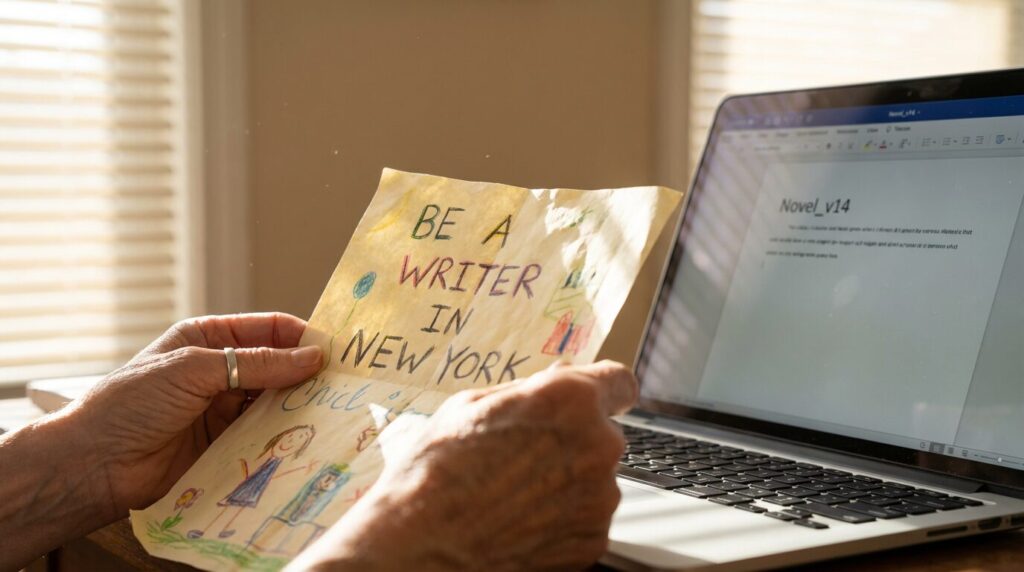
[“The Gap Between Promise and Page” – Image by Nano Banana Pro (moneycatzzz.com)]
The Negotiation Across Time
“You got fat,” she said, because twelve-year-olds have no filter, and also because it was true.
“You were shallow,” I replied, because apparently I was arguing with a child who was also me.
This is the thing about emotional reconciliation with your past self: it’s ugly. Irvin Yalom writes in The Gift of Therapy about the importance of facing all versions of yourself, but he makes it sound therapeutic, when really it’s like being roasted by someone who knows all your passwords.
My younger self pulled out artifact after artifact. The poem I’d written about becoming fearless, while I’d spent the last decade afraid of everything from commitment to carbohydrates. The list of places I’d travel, while my passport expired unused in a drawer. The sketch of my future apartment, all windows and plants and possibilities, while I lived in a beige box with Venetian blinds.
The Uncomfortable Questions
She wanted to know things I couldn’t answer:
“Why did you stop writing stories?”
“When did you decide being small was safer?”
“How did you forget that we hate morning meetings?”
“Why are you washing his underwear when he’s with a CrossFit girl?”
That last one made me drop the boxers into the trash, which was probably overdue by about six months and several therapy sessions.
Personal growth isn’t supposed to feel like being interrogated by your twelve-year-old self, but there I was, standing trial in my laundry room.
Harvard Business Review’s research on self-reflection emphasizes its importance for leadership. Still, it doesn’t mention that sometimes leadership means admitting to your childhood self that you became exactly what you swore you wouldn’t.

The List of Promises Broken
My younger self had kept receipts. Not metaphorical ones, actual lists in that diary:
“NEVER work in an office” (Currently has a designated parking space)
“ALWAYS choose adventure” (My last adventure was trying a new flavor of hummus)
“NEVER date boring men” (Had a file folder labeled “Kevin’s Tax Documents”)
“BE BRAVE” (Was afraid of my own email inbox)
Ian Morgan Cron writes in The Road Back to You about finding your way back to your essential self, but he doesn’t mention how embarrassing it is when your essential self is a twelve-year-old who thinks you’re a sellout.
The Truce
Somewhere between the spin cycle and accepting that I’d wasted my thirties, something shifted. My younger self stopped looking angry and started looking sad. Not for herself, but for me. For us. For the gap between whom we’d planned to be and who we’d settled for becoming.
“You’re not dead yet,” she said, which was both obvious and profound in the way only kids can manage.
She was right. At thirty-seven, I had time to honor at least some of those purple gel pen promises. Not all of them, because some were genuinely stupid (becoming friends with Madonna was probably never going to happen), but the ones that mattered. The ones about bravery, creativity, and not settling for boring love.
Self-reflection with your younger self isn’t about going backward. It’s about remembering what you knew before the world taught you to doubt it. That twelve-year-old with the embarrassing diary and unrealistic dreams had something I’d lost: the absolute certainty that life should be interesting.

[“What She Dreamed vs. What I Built” – Image by moneycatzzz.com]
The Integration
Since that laundry room encounter, I’ve been making different life choices. Small ones mostly. I threw out all the sensible shoes. Started writing again, badly but consistently. Ended things with Kevin-with-the-tax-documents. Signed up for a pottery class just because twelve-year-old me would have thought it was cool.
Emotional reconciliation with your younger self doesn’t mean becoming childish. It means remembering what mattered before you learned to be practical. It means checking your decisions against the person you were before fear became your operating system.
I carry her with me now, this twelve-year-old judge with her diary and her certainty. When faced with choices, I ask: would she be proud or disappointed? It’s a low bar, honestly. She mostly just wanted me to be interesting and brave. But I’d been failing even that standard for so long that meeting it feels revolutionary.
What Would Your Younger Self Say?
That “Fast Car” morning changed something fundamental about how I approach personal growth. Not through strategic planning or goal-setting, but through the simple practice of remembering who I was before I learned to apologize for existing.
Your younger self is still there, holding its own inventory of your compromises, betrayals, and abandoned dreams. They’re waiting for you to stop being sensible long enough to remember what you actually wanted before you learned to enjoy what was expected.
The conversation won’t be comfortable. They’ll point out every place you sold out, gave up, or chose safety over satisfaction. But they’ll also remind you of what you knew before knowing became complicated: that life is supposed to be more than endurance.
What promises did you make to your younger self that you’ve broken?
What would twelve-year-old you think of your current life choices?

Books That Helped Me Reconcile With My Younger Self

The Gift of Therapy

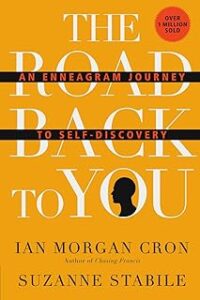
The Road Back to You
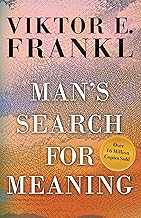
Man’s Search for Meaning
Disclosure: This post may contain affiliate links. We only recommend products we believe in, and we may receive a commission at no cost to you! Thank you for your support!
Acknowledgment: Cover Image by moneycatzzz.com
Disclaimer: The information is provided for general information only – moneycatzzz.com makes no representations or warranties in relation to the information, including but not limited to any representation or warranty as to the fitness for any particular purpose of the information to the fullest extent permitted by law. While every effort has been made to ensure that the information provided in this article is accurate, reliable, and complete as of the time of writing, the information provided in this article should not be relied upon to make any financial, investment, real estate or legal decisions. Additionally, the information should not substitute advice from a trained professional who can take into account your personal facts and circumstances, and we accept no liability if you use the information to form decisions.