
 Reading Time: 10 mins #
 This post may contain affiliate links.
In today’s unpredictable world, financial uncertainty has become a constant. From global pandemics to industry layoffs to personal crises, income loss can strike anyone, anytime. For professionals, entrepreneurs, freelancers, and families alike—resilience isn’t just a buzzword—it’s a financial imperative.
While we can’t always control what happens to our income, we can control how prepared we are. Building financial resilience means having the tools, mindset, and resources to weather setbacks and emerge stronger. At the heart of that preparedness is a well-funded emergency fund, diversified income streams, reduced debt, and a strategic approach to financial planning.
“By failing to prepare, you are preparing to fail.” – Benjamin Franklin.
This guide offers a comprehensive strategy to prepare for the unexpected, minimize financial damage, and confidently regain stability.
1. Start with Your Financial Safety Net: The Emergency Fund
An emergency fund is your “financial first responder“—it provides the cushion you need when income stops, whether due to job loss, illness, or market disruptions. Yet, according to Bankrate’s 2024 report, 44% of Americans can’t cover a $1,000 emergency expense from savings.
Building Your Emergency Fund:
- Set your goal: Aim to save three to six months of essential living expenses. Include rent or mortgage, utilities, food, insurance, and minimum debt payments.
- Start small, stay consistent: Automate a small weekly transfer into a high-yield savings account like those offered by Ally or Marcus by Goldman Sachs.
- Make it accessible but not tempting: Store funds in liquid accounts that are not too easy to dip into. Avoid tying up your emergency fund in investments that fluctuate.
Resources like NerdWallet offer comparisons of top high-yield accounts to optimize your savings.

[“Mastering Financial Resilience: Planning with Confidence” – Photo by Mikhail Nilov]
2. Diversify Your Income Streams for Stability
Relying on one source of income is increasingly risky. Today’s economic environment rewards those who build multiple income channels.
Side Hustles and Freelancing: Tap into your skills to build freelance work or side businesses. Platforms like Upwork or Fiverr enable professionals to earn income in writing, design, marketing, consulting, and beyond.
Passive Income Opportunities:
- Dividend-paying stocks: Regular payouts that can buffer cash flow.
- Real estate investments: Rental income provides consistent returns, though it comes with upfront costs.
- Digital products or courses: If you’re an expert in a niche, create eBooks, templates, or online classes on platforms like Teachable or Gumroad.
The goal isn’t to replace your full-time job but to build resilience by spreading financial risk across multiple sources.

3. Reduce Your Financial Risk with Smart Planning
Risk management is a critical but often overlooked part of building resilience.
Insurance is Your Backstop:
- Disability insurance: Replaces a portion of your income if you cannot work.
- Life insurance: Ensures your loved ones aren’t financially burdened if the unexpected happens.
- Health insurance: A major medical event without coverage can destroy your finances.
Tighten Expenses and Eliminate High-Interest Debt: Conduct a quarterly financial audit. Identify and reduce discretionary expenses. Funnel those savings toward debt reduction and emergency savings.
Debt is a financial accelerant—but in the wrong direction. Focus on paying off high-interest credit cards, personal loans, and payday advances first. Use tools like Undebt. to create a custom payoff strategy.
4. Learn to Negotiate: Don’t Suffer in Silence
When facing income loss, communication is key. Instead of falling behind on payments, proactively negotiate with creditors, lenders, or landlords.
What to Say:
- Explain your situation honestly: “I’ve experienced a recent job loss and am working on a new income plan.”
- Ask about hardship programs, payment plans, or interest rate reductions.
- Follow up in writing to keep a paper trail.
Resources like the National Foundation for Credit Counseling (NFCC) offer free or low-cost support if you need help dealing with multiple creditors.
5. Reevaluate Your Financial Goals Frequently
Financial plans must be flexible. Life doesn’t follow a straight line, and your goals shouldn’t either. During times of change or uncertainty:
- Shift from long-term to short-term goals: Focus on staying afloat, not scaling up.
- Cut non-essentials: Subscription audits, delayed large purchases, and lifestyle downgrades can add financial breathing room.
- Rebuild step-by-step: As income stabilizes, reset and rebuild your long-term plans with renewed purpose.
Resilience means knowing when to pivot.
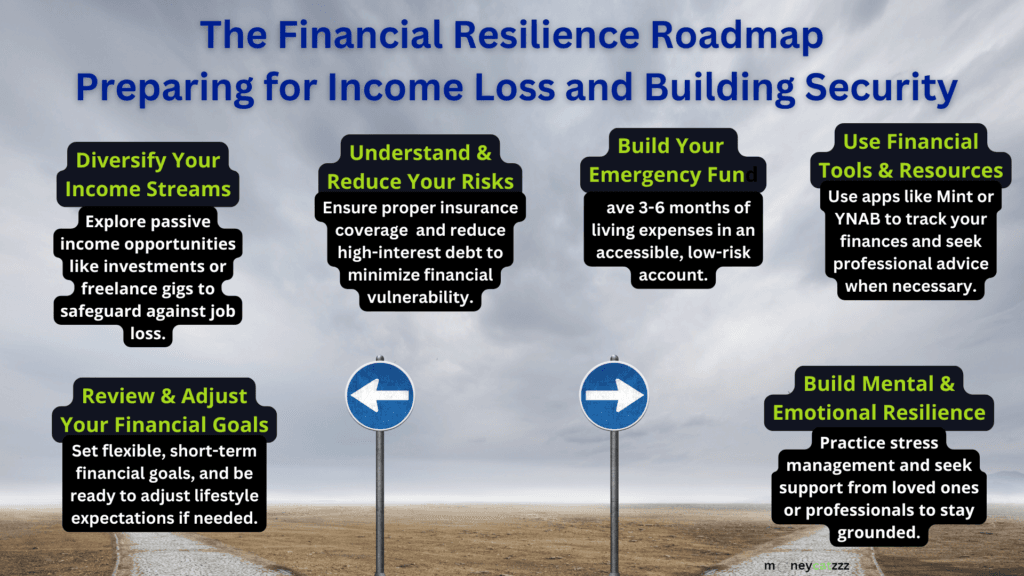
[“The Financial Resilience Roadmap” – Image by moneycatzzz.com]
6. Utilize Modern Financial Tools
Today’s tech landscape is rich with tools that promote clarity, control, and calm.
Budgeting apps:
- You Need a Budget (YNAB): Helps allocate every dollar intentionally.
- PocketGuard: Tracks spending and identifies where you can cut back.
Emergency savings tools:
Online advisors:
- Personal Capital: Blends automated investing with human advice.
Use these tools to track cash flow, monitor debt, and refine your real-time budget.

7. Build Mental and Emotional Resilience
Financial resilience isn’t just numbers and strategy—it’s mindset.
Adopt a Growth Mindset:
- View setbacks as setups for comebacks.
- Learn from each challenge and adapt.
Keep your focus on what you can control.
Practice Mental Wellness:
- Meditation, exercise, and journaling help reduce anxiety and clarify decision-making.
- Avoid shame. Financial hardship is not a personal failure; it’s a human experience.
Lean on Your Support Network: Friends, family, or online communities (such as Reddit’s r/personalfinance) offer solidarity and often surprising ideas or emotional relief.
Planting the Seeds for Your Financial Future
As Warren Buffett famously said, “Someone is sitting in the shade today because someone planted a tree a long time ago.“ This profound insight reminds us that the financial security and peace of mind we enjoy—or hope to pass on—are the fruits of deliberate, often unseen actions taken well in advance.
Building financial resilience isn’t reserved for the wealthy or those with perfect circumstances. It is a practical, empowering process available to anyone willing to prepare for the uncertainties of life—whether creating a robust emergency fund, managing debt responsibly, or diversifying income streams, every step you take today is a seed planted for tomorrow’s stability.
In a world where sudden income loss or unexpected crises can strike without warning, your emergency savings serve as the protective canopy—the shade—that shelters you and your loved ones from financial storms. Resilience is not merely about bouncing back; it’s about growing stronger, smarter, and more adaptable after hardship.
Start today and invest time and effort now into cultivating your financial landscape. Your legacy—your peace of mind, your family’s well-being, or your entrepreneurial ambitions—depends on the foundation you build today; by preparing thoughtfully, you ensure that future generations can rest comfortably in the shade you create.
Disclosure: This post may contain affiliate links. We only recommend products we believe in, and We may receive a commission at no cost to you! Thank you for your support!
Acknowledgement: Cover Photo by Andrés Canchón on Unsplash
Disclaimer: The information is provided for general information only – moneycatzzz.com makes no representations or warranties in relation to the information, including but not limited to any representation or warranty as to the fitness for any particular purpose of the information to the fullest extent permitted by law. While every effort has been made to ensure that the information provided in this article is accurate, reliable, and complete as of the time of writing, the information provided in this article should not be relied upon to make any financial, investment, real estate or legal decisions. Additionally, the information should not substitute advice from a trained professional who can take into account your personal facts and circumstances, and we accept no liability if you use the information to form decisions.