
 This post may contain affiliate links.
 Reading Time: 8 mins #
Leonard Cohen was singing “Anthem” when I finally understood why my old business cards felt like tombstones. “There is a crack in everything, that’s how the light gets in.” Those cards, printing me as “Senior Technical Architect,” weren’t just outdated. They were experiencing desuetude, the beautiful legal principle where laws die not through repeal but through the quiet dignity of disuse. Just like those cards, parts of who we used to be can fade away without drama, without announcement, simply through the geometry of neglect.
I keep those cards in a drawer now, not out of nostalgia, but as evidence. Evidence that identities, like laws, lose their force when we stop enforcing them. The person on those cards still exists in some parallel universe, where I never stopped coding, never started writing, and never discovered that letting go of my professional identity is how new selves are born.
The Architecture of Desuetude
Desuetude comes from the Latin meaning “out of use.” In law, it refers to legislation that remains technically valid but is practically dead because it is no longer followed. There’s a town in Michigan where it’s still illegal to tie your alligator to a fire hydrant. The law exists, but its authority has evaporated through decades of irrelevance.
Your old identities work the same way. That certification you earned ten years ago, that title you fought to achieve, that reputation you carefully built: they’re all still technically yours. But if you haven’t inhabited them recently, they’ve entered desuetude. They’re laws written for a country you no longer inhabit.
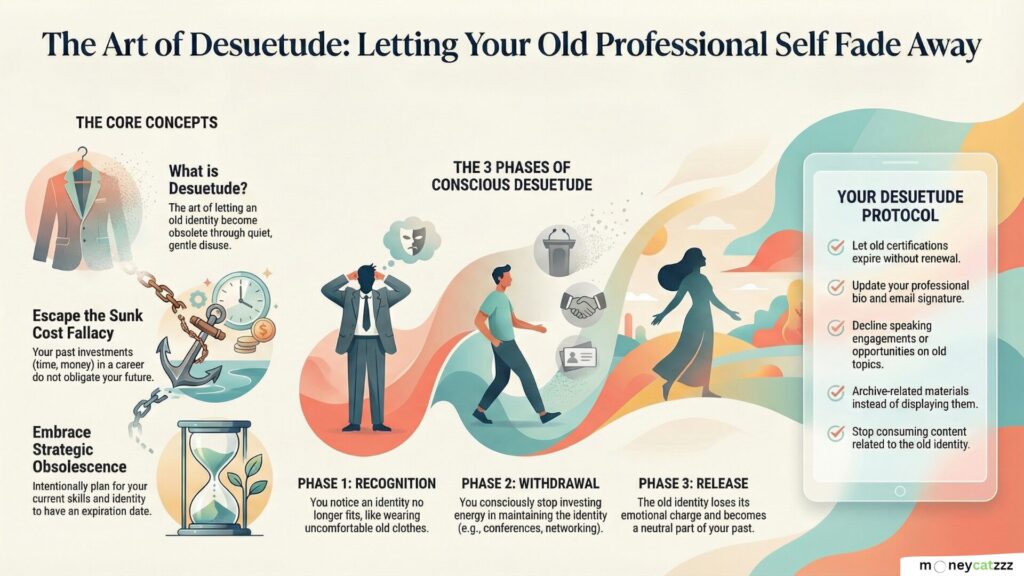
William Bridges notes that we often try to start new chapters without ending old ones. But transformation requires space, and space requires emptying. Desuetude is nature’s way of creating that space without violence.
The Sunk Cost Fallacy in Career Architecture
I spent seven years becoming an architect of systems. Not buildings, but the invisible structures that make technology work. The education cost me $80,000 and countless nights. When I realized I wanted to write instead, those seven years felt like chains.
This is the sunk cost fallacy in career planning: believing that past investments obligate future commitments. It’s thinking that your history is your destiny. But watching those old skills fade taught me something: expertise has a half-life. If you don’t feed it, it starves. And sometimes, that starvation is mercy.
Research from behavioral economics shows we irrationally overvalue past investments when making future decisions. We keep dead identities on life support because we can’t accept the loss. But desuetude offers a different frame: you’re not losing anything. You’re letting something complete its natural cycle.
The sunk cost fallacy in career decisions makes us treat our past like a mortgage that must be paid off. But what if it’s actually rent for a place we no longer live in? You can stop paying anytime. The landlord of your past has no legal recourse against your future.
Identity Liquidation as Sacred Geometry
Identity liquidation sounds violent, like a corporate bankruptcy. But I prefer to think of it as composting. You take the dead parts of who you were and let them decompose into nutrients for who you’re becoming.
I’ve been through three primary cycles of identity liquidation:
- From programmer to architect (age 25)
- From architect to consultant (age 30)
- From consultant to writer (age 35)
Each transition required letting the previous identity enter desuetude. Not fighting it, not announcing it, just… stopping. I stopped reading the technical journals. Stopped attending the conferences. Stopped answering questions about that world. Slowly, that version of me faded like a photograph left in sunlight.
Martha Beck writes about this in Finding Your Own North Star, referring to it as “death and rebirth.” But death sounds too dramatic. Identity liquidation through desuetude is gentler: it’s deciding not to water a plant and watching it naturally return to earth.

[“The Sunset Clause: Designing Your Own Exit” – Image by moneycatzzz.com]
Strategic Obsolescence of the Self
Companies use strategic obsolescence to ensure that products eventually become obsolete, necessitating replacement. They built in expiration dates. We should do the same with our identities. Every version of you should have a sunset clause.
The problem is we treat our professional selves like permanent monuments when they should be temporary installations. That expertise you’re clinging to? It was never meant to last forever. It was meant to serve a season, then fade.
Strategic obsolescence in personal development means:
- Accepting that current skills will become irrelevant
- Planning for your own replacement
- Building identities with graceful exit strategies
Studies on career transitions show that people who plan for obsolescence adapt better to change than those who assume permanence. They’re not surprised when their industry shifts or their passion wanes. They’ve already architected their fade.
Letting Go of Professional Identity Without Drama
Letting go of professional identity doesn’t require a resignation letter to the universe. You don’t need to burn bridges or make declarations. You need to stop participating in the old rituals.
When I stopped being a technical architect, I didn’t make a public announcement. I just:
- Declined speaking engagements on technical topics
- Let certifications expire without renewal
- Changed my email signature
- Started introducing myself differently
Within six months, the universe had updated its records. People stopped calling me for technical consultations. New opportunities aligned with my new identity began to appear. The market adjusted to my desuetude faster than I expected.
Carol Dweck’s Mindset distinguishes between fixed and growth mindsets. But there’s a third option: the desuetude mindset, where you neither cling to who you were nor force who you’ll become. You allow natural transitions to occur through selective neglect.
The Physics of Replacement
Nature abhors a vacuum, but it adores replacement. When you stop feeding old identities, new ones naturally emerge. It’s not something you force; it’s something you allow. The space created by letting go of professional identity doesn’t stay empty long.
Think about your computer desktop. When you delete old files, you don’t have to fill that space immediately. The emptiness is useful. It’s potential. Desuetude creates that same desktop space in your identity structure.
Research on neuroplasticity confirms that the brain literally rewires itself when old patterns are no longer reinforced. The neural pathways of your former identity weaken through disuse, making room for new configurations. Strategic obsolescence isn’t just a metaphor; it’s a biological phenomenon.
The Three Phases of Conscious Desuetude
Through observation, I’ve identified three phases of conscious desuetude:
Phase 1: Recognition
You notice that an identity no longer fits. It feels like wearing clothes from high school: technically possible but uncomfortable. This recognition often comes during moments of friction, when you’re asked to perform the old role and feel resistance.
Phase 2: Withdrawal
You stop investing energy in maintaining the identity. No more conferences, no more continuing education, no more networking in that space. This isn’t abandonment; it’s strategic obsolescence in action.
Phase 3: Release
The identity loses its charge. Someone asks about your old work, and you feel nothing. Not sadness, not nostalgia, just neutral acknowledgment of something that used to be. This is true desuetude: the law is still on the books, but it is no longer enforced.
The Liberation of Multiple Desuetudes
I recently counted the identities I’ve let fade:
- Programmer (active 1990-1995, desuetude complete)
- Musician (active 1995-2000, desuetude complete)
- Technical architect (active 2000-2010, desuetude complete)
- Consultant (active 2010-2020, entering desuetude)
Each identity liquidation created space for something new. The programmer became an architect. The architect became a consultant. The consultant is becoming a writer. Each transition required letting go of professional identity without knowing what would replace it.
Seth Godin writes in The Dip about knowing when to quit.
But desuetude isn’t quitting; it’s completing. You’re not failing at your old identity; you’re graduating from it.
[“The Art of Professional Desuetude” – Image by moneycatzzz.com]
Your Desuetude Protocol
Starting this week, audit your identities:
Active Identities: What roles do you currently inhabit with energy?
Dormant Identities: What roles do you maintain but rarely activate?
Ghost Identities: What roles exist only because you haven’t officially ended them?
For the ghost identities, initiate conscious desuetude:
- Stop renewing certifications
- Update your bio
- Decline related opportunities
- Archive-related materials
- Stop consuming related content
Don’t announce the funeral. Just stop feeding the ghost.
The Geometry of Becoming
The most beautiful thing about desuetude is its geometry. It’s not a sharp angle or a violent break. It’s a gentle curve, a gradual fade, a natural transition that honors both what was and what’s becoming.
Your old selves aren’t failures to be hidden or successes to be preserved. They’re completed chapters in an ongoing story. Through strategic obsolescence, through identity liquidation, through the sunk cost fallacy in career recognition, you create space for inevitable growth.
Those business cards in my drawer aren’t tombstones after all. They’re fossils: evidence of evolution, proof that transformation is possible through the simple act of letting go.
Desuetude isn’t about losing who you were. It’s about making room for who you’re becoming by letting the unnecessary fade into the dignity of disuse.
The geometry is perfect. The transition is natural. The space is waiting.
What will you let fade away?
Find Meaning With These Books and Resources



The Dip
Transitions
Disclosure: This post may contain affiliate links. We only recommend products we believe in, and we may receive a commission at no cost to you! Thank you for your support!
Acknowledgment: Cover Image by moneycatzzz.com
Disclaimer: The information is provided for general information only – moneycatzzz.com makes no representations or warranties in relation to the information, including but not limited to any representation or warranty as to the fitness for any particular purpose of the information to the fullest extent permitted by law. While every effort has been made to ensure that the information provided in this article is accurate, reliable, and complete as of the time of writing, the information provided in this article should not be relied upon to make any financial, investment, real estate or legal decisions. Additionally, the information should not substitute advice from a trained professional who can take into account your personal facts and circumstances, and we accept no liability if you use the information to form decisions.