
 Reading Time: 8 mins #
 This post may contain affiliate links.
At 11:40 p.m., I was still rewriting a three‑sentence email. Classic overthinking. The more I tweaked, the worse it felt. What if it sounded pushy? What if I missed a comma? That tiny task became a 30‑minute spiral into the trap of overthinking. The next morning, the reply was, “Looks great.” Most of my stress came from patterns, not problems.
In this guide, we’ll define overthinking, explain why your brain leans toward rumination and analysis paralysis, and give you a simple playbook to move from stuck to shipped.
What is overthinking?
Overthinking is when attention gets trapped in repetitive, unproductive loops — replaying the past or rehearsing the future without taking action. Psychologists distinguish it from healthy reflection: overthinking increases anxiety, fuels rumination, and rarely leads to new information or decisions.
Common signs include second‑guessing, catastrophizing, and other cognitive distortions; delaying small decisions; and seeking reassurance instead of evidence. If worry is persistent and hard to control, the National Institute of Mental Health notes it could indicate generalized anxiety and is worth discussing with a professional.
Why we fall into the trap of overthinking
Your brain’s default wiring favors rumination.
When the mind idles, it often wanders to self‑referential thoughts: why that meeting went sideways, whether you said the wrong thing, so rumination shows up in the shower or at night. Without a task or plan, the mind replays open loops.
Uncertainty and the illusion of control
Overthinking promises certainty it can’t deliver. The brain tries to predict outcomes with incomplete data, so loops repeat. That gap also invites perfectionism, which raises the bar and delays action.
Too many choices, too little clarity
Barry Schwartz’s “paradox of choice” shows that more options can reduce satisfaction and stall action (TED talk). In practice, choice overload feeds analysis paralysis.
The paradox of choice | Barry Schwartz | TED | Youtube
Decision fatigue
After many choices, willpower and working memory flag, a classic decision fatigue. Late‑day choices skew slow, risk‑averse, or impulsive as prescribed by APA’s overview of self‑control research.
Cognitive distortions
Unchallenged cognitive distortions (all‑or‑nothing thinking, mind reading, catastrophizing) make neutral events feel threatening, which keeps the loop spinning. Research summarized by the American Psychological Association links repetitive negative thinking to worse mood and problem‑solving, especially when rumination replaces action.
The hidden tax of overthinking
It burns hours, confidence, and sleep. At night, rumination blocks rest; attention is scattered and error‑prone the next day. Productivity drops, and next‑day decision fatigue rises. Relationships suffer too; slow replies, hedged language, and delayed asks are standard when perfectionism and fear of judgment take the wheel.
How to stop overthinking: 10 research‑backed strategies
1. Reversible vs. irreversible decisions: Borrow Jeff Bezos’s distinction that most choices are reversible (“Type 2”). If a decision is reversible, give yourself a small timebox and act. Save deep analysis for “Type 1” choices (Amazon 2016 shareholder letter). This alone cuts analysis paralysis on everyday calls.
2. Set “good enough” criteria + a timebox: Use Colin Powell’s 40–70 rule—decide with 40–70% of the information, then move. Write two or three “good enough” criteria, set a 20‑minute timer, and ship. This is how you blunt perfectionism and reduce overthinking.
3. Schedule “worry time”: Instead of trying not to worry, contain it. Pick a 15‑minute daily window to write worries and postpone them until then (Anxiety Canada). Paradoxically, loops quiet between windows and rumination loses control.
4. Test your thoughts with a thought record: From cognitive behavioral therapy, use a simple thought record (situation → automatic thought → evidence for/against → balanced alternative). It’s a fast way to spot cognitive distortions and de‑threaten the story (CCI WA resource). CBT skills make vague fears concrete and manageable.
5. Use a 1:1 think‑to‑do ratio: Match five minutes of thinking with five minutes of doing: draft the email, test the setting, make the call. Micro‑actions create feedback that thinking alone can’t provide; a core theme in Atomic Habit’s focus on tiny, repeatable steps.
6. Limit choices to three: Choice architecture beats willpower. Pre‑select the three most viable options and decide among them. This applies Barry Schwartz’s insight to your day, preventing analysis paralysis from endless menus.
7. Run a pre‑mortem: Before making a big decision, imagine it failed and list why. You’ll surface risks without spiraling. Then choose one mitigation and proceed. This turns “what if?” from fuel for overthinking into practical foresight.
8. Mindfulness micro‑pauses: Three breaths before you click “send” or “buy.” Body check: name one sensation (feet on floor), one emotion, one intention. Mindfulness interrupts the loop and returns you to the present. The NHS offers accessible mindfulness guidance you can use immediately:
9. Protect sleep, food, and movement: Fatigue amplifies loops and decision fatigue. Guard a consistent sleep window (CDC sleep hygiene), hydrate, and move daily. You’re not a brain on a stick; physiology sets your cognitive ceiling.
10. Create one “Deep Work” block: Context switching fuels chatter. Reserve one 25–50 minute block daily for focused execution. Evidence from knowledge work shows single‑tasking improves speed and quality, reducing the urge to tinker.
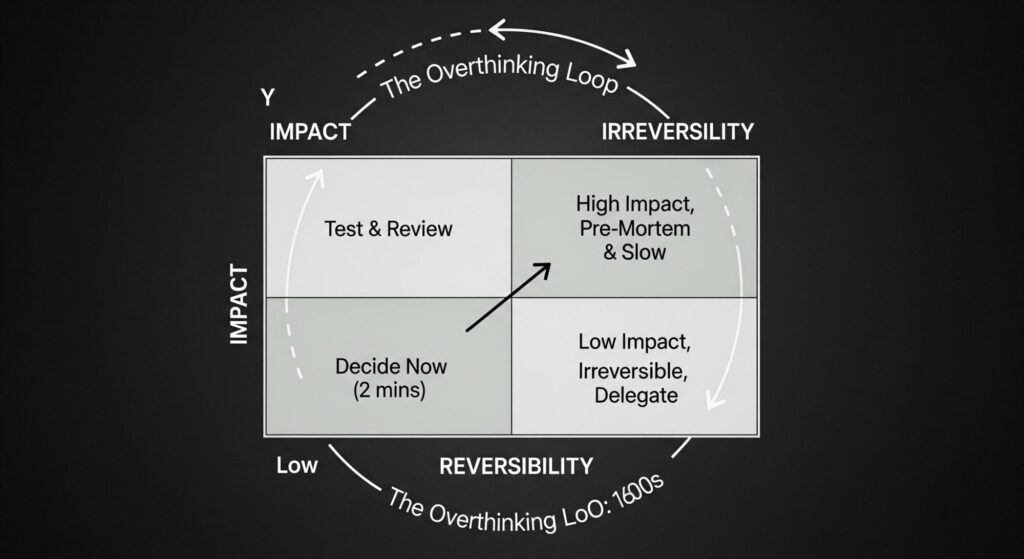
[“The Decision Triage Playbook: Matching Effort to Risk” – Image by moneycatzzz.com]
What it feels like when overthinking runs the show
- You “research” for an hour to send a three‑line message.
- You collect opinions because you’re scared to pick one.
- You can’t sleep after a minor social hiccup.
- You miss windows: prices change, opportunities pass, energy fades.
If any of that stings, you’re not broken — you’re human. These habits shift with practice, not personality transplants.
Decision Triage Playbook
Sort decisions by Impact (low/high) and Reversibility (low/high). Then follow the rule.
- Low Impact + reversible: Decide in 2 minutes. Default to the simplest viable option.
- High Impact + reversible: 20 minutes of focused research; run a 5‑minute pre‑mortem; decide and set a review date.
- High Impact + irreversible: Slow down. Gather two credible sources, run a full pre‑mortem, and define “no‑go” criteria before committing
- Low Impact + irreversible: Reframe into a reversible test if possible; otherwise, delay or delegate.
- Why it works: Matching effort to risk prevents overthinking low‑stakes items and reserves deep thinking for the few choices that merit it.
FAQ: Overthinking
What causes overthinking?
Uncertainty, choice overload, and mental habits like rumination drive the loop. Late‑day decisions, low energy, and decision fatigue make it worse. Naming the decision type (reversible vs. irreversible) and timeboxing helps.
Is overthinking the same as rumination?
Related but not identical. Rumination is repetitive negative thinking about distress, often past‑focused; overthinking includes future rehearsal and excessive scenario‑spinning. Both respond to mindfulness and action‑bias habits
Does mindfulness really help?
Yes. Brief mindfulness pauses reduce reactivity, improve attention, and create space to choose. Start with three breaths and a body check before you hit send or buy.
How do I stop overthinking at night?
Use worry time during the day, a pen‑and‑paper brain dump before bed, and a consistent wind‑down. If loops persist and impair functioning, check NIMH guidance and consider talking with a clinician.
Would therapy help?
Many do well with cognitive behavioral therapy; CBT teaches skills like thought records and behavioral experiments. If overthinking is chronic, distressing, or tied to anxiety or depression, professional support can accelerate progress.
Final thoughts: Outthink the loop by acting small
You won’t think your way out of the trap of overthinking — you’ll act your way out. Set small guardrails, use simple tools, and let results teach you. When the urge to spin hits, remember: a clear “good enough” bar, one tiny action, and a mindful breath beat an hour of mental gymnastics. That’s how to stop overthinking in real life.
Books to Dig Deeper
The Paradox of Choice

Deep Work
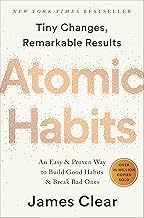
Atomic Habits
Disclosure: This post may contain affiliate links. We only recommend products we believe in, and We may receive a commission at no cost to you! Thank you for your support!
Acknowledgement: Cover Image by moneycatzzz.com
Disclaimer: The information is provided for general information only – moneycatzzz.com makes no representations or warranties in relation to the information, including but not limited to any representation or warranty as to the fitness for any particular purpose of the information to the fullest extent permitted by law. While every effort has been made to ensure that the information provided in this article is accurate, reliable, and complete as of the time of writing, the information provided in this article should not be relied upon to make any financial, investment, real estate or legal decisions. Additionally, the information should not substitute advice from a trained professional who can take into account your personal facts and circumstances, and we accept no liability if you use the information to form decisions.