 Reading Time: 8 mins #
 This post may contain affiliate links.
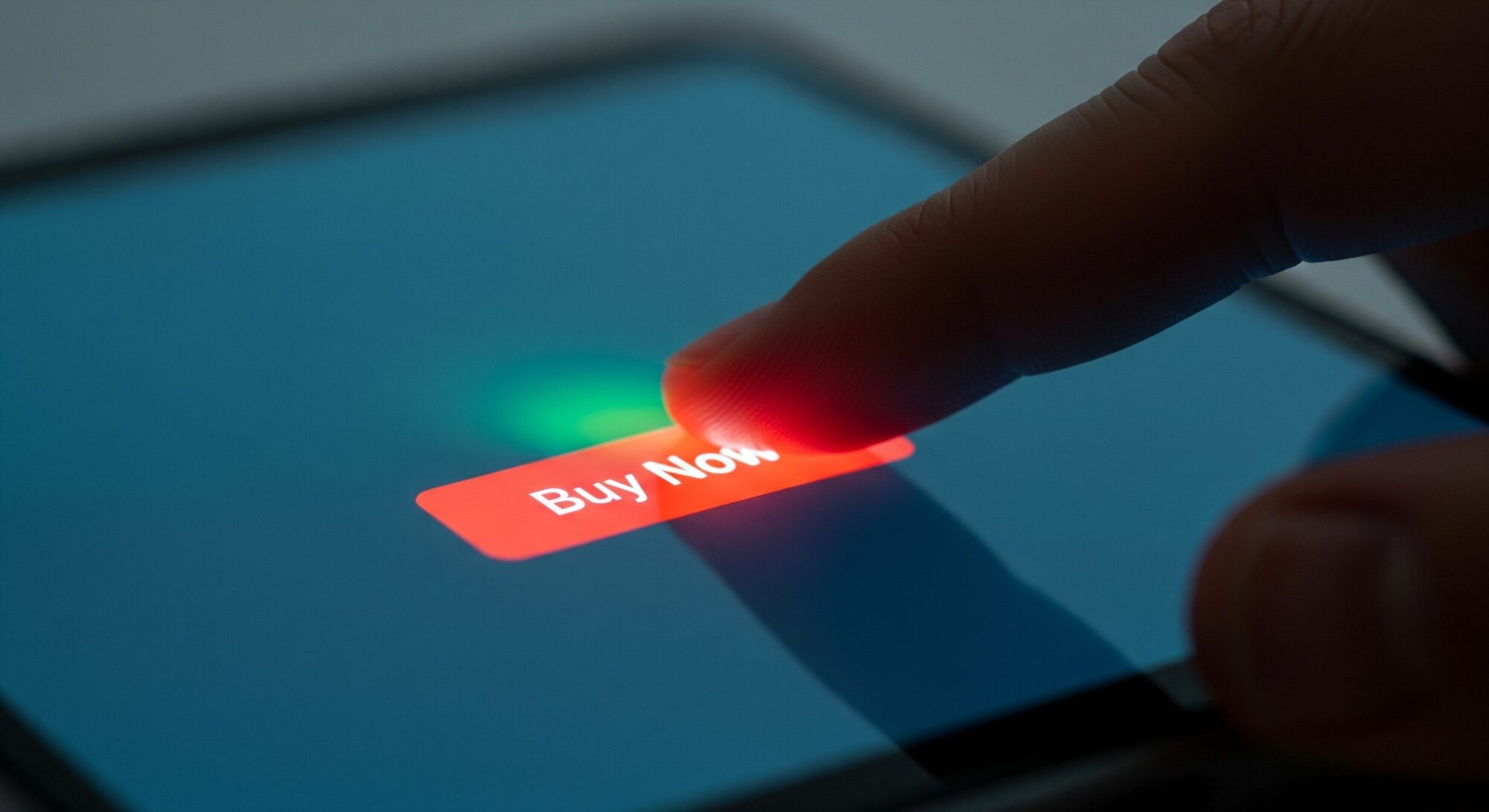
2 a.m. You tap “Buy Now.” Morning, you wonder why. That late‑night thrill isn’t random; it’s the dopamine loop doing what it does best: pairing novelty with a tiny promise of relief. This guide helps you stop impulse buying without shame. You’ll add small friction where it matters, use a cooling‑off rule to let your future brain speak, and turn attention-driven spending into mindful spending: calm, values‑aligned, repeatable.
Attention-driven spending happens when captured attention (ads, countdowns, influencers, “Buy Now”) turns into unplanned purchases, sometimes nudged by deceptive design built to tip you over the edge. We reverse it with precommitment, simple friction, and small rituals that make intention easier than impulse.
In this guide, we will first introduce the foundational Cart Triage Matrix for instant decision clarity, followed by the specific Cooling-Off Rule and the weekly Wishlist Wednesday ritual.
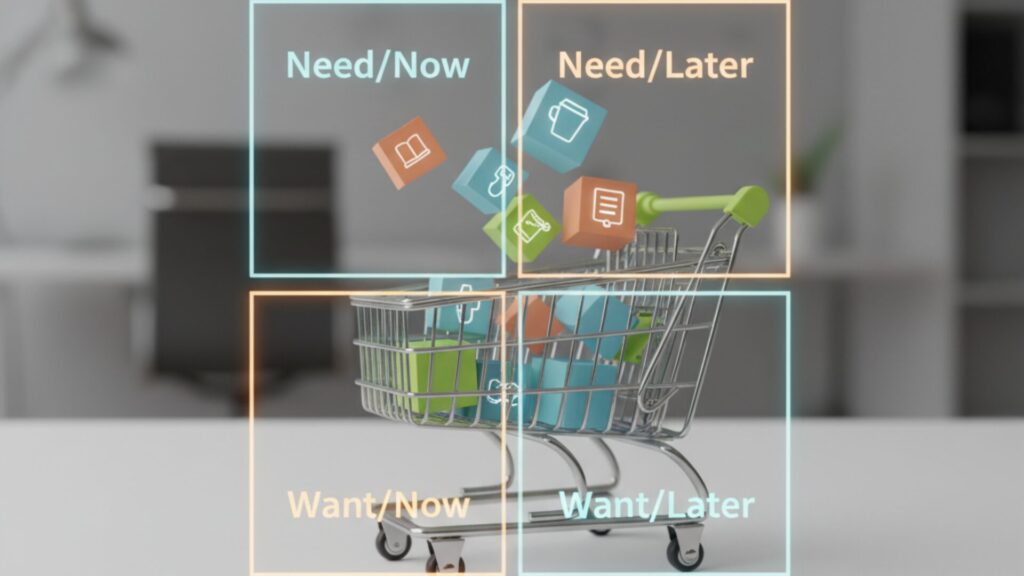
Cart Triage Matrix (Need/Want × Now/Later)
Use this before every checkout; the 30-second pause interrupts present bias and gives you a clear “yes/no/not yet.”
| Now | Later | |
| Need | – Buy if it solves a real problem today. – Prefer the cheapest reliable option. – Note a review date in 90 days. | – Schedule a date to buy. – Set a price alert. – Keep it off the card until the date. |
| Want | – Move to Wishlist with a 24-hour hold. – If still excited, recheck the budget tomorrow. | – Park it on the Wishlist for 30 days. – If you forget it, you never needed it. |
Examples
The Cart Triage is the simplest way to stop impulse buying before it happens. It also reduces impulse buying by making you choose consciously instead of chasing a feeling. It quietly turns attention-driven spending into a wait-and-see decision.
The Cooling‑Off Rule (24–72–30)
A simple cooling‑off rule brings your future self into the decision.
- 24 hours: Carts over $50 wait at least a day.
- 72 hours: Carts over $250 wait three days.
- 30 days: Big‑ticket items (e.g., >$1,000) sit for a month with notes on use‑cases and options.
The short pause takes the megaphone away from present bias. Keep the cooling‑off rule with a calendar nudge so it isn’t just willpower. Use the cooling‑off rule for gifts and subscriptions; the ladder helps you stop impulse buying on autopilot and calms impulse buying tendencies.
Tip: When a site shouts “Only 2 left” or flashes a countdown, that scarcity frame is doing its job, pressuring you to buy fast. Your rule beats their timer.

[“The Focused Pause” – Image by moneycatzzz.com]
Wishlist Wednesday (the ritual that saves you quietly)
Once a week, review your list with tea, not adrenaline. Make it a friendly appointment with yourself.
Steps
- Sort the list by date added.
- Delete anything you forgot or no longer love.
- For what remains, apply Cart Triage again.
- If you buy, note why and how it serves your values.
The wishlist method moves purchases from hot to cool, toward mindful spending. Share your wishlist method with a friend and compare notes; a little accountability helps.
Friction Toolkit (make impulse expensive, intention easy)
Add friction to temptations and remove friction from essentials.
- Remove saved cards and in‑browser payments.
- Disable one‑click checkout everywhere.
- Unsubscribe from promos; filter “sale,” “deal,” and “last chance” into a quiet folder.
- Move shopping apps to a hidden folder; log out after each purchase.
- Block merchant sites during “hot hours” (evenings/weekends) with a simple blocker.
This saves you by default because this is pre-commitment in plain clothes. With fewer easy doors, decisions happen in slower light, and these guardrails break the dopamine loop, so “Buy” takes effort.
Buying Triggers: Spot them, swap them
Name your two biggest buying triggers to plan a better move.
Common buying triggers
- Stress after work → “I deserve this.”
- Bored scrolling → “This will make today interesting.”
- Social proof → “Everyone’s talking about it.”
Fast swaps
- Stress to soothe: 10‑minute walk + playlist; revisit cart tomorrow (present bias loves late hours).
- Boredom to spark: Read one saved article or work on a 5‑minute hobby.
- Social proof to self‑proof: Ask, “Will I use this 10+ times in 30 days?”
Write your two buying triggers on a card and keep it near your wallet. Certain patterns spin the dopamine loop faster; spotting them lets you choose differently.
Budget by Intent (buy what speeds your life)
A simple lens that makes mindful spending obvious.
- Accelerators: Tools that speed creation, health, or relationships.
- Ornaments: Novelty that looks cool but doesn’t change your week.
- Sinks: Stuff that adds maintenance without meaning.
Buy accelerators quickly (after the 24‑hour check). Ornaments wait 30 days. Sinks almost always fail the pause. A one‑line values sentence helps: “I buy what speeds my craft and deepens my life.” If you’re rebuilding money habits, Your Money or Your Life is a gentle compass for aligning purchases with what matters to you.
[“Sorting Your Choices: The Cart Triage Matrix” – Image by moneycatzzz.com]
If–Then Scripts (Implementation Intentions)
Give your future self lines to stand on. Write two implementation intentions today.
- “If a cart is over $50, then I apply the 24‑hour pause.”
- “If I see a countdown timer, I screenshot it and wait 24 hours.”
- “If a purchase is for status, it goes to Wishlist Wednesday.”
- “If I’m stressed, I take a 10‑minute walk before checkout.”
For extra oomph, tie implementation intentions to specific places: one for the couch (for late-night browsing) and one for the desk (for workday ads). If you like a habits primer, Atomic Habits offers a clear, practical take on cue‑response planning without the guilt.
Two tiny reviews (10 minutes each)
- Money‑date Friday: Look at one number (savings rate, debt down, or “impulse avoided” tally). Celebrate a small win.
- Calendar‑check Sunday: Schedule one “buying guardrail” task for the week (e.g., removing saved cards).
Mini case snapshots
- The $380 reset: I removed saved cards, added a 24‑hour pause, and kept carts over $250 for three days. Last month, my impulse buying dropped by $380. It didn’t feel like deprivation, just quiet relief.
- The cart I kept: An ergonomic chair lived on my Wishlist for 30 days. I wrote when and how I’d use it. It cut an accelerator that ended back pain. Good buys feel different.
FAQs: Stop Impulse Buying (without shame)
How do I actually stop impulse buying?
Use a cooling‑off rule (24–72–30), run Cart Triage, and add slight friction (no saved cards, no one‑click). These bring your future brain into the room and help stop impulse buying on autopilot.
How can I make mindful spending stick?
Two rituals: Wishlist Wednesday and a 10‑minute Friday money‑date. Add two implementation intentions so decisions take seconds.
Isn’t some impulse buying fine?
Yes. Budget a “fun” line and use the wishlist method so treats are chosen, not chased. The goal isn’t zero impulse buying—it’s intention.
Why do I spend late at night?
Fatigue shrinks horizons, and the dopamine loop is loudest when you’re tired or stressed. That’s why we rely on friction and rules, so late‑night you can’t out‑click your guardrails.
Final Thoughts: Buy Your Future on Purpose
The goal here isn’t to police your pleasure or enforce a rigid “never buy” deprivation. It’s to buy like you mean it.
When you introduce a cooling-off rule, adopt the wishlist method, and apply a little smart friction, you fundamentally change the transaction. You stop being a passive target of the dopamine loop and become the intentional architect of your financial life. This shift isn’t just about saving money; it’s about reclaiming your attention and your agency.
Every dollar you don’t burn on attention-driven spending instantly transforms into an option you can truly feel: the option to say yes when it really counts, the currency of time, the luxury of calm, and the tangible freedom to design a life where your resources and your focus align perfectly with your values. Stop buying things you forget, and start buying your future on purpose.
Essential Reads for Financial Literacy
The Psychology of Money

Your Money or Your Life
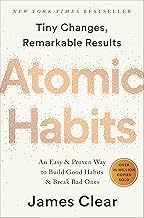
Atomic Habits
Resources, Tools, and Books for Intentional Spending
Make intention easier than impulse with this curated stack of tools, books, and checklists.
🛠️ Tools for Smart Friction and Focus
Blockers: Use Freedom or Cold Turkey to block shopping sites during peak temptation hours.
Payment Control: Use Privacy.com to create virtual, single-use cards or set spend limits.
Email Cleanup: Use ‘Leave Me Alone‘ to bulk unsubscribe from promotional emails and remove spending triggers.
Browser Control: Use uBlock Origin and Privacy Badger to minimize tracking and intrusive “you might also like” ads.
📋 Lists, Alerts, and Checkout Calm
Price Tracking: Use Keepa or CamelCamelCamel to check price history and set alerts for “Need/Later” items, beating fake scarcity.
Wishlist Management: Build your Wishlist Wednesday list in Notion or Google Sheets with columns for: Item, Date Added, Price, Why It Helps, and Review Date.
💰 Budgeting & Tracking
Use these apps to align spending with your values:
YNAB (You Need a Budget): Envelope-style budgeting to assign a job to every dollar.
Monarch Money / Tiller / Copilot: Tools for custom views, automated tracking, and calm weekly reviews.
Disclosure: This post may contain affiliate links. We only recommend products we believe in, and we may receive a commission at no cost to you! Thank you for your support!
Acknowledgement: Cover Image by moneycatzzz.com
Disclaimer: The information is provided for general information only – moneycatzzz.com makes no representations or warranties in relation to the information, including but not limited to any representation or warranty as to the fitness for any particular purpose of the information to the fullest extent permitted by law. While every effort has been made to ensure that the information provided in this article is accurate, reliable, and complete as of the time of writing, the information provided in this article should not be relied upon to make any financial, investment, real estate or legal decisions. Additionally, the information should not substitute advice from a trained professional who can take into account your personal facts and circumstances, and we accept no liability if you use the information to form decisions.