
 Reading Time: 8 mins #
 This post may contain affiliate links.
Picture your life as a vibrant mosaic composed of countless fragments, each representing a facet of your identity, a memory, or an aspiration. The art of selective self-disclosure lies in carefully choosing which pieces to reveal and which to keep hidden. It’s about crafting an authentic and intriguing narrative, inviting others to explore your story without overwhelming them with its full complexity.
This approach isn’t about deception; it’s about control—curating a personal narrative that reflects your true self while maintaining an air of mystery. This control empowers you to create a dynamic interplay between what is known and what remains to be discovered, drawing others into your story.
“The greatest discovery of my generation is that human beings can alter their lives by altering their attitudes of mind.” – William James.
The Psychological Dance of Disclosure
At the heart of selective self-disclosure is a complex dance of psychological forces. We are all driven by the fundamental human need for connection, which often pushes us to share aspects of our lives with others. Yet, we also have a deep-seated desire for privacy, a need to protect our inner sanctum from the world’s prying eyes.
Psychologist Erik Erikson‘s theory of identity formation offers insight into this dance. As we navigate life, we construct and reconstruct our sense of self. Sharing certain aspects of our lives can help solidify our identity while concealing others allows for continued exploration and personal growth. For example, consider the individual who shares their professional achievements but keeps their struggles private—each choice shapes how they are perceived and, ultimately, who they become.

The Role of Technology in the Game of Revelation
Technology has transformed how we communicate and share our lives in the digital age. Social media platforms, in particular, offer a stage for selective self-disclosure, enabling us to present carefully curated glimpses into our lives. This technological advancement has revolutionized our social interactions and empowered us to craft our narratives in a way that was impossible before.
However, the power of social media lies in understanding its dual nature: it can connect and isolate. Platforms like Instagram or Facebook allow us to share our successes, milestones, and curated moments. Still, they also pressure us to maintain an image that may not fully align with reality. Constantly curation can lead to inauthenticity as we struggle to balance our online persona with our true selves.
As Sherry Turkle explores in “Alone Together,” this constant connectivity can paradoxically lead to feelings of isolation. With all its polished edges, the digital self is a reflection that often obscures the complexities of our inner lives. Recognizing this allows us to approach social media with a critical eye, using it as a tool for connection rather than letting it dictate our self-worth.
[Balancing Transparency and Privacy” – moneycatzzz.com]
Strategic Silence: The Power of What’s Unsaid
Silence can be your most powerful tool in a world filled with noise. The strategic choice to withhold information can create an air of mystery that draws others in, fostering deeper connections as people seek to uncover what lies beneath the surface.
Take Steve Jobs, for instance—a master of public relations and the art of strategic silence. Jobs carefully crafted his public image, punctuating long periods of silence with iconic product launches. This approach not only built anticipation but also cemented his legendary status. The power of strategic silence lies in its ability to build suspense to make others eager for your next move.
Navigating Criticism: The Balance of Openness and Privacy
While powerful, the concept of selective self-disclosure has its critics. Some argue that genuine connection requires complete openness and vulnerability. However, indiscriminate sharing can lead to exploitation and emotional harm. Selective self-disclosure offers a more nuanced approach—one that balances intimacy with the preservation of personal boundaries, providing a reassuring sense of control. It’s essential to be aware of the potential risks, such as misinterpretation or manipulation, and to consider these when deciding what and how much to share.
Critics also claim that in the digital age, privacy is obsolete, as information is readily available online. But this perspective overlooks the importance of curation. By carefully managing what we share, we maintain control over our narratives, ensuring that not all of our lives are on public display.
Another critique is that selective self-disclosure can be manipulative and involves withholding information. Yet, the distinction lies in intent: strategic communication is about presenting oneself honestly while considering the impact of one’s words and actions rather than manipulating others.
Personal Branding: The Impact of Strategic Disclosure
In the realm of personal branding, selective self-disclosure can be a game-changer. By aligning what you share with your core values, experiences, and aspirations, you create a compelling and authentic brand identity that resonates with your audience. This strategic approach not only humanizes your image but also helps you build a brand that is both relatable and trustworthy.
On social media, this might mean sharing stories highlighting your professional achievements while occasionally offering glimpses into your personal life to humanize your image. For instance, you could share a post about a successful project at work and then follow it up with a photo of a hobby you enjoy. Maintaining consistency between your online and offline personas ensures your brand remains genuine across all platforms.
However, personal branding requires a delicate balance—too much self-disclosure can undermine your credibility, while too little can make you appear distant or inauthentic. By carefully curating your public persona, you can build a brand that is both relatable and trustworthy.
Cultural and Generational Differences in Disclosure
Cultural and generational factors heavily influence the practice of self-disclosure. Different cultures have varying norms around privacy and sharing, and understanding these nuances is crucial for effective communication.
For instance, in collectivist cultures, such as those in East Asia, there is often a greater emphasis on group harmony and privacy. In contrast, individualistic cultures, like the West, encourage more open self-disclosure to express individuality. Similarly, generational differences play a role—Millennials and Gen Z are generally more comfortable sharing personal information online, whereas older generations may prioritize privacy.
By understanding these differences, you can adapt your approach to connect with diverse audiences, whether in personal interactions or professional settings. This understanding fosters empathy and adaptability, key qualities in the digital age where we interact with people from diverse cultural and generational backgrounds, making you a more effective communicator.
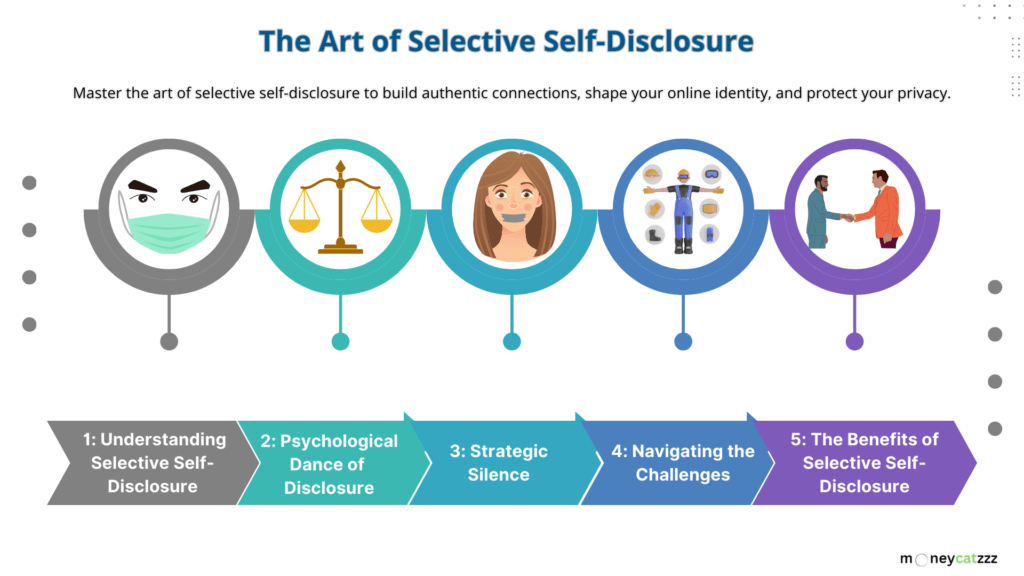
[“The Art of Selective Self-Disclosure” – moneycatzzz.com]
The Journey of Self-Discovery: A Lifelong Adventure
Mastering the art of selective self-disclosure is not a one-time achievement but an ongoing journey of self-discovery. It requires a deep understanding of oneself, a keen awareness of one’s audience, and a willingness to adapt to changing circumstances. Importantly, feedback from your audience can be a valuable compass in this process, guiding you to what resonates with them and what might need adjustment.
Consider the process like a dance—sometimes you reveal, conceal, and sometimes wait. The key is to remain true to yourself while navigating the complex interplay of connection and privacy. Remember, it’s not about striving for perfection but about embracing authenticity. You build deeper connections and achieve greater fulfillment by thoughtfully sharing your unique qualities.
Overcoming the Challenges: Practical Strategies
Mastering selective self-disclosure comes with challenges, from overcoming the fear of vulnerability to managing your online reputation. To navigate these challenges effectively, consider the following strategies:
- Embrace Vulnerability: As Brené Brown emphasizes in “Daring Greatly,” embracing vulnerability can lead to greater authenticity and connection. By sharing your imperfections and insecurities, you create space for others to do the same, fostering a sense of shared humanity.
- Set Boundaries: Establish clear boundaries about what you are comfortable sharing. Communicate these boundaries respectfully, and don’t be afraid to enforce them when necessary.
- Cultivate Mindfulness: Practice mindfulness to become more aware of your motivations for sharing or withholding information. Being present allows you to respond authentically rather than reacting impulsively.

Conclusion: The Art of Selective Self-Disclosure
The art of selective self-disclosure is a powerful tool for navigating the complexities of the digital age. It allows us to curate our online presence, build authentic connections, and protect our privacy.
Remember, it’s not about perfection but progress. Each experience, whether you overshare or under-share, is an opportunity to learn and grow. By understanding the psychological forces, cultural nuances, and potential pitfalls, you can develop a strategic approach that empowers you to connect authentically while maintaining your boundaries.
So, what’s your next step? Start by reflecting on your current online presence. What do you want to change or improve? Then, begin experimenting with different strategies for self-disclosure. Be patient with yourself and celebrate your progress along the way.
By mastering the art of selective self-disclosure, you can create a rich and fulfilling life that is yours.
Signup to our Newsletter for regular updates:
Disclaimer: The information is provided for general information only – moneycatzzz.com makes no representations or warranties in relation to the information, including but not limited to any representation or warranty as to the fitness for any particular purpose of the information to the fullest extent permitted by law. While every effort has been made to ensure that the information provided in this article is accurate, reliable, and complete as of the time of writing, the information provided in this article should not be relied upon to make any financial, investment, real estate or legal decisions. Additionally, the information should not substitute advice from a trained professional who can take into account your personal facts and circumstances, and we accept no liability if you use the information to form decisions.