Reading Time: 8 mins #
This post may contain affiliate links.

Nothing proves how fast limiting beliefs shrink your life quite like three straight years at the same coffee shop table. The barista sees you walk in, nods, and pours a black coffee with a splash of oat milk before you say a word. The routine feels safe, but it’s really just a velvet leash keeping you in place.
Â
There is a café across the street, a new place with a yellow awning and mismatched chairs. You walk past it every morning. You have never been inside.
Â
The coffee might be terrible. You wouldn’t know. You have never allowed yourself to find out.
Â
Limiting beliefs don’t rely on security guards or deadbolts. They work through a quiet conviction that certain rooms belong to other people.
The Walls You Built
The walls are not what you think.
Â
Circumstance, bad luck, and poor timing didn’t build these walls. You built them out of old habits, default stories, and quiet fears.
Â
You built them slowly, brick by brick, so gradually you did not notice the construction at all.
Â
“I am not a morning person.” This becomes a wall. You stop trying, accept it as fact, and the wall becomes so convincing you forget it was ever just an idea.
Â
“People like me don’t do that.” Start businesses, change careers, travel alone, speak up in meetings; whatever it is, it is not for you.
Â
The wall builds. One belief at a time.
Â
Then there are the habits, the patterns you got stuck in without realizing they were forming walls around you. Wake up, check email, respond, work, come home, scroll, sleep, and then repeat it all the next day.
[MindValley Promo | Rewire your mind, transform life. | Nir Eyal]
A comfortable rhythm easily becomes a cage. Behind it sit the quiet fears you never voice. Caution is usually just fear of change. Realism is often a fear of failure, and humility becomes a convenient hideout for the fear of being judged.
Â
You are not afraid of the unknown. You are afraid of what you might discover about yourself if you actually tried.
Â
So you stay in the room. You know the room: how to move through it without bumping into anything, the temperature, the light, and the way the air feels at different times of day.
Â
You know this room.
The Door You Stopped Seeing
The most absurd detail? The door never moved
Â
It wasn’t hidden or locked behind wallpaper. It sat in plain sight, waiting.
Â
The first time you told yourself you were not a morning person, the door was there. You did not see it. The second time. The hundredth time. The door remained. You remained blind to it.
Â
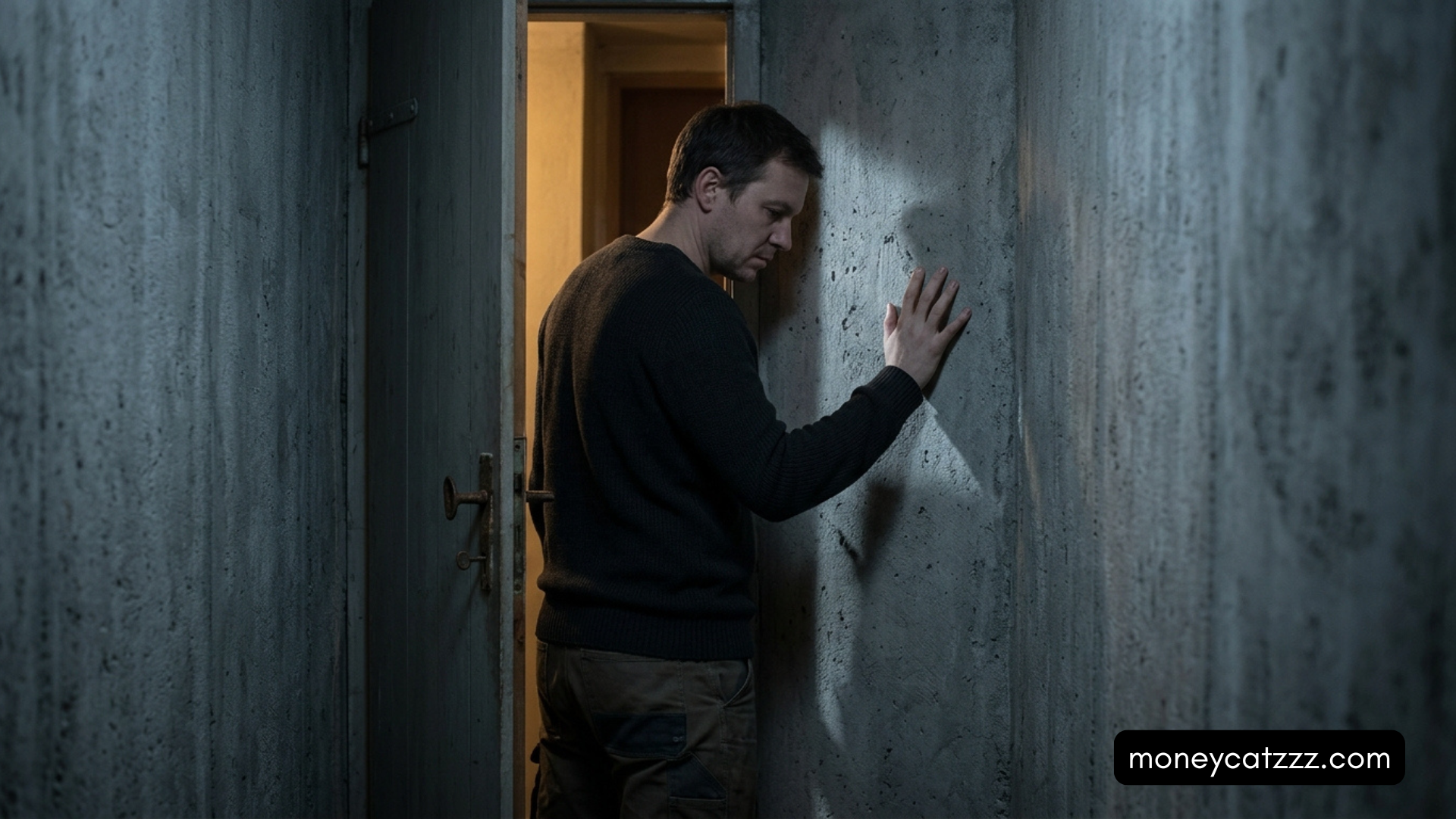
This is the mechanism of the cage. The real trap has nothing to do with heavy timber or iron bolts. It’s the simple failure to see the exit.
[The Cage I Built | moneycatzzz.com]
The cage was never meant to lock you in; it is to keep you from noticing there was ever a way out.
Â
Carol Dweck’s research on fixed versus growth mindsets captures this. A fixed mindset treats ability as static. It builds walls. A growth mindset treats ability as develop-able. It sees doors.
Â
But Dweck does not talk about what happens when you have lived with a fixed mindset for so long that the walls feel permanent, when you have spent years reinforcing the belief that you are not the kind of person who does certain things.
Â
Papers on self-imposed limitations deduced that the brain does not distinguish between real and imagined barriers. Both restrict behavior equally. If you believe you cannot do something, the brain treats that belief as fact and adjusts your behavior accordingly.
Â
You do not need to break the walls or have a key. The door opens from the inside.
Â
It always did.
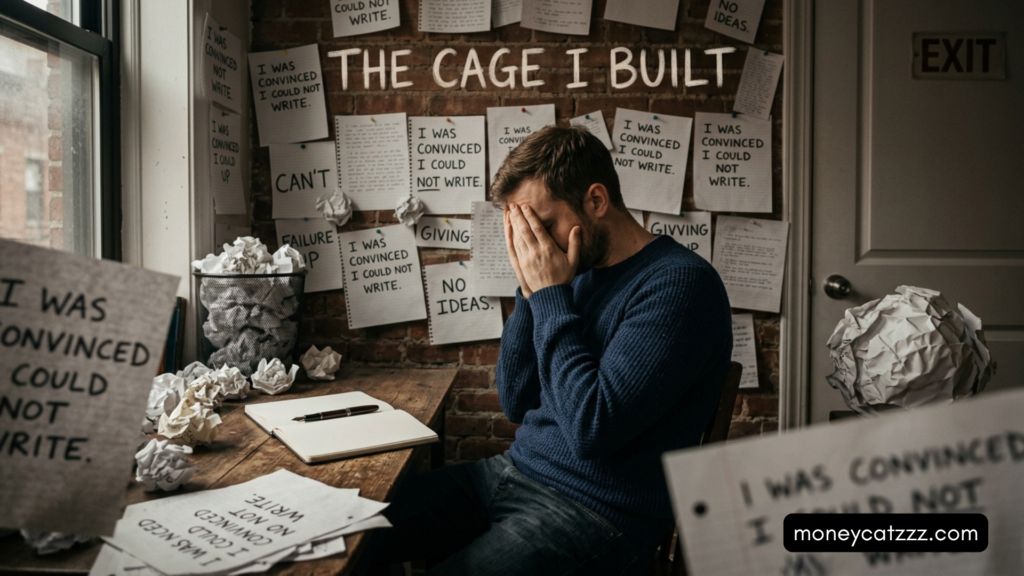
The Cage I Built
I was convinced I could not write.
Â
For fifteen years, I carried that belief. I had tried and failed, but the question remains: had I really tried at all? I had told myself this story so many times that it became my core belief.
Â
“I am not a writer.” This was the wall.
Â
I read constantly and thought clearly enough, with plenty of ideas in reserve. Still, I reserved the label “writer” for others. I assumed it belonged to people with English degrees, early talent, or official permission to speak.
Â
I do not belong in that bracket of people.
Â
So I stayed in the room. I read, thought, and edited my own thoughts before they ever made it to paper.
Â
Years passed. The wall grew thicker.
Then something shifted through a small realization. I caught myself editing my own thoughts before even speaking them aloud. I had bought into my own limits so completely that I stopped trying before I even started.
Â
The room served its purpose by keeping me away from the door.
Â
Noticing the cage changed the rules. The wall stayed put, but seeing it clearly made it optional. I started writing the moment I stopped obeying the story that I couldn’t.
Â
The cage did not break. I walked out the door I had spent years ignoring.
Â
I still edit myself more than I should. There are mornings when the wall feels real again, when I look at the blank page and hear the old story:
Â
“You’re not really a writer.” But I hear it differently now. I hear it as a story I used to believe, not a truth I still have to obey.
The Mechanism of Constraint
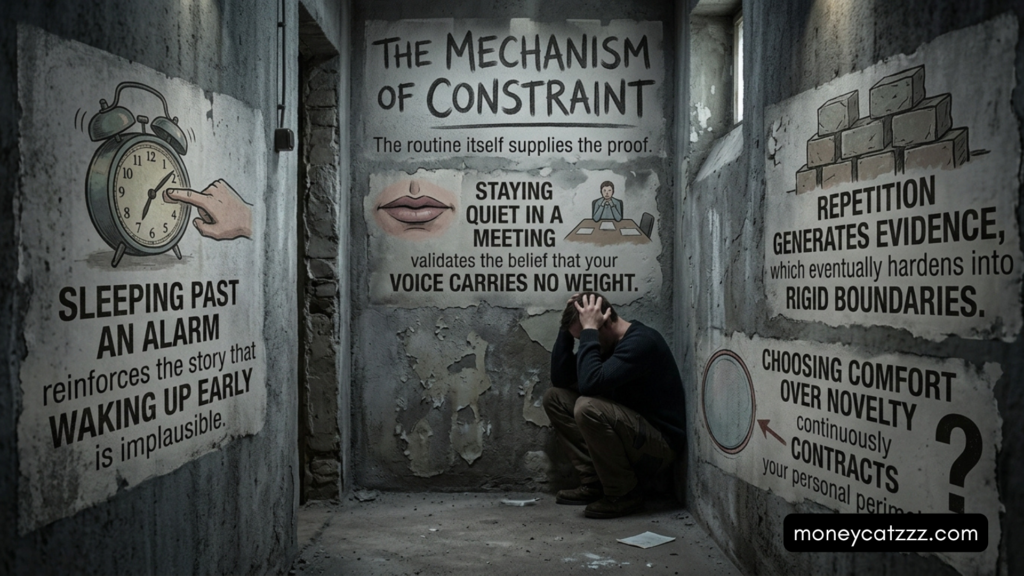
Getting stuck in self-reinforcing routines turns a simple delay into a permanent barrier. The routine itself supplies the proof:
- Sleeping past an alarm reinforces the story that waking up early is implausible.
- Staying quiet in a meeting validates the belief that your voice carries no weight.
- Choosing comfort over novelty continuously contracts your personal perimeter.
- Repetition generates evidence, which eventually hardens into rigid boundaries.
Habits form through repetition: the more you repeat a behavior, the more automatic it becomes, demanding far less conscious effort. According to Charles Duhigg, the habit isn’t the cage itself. It’s simply the door you forgot you could open.
[The Mechanism of Constraint: The Contracted Perimeter | moneycatzzz.com]
Research on neural pathways, including an article by Dr. Paul McCarthy, shows that repeated behavior creates neural pathways that feel like truth. The brain optimizes for efficiency; it does not distinguish between a helpful pattern and a restrictive one. It just reinforces what you do most often.
Â
The mechanism is elegant. Terrible, but elegant.
Â
You stay in the room because the room feels safe. You stay in the room because you have practiced doing so thousands of times. You stay in the room because the idea of leaving has become so abstract that it feels impossible.
Â
But the door has not moved. The lock has never existed.
Â
The only thing keeping you inside is the belief that you are supposed to stay inside.
Â
And beliefs, I have learned, are the most portable cages we build. We carry them everywhere, reinforce them daily, and defend them fiercely; even when they are killing us.
The Cost of the Room
Staying put isn’t sustainable. You outgrow the space, or the walls close in.
Â
The toll isn’t a sudden crash; it’s a slow leak. You suppress ideas, withhold opinions, and defer momentum until you lose count. Ability isn’t the limiting factor. You just got dangerously good at making yourself small enough to fit the container. Limiting beliefs don’t strip your capability; they trap you in a search for permission you never needed.
[MindValley Promo | Rewire your mind, transform life. | Vishen Lakhiani]
How to Break Free
The door opens from the inside. Reaching for the handle is the real hurdle because doing so forces you to admit a brutal truth: you could have left at any point.
Â
You don’t need to dismantle your doubt before you move. You can believe you aren’t a writer and still write. You can feel unready and still execute. The belief doesn’t have to vanish; your behavior has to override it.
The Choice
The café across the street is fine: uncomfortable seating, average coffee. I still sit at my original spot most mornings. The difference? Routine is no longer a default cage. It’s a conscious choice.
Â
The room is still there. So are the walls. But the door never had a lock, and you were only ever trapped by your own compliance. Stop waiting to feel brave. Stop bargaining with a room that no longer fits.
Â
Reach for the handle. Open it.
_________________________________________________
Disclosure: This post may contain affiliate links. We only recommend products we believe in, and we may receive a commission at no cost to you! Thank you for your support!
Acknowledgment: Cover Image by moneycatzzz.com
Disclaimer: The information is provided for general information only – moneycatzzz.com makes no representations or warranties in relation to the information, including but not limited to any representation or warranty as to the fitness for any particular purpose of the information to the fullest extent permitted by law. While every effort has been made to ensure that the information provided in this article is accurate, reliable, and complete as of the time of writing, the information provided in this article should not be relied upon to make any financial, investment, real estate or legal decisions. Additionally, the information should not substitute advice from a trained professional who can take into account your personal facts and circumstances, and we accept no liability if you use the information to form decisions.