
 Reading Time: 8 mins #
 This post may contain affiliate links.
There’s a specific kind of grief that arrives without a funeral. No casseroles show up at the door. fromyouflowers.com was a no-show. Your inbox doesn’t fill with “thinking of you” messages, and you don’t get bereavement leave. The loss is real, and the grief is real, but the world has no ritual for it because nobody died.
What passed was the version of your life you were certain you’d be living by now.
I turned 44 in a rented apartment with a cat, a half-finished manuscript, and a marriage that had quietly become a roommate situation sometime around year seven. I wasn’t mourning a person. I was mourning a series of assumptions: the house we own together, the books I had written, the version of myself who had somehow, by this point, figured things out. That woman. The one I’d been building toward since my mid-twenties—she just… hadn’t shown up.
Voltaire, my cat, who had no opinion about any of this, sat on the windowsill and watched pigeons with the focused equanimity of someone who had never once confused the life they were living with the life they’d planned to live. Cats don’t do that—that particular suffering is exclusively ours.
The Loss That Doesn’t Have a Name
Psychologist Pauline Boss spent decades studying what she calls ambiguous loss, the kind of grief that exists without clear boundaries or social recognition. She was writing primarily about families of people with dementia, or soldiers listed as missing in action. People who were gone but not gone. Present but absent. The grief had nowhere to land because the loss had no definitive moment.
Nothing catastrophic had happened. My marriage wasn’t abusive. I was happy with my career trajectory, and I have no major health issues. Externally, my life looked reasonable, and yet I was grieving something consistently, internally, and so quietly that it had become the background hum of every single day. It became the frequency I was living on without realizing it had a name.
There’s a line in “The Wild Edge of Sorrow:” Grief is the price we pay for love, and that one of its five gates is the grief for what we expected and never received. Francis Weller’s mostly talking about childhood wounds, but the gate opens both ways. You can grieve forward, too. You can mourn the future that didn’t arrive just as painfully as you mourn the past that did.
I’d been standing at that gate for years without knowing it existed.

The Uninvited Guest
Here’s what nobody tells you about this particular grief. It doesn’t announce itself as grief. It shows up disguised as irritability, or restlessness, or a vague but persistent sense that something is wrong that you can’t quite locate. It looks like a distraction. It feels like dissatisfaction. You think you need a new job, a different city, or to finally commit to a morning routine, because those are problems you can solve. Grief, the unnamed kind, doesn’t feel solvable. So you don’t call it that.
I called mine “being in a rut” for about three years. I called it “needing more stimulation.” I called it “the problem with my marriage,” and “the problem with my career,” and “the problem with where I live.” The real name for it was grief, and I couldn’t see that because I didn’t know you were allowed to grieve a life that hadn’t happened.
We tend to invalidate our own pain because someone else’s is objectively worse, Brené Brown calls it comparative suffering. Nobody died. I still have my health. Who am I to grieve? This is the thought that keeps unnamed grief unnamed. It’s also the thought that keeps it running on low heat indefinitely, never burning off because you never gave it enough oxygen, actually, to move through you.
[The Unnamed Frequency of Grief | moneycatzzz.com]
When things fall apart, the only way out of pain is through it. Not around it. Not above it. Pema Chödrön describes it as a kind of radical presence with whatever is true, even when what’s true is uncomfortable. Especially then.
I wasn’t being present with my grief. I was managing it, explaining it away, reframing it into productivity, turning it into content about resilience—I was doing everything except actually feeling it. I went around and above it.
What Letting Go Actually Costs
Every transition begins with an ending. Not a beginning. Before you can move into something new, you have to let the old thing actually be over. William Bridges says it might sound obvious, but it’s anything but. It is one of the hardest things a person can do.
Letting go of the past isn’t a single event. It’s not a decision you make on a Tuesday, and then you’re done. Repeatedly, sometimes daily, releasing your grip on a version of your life that is no longer available. House. Career. Relationship. You have to mourn these specifically, individually, by name, or they stay in the room with you like uninvited guests who never quite leave.
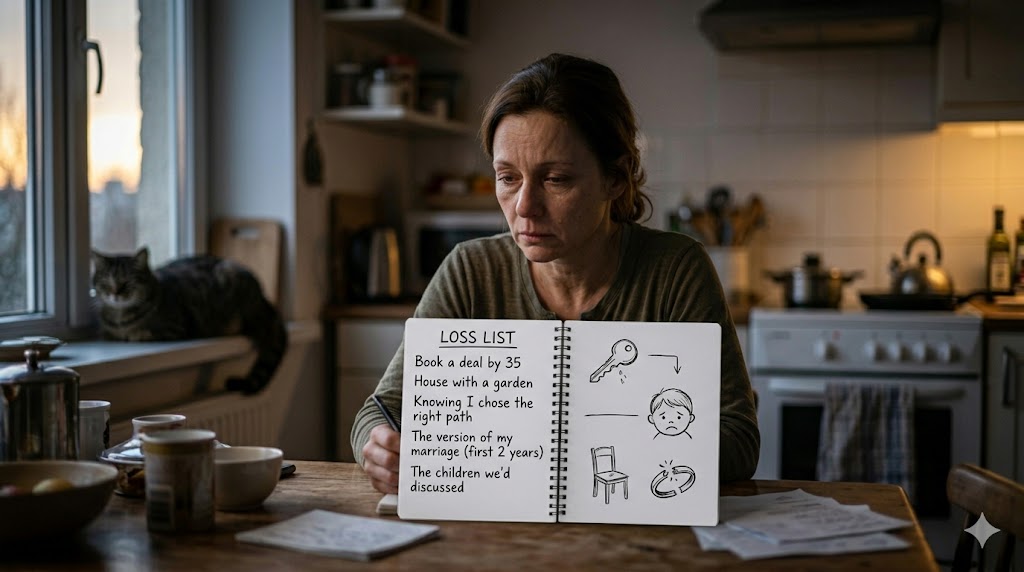
Making a list helps —not a gratitude list, though I understand the appeal—a loss list. I listed the specific things I had expected that hadn’t happened. Book a deal by 35, a house with a garden. The feeling of having chosen the right thing and knowing it. The version of my marriage that existed in my head during the first two years. The children we’d discussed but never had.
Writing them down felt melodramatic at first. Then it felt devastating. Then it felt, strangely, like relief.
There is something about naming a loss that changes its relationship to you. It stops being ambient and becomes specific. Specific things can be grieved. Ambient things accumulate.
The Gate You Have to Walk Through
Grief is not static. Francis Weller describes grief as something that wants to move. It has direction. The problem is we treat it like something to be managed or minimized, when its actual function is to carry us from one version of ourselves to the next.
A midlife crisis is what happens when this grief goes unacknowledged long enough to become an emergency: the sports car, the affair, the sudden dramatic reinvention. These aren’t failures of character, but undiscovered grief that had run out of patience. They are what happens when the loss accumulates past the point where ordinary daily suppression can contain it, and it starts looking for an exit.
Sitting with grief doesn’t make for good movies, but learning to hold loss without resolution, about developing what Pauline Boss calls resilience in the face of ambiguity, is the ability to carry the loss without it carrying you.
Voltaire lost his outdoor access when I moved to the apartment. He’d been an indoor-outdoor cat for five years. He sat at the door and cried for three days. Genuinely cried, that low, specific yowl that means something real is wrong. Then he found the windowsill. Later, he found the heating vent and the patch of afternoon sun that hits the kitchen floor at 2 pm. He didn’t stop being a cat who once had a garden. He just became a cat who now has a windowsill, and he committed to that completely.
I’m not saying cats are emotionally sophisticated. They don’t carry the gap between what was and what is as a permanent identity. They update.

Learning the Guest’s Language
The grief of unmet expectations becomes a teacher when you stop trying to evict it and start asking what it knows.
Mine taught me that I’d been living toward a destination rather than living in a life. That I’d been so focused on the version of myself I was supposed to become that I’d been only partially present for the version of myself that actually existed. I was mourning the life that was, in many ways, one I’d invented at 26 with very little information and had been treating as a binding contract ever since.
It also taught me that the life transitions I’d framed as failures were, in fact, just transitions. Marriage. Manuscript. Apartment. These weren’t evidence that something had gone wrong. They were just the actual shape of a life being lived in real time, rather than according to a plan drafted by someone who didn’t know very much yet.

[The Neutral Zone: Decommissioning the Blueprint | moneycatzzz.com]
That disorienting space between the old life and the new one, the neutral zone, is not empty. It just feels empty. Bridges claims things are actually happening there. The old identity is composting. The new one is forming. The discomfort of that space is not a sign that you’re stuck. It’s a sign that you’re in the middle of something that takes longer than you want it to.
Letting go of the past doesn’t mean the past didn’t matter. It means you’ve stopped asking it to be the present.
The Guest Doesn’t Leave. It Changes.
I still live in the apartment. The manuscript is closer to finished now. Voltaire has claimed four distinct territories across 700 square feet and manages them with the strategic precision of someone who has fully committed to the available real estate.
The grief didn’t disappear. Grief doesn’t operate that way, and anything that tells you it will is selling something. What changed is my relationship to it. It stopped being ambient noise and became something I could actually sit with, something that had useful information if I were willing to stop managing it long enough to listen.
The life I thought I’d have was a beautiful idea. It deserved to be mourned properly, by naming it, feeling it, and giving it the specific attention it was asking for, which is what finally made room for the life I’m actually in.
Which is the only one available?
That’s not a consolation prize. It’s just the truth, and truth is a better place to build from than any plan drafted at 26 by someone who didn’t yet know how much she didn’t know.
You might also like:
Disengage Without Detaching: How to Reclaim Mental Clarity and Emotional Freedom
The Blueprint Audit: Essential Tools for Structural Mourning

Ambiguous Loss

When Things Fall Apart
Transitions

The Gifts of Imperfection
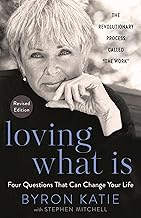
Loving What Is
Disclosure: This post may contain affiliate links. We only recommend products we believe in, and we may receive a commission at no cost to you! Thank you for your support!
Acknowledgment: Cover Image by moneycatzzz.com
Disclaimer: The information is provided for general information only – moneycatzzz.com makes no representations or warranties in relation to the information, including but not limited to any representation or warranty as to the fitness for any particular purpose of the information to the fullest extent permitted by law. While every effort has been made to ensure that the information provided in this article is accurate, reliable, and complete as of the time of writing, the information provided in this article should not be relied upon to make any financial, investment, real estate or legal decisions. Additionally, the information should not substitute advice from a trained professional who can take into account your personal facts and circumstances, and we accept no liability if you use the information to form decisions.