
 Reading Time: 8 mins #
 This post may contain affiliate links.
“I’m just being honest,” she said, after telling me my career choices were “delusional” and my partner was “settling.” When I flinched, she added, “You wanted authentic boundaries, right?”
I sat in my car afterward, trying to untangle the knot in my chest. Was this what real, authentic boundaries looked like? Was her cruelty somehow my fault for wanting realness?
Two weeks later, my therapist offered a different frame: “Authenticity without emotional skill is just sophisticated selfishness.
Real boundaries require the courage to be truthful AND kind. That’s much harder than just saying whatever you feel.”
She explained that toxic authenticity (borrowing from Ray Tan’s brilliant framework in Thought Leadership Thursday) uses “being real” as permission for relational laziness. But true compassionate honesty requires something most people won’t do: the emotional labor of delivering truth with care.
What if authenticity isn’t about saying everything you think? What if it’s about skillfully sharing what serves the relationship?
The Promise: Truth and Kindness Together
In this guide, we’ll explore how authentic boundaries require emotional intelligence not just honesty. You’ll learn to distinguish between compassionate honesty and self-serving cruelty, and also receive specific scripts for delivering brutal truths while preserving connection and practicing vulnerability without harm.
What Are Authentic Boundaries (And How Are They Different from “Brutal Honesty”)?
Authentic boundaries are the practice of being truthful about your needs, limits and experiences while taking responsibility for how you deliver that truth. They’re not about censoring yourself or people-pleasing. They’re about recognizing that HOW you say something is part of WHAT you’re saying.
Dr. Harriet Lerner, author of The Dance of Anger, distinguishes between “honesty in the service of connection” versus “honesty in the service of discharge.” One builds bridges; the other burns them while claiming moral high ground.
Real boundaries require:
- Clarity about your truth AND consideration for impact
- Vulnerability about your experience without weaponizing it
- Firmness in your limits with gentleness in delivery
- Owning your feelings without making others responsible for them
- Speaking up AND speaking skillfully
- Protecting yourself while respecting others
The key distinction: Kind boundaries consider both people in the equation. Toxic authenticity only considers one: you. As Ray Tan noted in the pillar article, using “authenticity” to justify cruelty is actually the opposite of emotional intelligence.
Real authenticity requires the courage to hold multiple truths: yours AND theirs.
Why We Confuse Cruelty with Courage
The Discharge Relief Trap
Brené Brown’s research on emotional intelligence reveals that we often confuse emotional discharge with brave communication. Blurting out unfiltered thoughts feels cathartic, like a form of courage. But it’s actually the easier path, requiring no emotional skill or consideration.
Real compassionate honesty requires metabolizing your emotions first, then choosing how to express them. That’s the more complex, more courageous work that true boundaries demand.
The Conflict Avoidance Rebound
Many people discovering authentic boundaries are recovering from years of people-pleasing. The pendulum swings from “never speaking up” to “saying everything unfiltered.” Both extremes avoid the real work: learning to navigate conflict with skill.
Research on relational intelligence shows that people who maintain kind boundaries report higher relationship satisfaction than either people-pleasers OR those practicing “radical honesty.”
What if the goal isn’t maximum honesty but optimal honesty? What is the amount and delivery that serves both truth and connection?
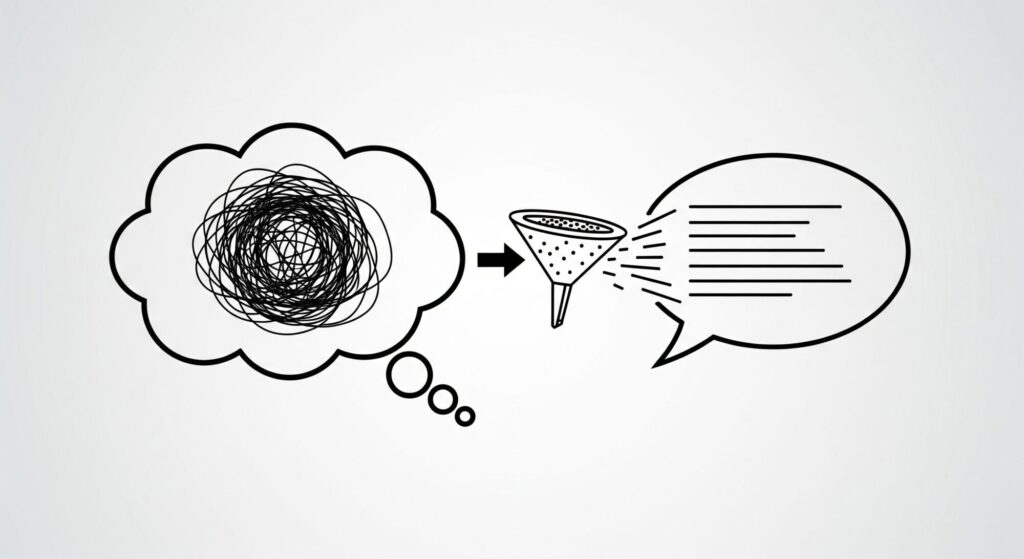
[“Check Your Intention Before Speaking – The Filter” – Image by moneycatzzz.com]
The Hidden Cost of Unskilled Authenticity
When we practice authenticity without emotional skill, claiming boundaries while lacking compassion, the damage compounds:
Relationship Erosion: Each “honest” blow creates scar tissue. People stop trusting you with vulnerability because your “authenticity” feels unsafe. You’re alone with your truth, which defeats the purpose of genuine connection.
The Reputation Paradox: People who pride themselves on “brutal honesty” are rarely seen as trustworthy. Research on workplace relationships shows that those practicing compassionate honesty are rated as MORE authentic than those who are unfiltered. Kindness doesn’t dilute truth; it amplifies it.
Missed Growth Opportunities: When we deliver truth cruelly, others defend rather than reflect. Your feedback, however accurate, can’t land because the delivery triggers protection, not growth. You waste the chance for real impact.
The Loneliness Tax: Toxic authenticity creates distance, not closeness. You might feel temporarily powerful for saying harsh truths, but you pay the price in isolation. Actual vulnerability creates intimacy; cruelty, disguised as honesty, creates walls.
A Psychology Today piece on emotional intelligence reveals that individuals with high EQ experience 25% stronger relationships and 30% better conflict resolution outcomes. Not because they’re less honest, but because they’re more skillful.
The shift: Stop asking “Am I being honest?” Start asking “Am I being helpful?”
How to Set Kind but Firm Boundaries: The Practice of Compassionate Honesty
Check Your Intention Before Speaking
Before delivering a complicated truth, pause. Ask yourself: “Is this for their growth or my relief?” If it’s discharge, journal it first. If it’s genuine care, proceed with skill.
Suggestion: Write the harsh version in private. Then translate it through the filter of “What would love say here?” The truth remains; the delivery transforms.
Real example: I wanted to tell a friend her constant crisis calls were exhausting me. The discharge version: “You’re emotionally vampiring me.” The skillful version: “I care about you AND I need to protect my evening energy. Can we schedule our check-ins?” That’s authentic boundaries in action.
Use the Sandwich Without the Manipulation
The old “feedback sandwich” (positive-negative-positive) feels manipulative when it’s fake. But authentic appreciation paired with brutal truth creates safety for hard messages to land.
Try saying: “I value our friendship, which is why I need to share something difficult. [Truth]. I’m telling you because I want us to grow through this, not around it.”
This approach honors both the relationship and the truth. It’s compassionate honesty at its finest.
Own Your Experience Without Making It Universal
Kind boundaries speak from “I” without implying “everyone thinks this.” Your truth is valid without being absolute.
Instead of: “You’re too intense for people”
Try: “I sometimes feel overwhelmed by the pace of our conversations. Could we experiment with more pauses?”
The first attacks identity; the second shares impact and invites collaboration. One creates defense; the other creates possibility.
The Permission Check for Vulnerable Feedback
When boundaries involve giving feedback, ask permission first. This isn’t weakness; it’s a sign of respect.
Try saying: “I have some thoughts that might be hard to hear, but could be helpful. Are you in a space to receive them, or would another time be better?”
This honors their capacity while maintaining your truth.
Real vulnerability considers both people’s readiness.
Distinguish Feelings from Facts
Skillful boundaries separate what you feel from what is. Both matter, but conflating them creates unnecessary conflict.
Try: “I feel unheard when you interrupt” versus “You never listen.”
Or: “I’m noticing I need more solo time” versus “You’re too needy.”j
Feelings are indisputable and invite empathy. Accusations trigger defense. Please choose the language that opens doors rather than slams them.
The Honesty-Kindness Matrix: Four Ways We Communicate
This matrix illustrates how combining the dimensions of Truth (Content) and Delivery (Intention) results in four distinct communication styles.
| Kind | Cruel | |
| True | Compassionate Honesty | Toxic Authenticity |
| Delivers truth with care. Builds trust. | Uses truth as a weapon. Burns bridges. | |
| “I’m struggling with this dynamic and want to find a solution together.” | “You’re exhausting, and everyone thinks so.” | |
| False | Protective Kindness | Manipulative Cruelty |
| Sometimes necessary for safety or timing. | Lies that harm. Gaslighting. | |
| “I need time to think about this.” | “You’re imagining things.” |

[“The Practice of Compassionate Honesty” – Image by moneycatzzz.com]
The goal isn’t maximum honesty (top right) but thoughtful truth (top left). That quadrant requires the most emotional skill, which is why authentic boundaries feel difficult. You’re not just being truthful; you’re being thoughtfully truthful.
Notice: Even “False + Kind” has its place (protecting someone from unnecessary hurt when truth serves no purpose). But “True + Cruel” has no justification beyond emotional laziness.
Signs You’re Using “Authenticity” as an Excuse
- You say, “I’m just being honest,” after hurting someone
- Your “truth-telling” leaves people worse than you found them
- You pride yourself on having “no filter”
- Friends stop coming to you for support
- You feel righteous but lonely after “authentic” conversations
- You discharge emotions without considering the impact
- Your boundaries feel more like walls
If this resonates, you’re not broken. You’re still learning the difference between discharge and dialogue. Real boundaries take practice, especially if you’re swinging from people-pleasing to truth-telling.
Authentic Boundaries: Frequently Asked Questions
What are authentic boundaries in relationships?
Authentic boundaries in relationships honor both your truth and the relationship itself. They're not about saying everything you think, but about skillfully sharing what serves growth and connection. This means being honest about your needs while considering how to express them with care. Research shows relationships thrive on respectful honesty, not unfiltered expression.
How do I maintain an authentic self without hurting others?
Honesty shares truth in the service of growth, connection, or necessary information. Cruelty uses truth (or lies) to discharge emotion, claim superiority, or cause harm. The difference isn't in the content but in the intention and delivery. Compassionate honesty considers impact; cruelty doesn't care or actively seeks to wound.
How do I practice vulnerability without being cruel?
Vulnerability without cruelty shares YOUR experience without attacking THEIR character. Say "I felt hurt when..." instead of "You always..." Share fears without making others responsible for fixing them. Express needs without demanding. Actual vulnerability invites connection; cruelty disguised as vulnerability creates distance.
Can boundaries be too rigid?
Yes. Kind boundaries are firm yet flexible, adapting to the context and relationship. Rigid boundaries that never bend become walls. The key is holding your limits while remaining open to influence, maintaining your truth while making room for theirs. That's the dance of healthy boundaries: neither doormat nor fortress.
The Courage to Hold Both Truth and Love
The friend who called me “delusional”? She was being honest but not helpful. The therapist who taught me about compassionate honesty? She was being both.
Authentic boundaries don’t require you to choose between truth and kindness. They need you to master both.
That’s not fake. That’s the real thing you’ll ever do.
Dig Deeper: Books on Boundaries and Communication
The Dance of Anger

Set Boundaries, Find Peace
Rising Strong
Disclosure: This post may contain affiliate links. We only recommend products we believe in, and we may receive a commission at no cost to you! Thank you for your support!
Acknowledgment: Cover Image by moneycatzzz.com
Disclaimer: The information is provided for general information only – moneycatzzz.com makes no representations or warranties in relation to the information, including but not limited to any representation or warranty as to the fitness for any particular purpose of the information to the fullest extent permitted by law. While every effort has been made to ensure that the information provided in this article is accurate, reliable, and complete as of the time of writing, the information provided in this article should not be relied upon to make any financial, investment, real estate or legal decisions. Additionally, the information should not substitute advice from a trained professional who can take into account your personal facts and circumstances, and we accept no liability if you use the information to form decisions.