
 Reading Time: 8 mins #
 This post may contain affiliate links.
Have you ever had one of those electrifying “aha” moments when an idea strikes like lightning? Your heart races, your mind floods with possibilities, and for a brief, golden second, you think: “This could change everything.” Most of us have felt that surge. But the difference between those who act and those who stall lies not in brilliance—but in execution.
A 2023 McKinsey study found that fewer than 30% of transformation initiatives succeed. And yet, it’s not because of a lack of ideas—it’s the failure to structure, sustain, and scale them. So, how do you become part of the rare group that turns inspiration into innovation?
Let’s dive into what it takes to bring a vision to life—with precision, resilience and with momentum.
‘Vision without action is just a daydream, but with determination and hard work, it becomes a reality.‘ – Jim Rohn.
1. Planting the Seed: Where Ideas Begin
Every powerful endeavor starts with a spark. Think of your idea as a seed—it holds limitless potential whether it flourishes or fizzles, depending on how you nurture it.
As any gardener knows—different seeds need different environments. Some require rich soil and shade; others demand direct light and space to sprawl. The same is true for ideas. A business concept, creative project, or social initiative thrives under different care, strategy, and support.
“Vision without action is a daydream. Action without vision is a nightmare.” – Japanese Proverb.
Brian Chesky and Joe Gebbia of Airbnb conceived their core concept by renting out an air mattress to pay rent. But instead of dismissing that moment of necessity, they watered the seed. What followed reshaped the travel industry. It’s a reminder that humble beginnings don’t predict small outcomes.

2. Build the Blueprint: Design Before You Build
Remember the thrill of building elaborate LEGO cities as a kid? The best creations weren’t random—they had some plan, even if scribbled on napkins. The same goes for turning your vision into reality: you need a blueprint that respects creativity and practicality.
Here’s what that looks like in real terms:
- Define a crystal-clear vision: What exactly are you building?
- Reality check: What are the constraints (funds, time, skills)?
- Team composition: Who has the skills you lack?
- User validation: Who will benefit—and how do you know they want it?
When Steve Jobs re-imagined the phone, he didn’t just want a better device—he envisioned a tool that redefined how we interact with the world. He brought exceptional minds, relentlessly pursued clarity, and stayed rooted in user needs.
This stage isn’t glamorous—it’s foundational. And suppose you’re unsure how to start mapping your vision. In that case, the Miro online whiteboard offers interactive templates for planning product roadmaps, business canvases, and ideation workflows, perfect for anyone turning ideas into strategy.

[Framing Beauty with Creativity by ZeeShutterz from Pixabay]
3. Execution: Where the Work Gets Real
Vision is inspiring. Strategy is smart. But execution is everything.
Turning an idea into reality is less like waving a wand and more like sculpting marble—you chip away, adjust, and sometimes make mistakes.
The key is showing up and staying the course, even when enthusiasm wears thin.
Smart Execution Tactics:
- Break it down: Focus on one phase at a time
- Celebrate micro-wins: A completed wireframe, a new user, a client call—track them
- Stay agile: Don’t be afraid to pivot if feedback demands it
- Measure everything: Use KPIs or OKRs to stay on track
Netflix provides a masterclass in this. Starting as a DVD mail service, they didn’t cling to comfort. They evolved—first to streaming, then to original content, now to global cultural force. That adaptability wasn’t luck—a relentless commitment to forward motion.
To stay on task without burning out, tools like the PomoDone App can integrate time tracking into your workflow using the Pomodoro technique—which has been shown to boost focus and decrease fatigue.
4. Navigating Roadblocks: From Friction to Fuel
Here’s the truth: Every ambitious idea hits friction. Expect it, plan for it, and learn from it.
Toyota’s rise wasn’t just from engineering excellence—it came from their Kaizen philosophy, which turned daily problems into ongoing improvement. What began as a solution to production bottlenecks became a global standard in operational excellence.
Roadblock Response Plan:
- Identify root causes: What’s holding you back?
- Brainstorm solutions: Use group ideation or tools like IDEO’s design thinking framework
- Leverage tech: AI, automation, and cloud tools exist to ease friction—use them
- Stay people-first: Your team and users offer insights data can’t
Sometimes, the “obstacle” isn’t a problem—it’s a pivot waiting to happen.
5. Cultivate Creativity: Keep the Spark Alive
Ideas aren’t machines. They require creative energy, and that can wane. But like any muscle, creativity can be cultivated:
- Mind mapping: Connect concepts visually to uncover hidden patterns
- Change the scene: Go for a walk, work from a café—new surroundings refresh the mind.
- Mindfulness: As noted in Harvard Business Review, mindfulness enhances problem-solving and innovation by increasing awareness and reducing mental clutter
If you want a deeper dive into unlocking creative flow, Todd Henry’s book The Accidental Creative is a must-read. It offers practical ways to build habits that fuel sustainable, long-term creativity—even under pressure.
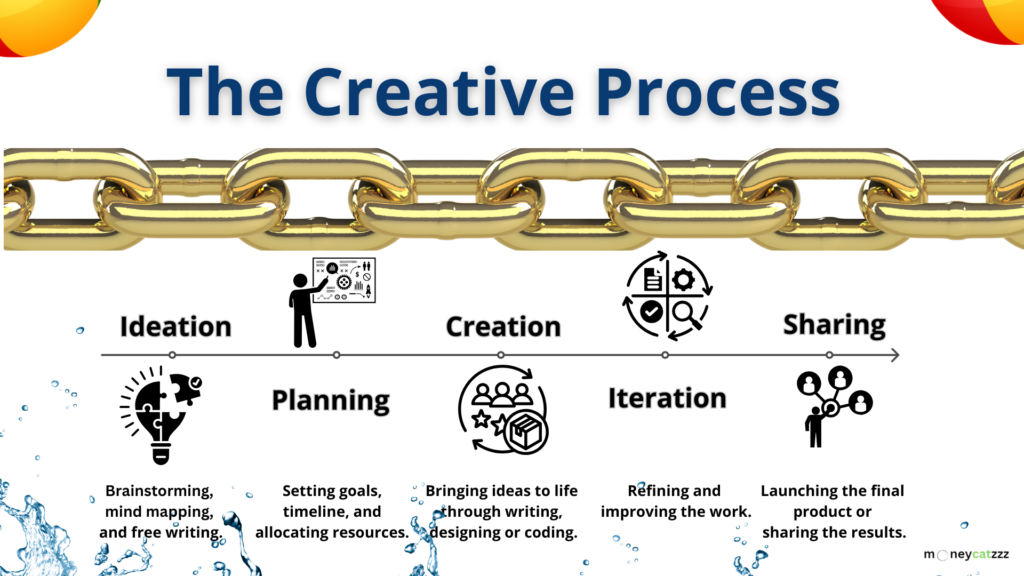
[“The Creative Process” – moneycatzzz.com]
6. Momentum: The Silent Power Behind Big Breakthroughs
Starting something is brave. But finishing—and sustaining—is where transformation lives.
Momentum isn’t about speed. It’s about consistent forward movement. Think of it as compound interest for your efforts—small actions building over time into outsized results.
Ways to Sustain Momentum:
- Create feedback loops: Regular input keeps you aligned
- Build community: Surround yourself with builders, not just dreamers
- Iterate in public: Share progress to stay accountable and attract early believers
- Celebrate progress: Never underestimate the power of recognizing growth
Amazon is a powerful example. Their culture of “Day 1“ thinking means every step is treated as the first toward a bigger horizon. That mindset keeps them innovating—and expanding.
7. Plan for Risk: Don’t Just Hope for the Best
Let’s face it—hope is not a strategy.
From market shifts to personal burnout, every project faces risks. Brilliant creators build contingency plans. A solid risk strategy includes:
- SWOT Analysis: Identify threats early
- Scenario planning: Prep for best-case, worst-case, and in-between
- Risk distribution: Don’t put all eggs in one revenue stream or audience
- Know your triggers: What signals should spark a pivot?
Planning for risk isn’t about paranoia but building staying power. When you’ve anticipated turbulence, you move with confidence, not panic. And when the unexpected hits (because it will), your ability to adapt becomes your real edge.
And that brings us full circle: the spark of a great idea only becomes transformational when backed by courage, consistency, and clarity of direction.

[“The Creative Spark” – Image by Petra from Pixabay]
Turning Spark into Signal
That idea in your mind—it’s not just a spark. It’s a signal that something inside you is ready to build.
The journey from “what if“ to “what is“ doesn’t require superpowers. It needs structure, support, and heart—with the right mindset, tools, and team—you can go the distance.
So the next time an idea strikes—don’t just admire the flash.
Start the fire.

Research-Backed Insights That Shape Sustainable Transformation
Great ideas don’t thrive in isolation—the best minds in business, psychology, and design reinforce them. Here are four powerhouse sources that offer grounded insights into what fuels transformation:
1. McKinsey & Company: What Drives Transformation Success?
In their landmark study, McKinsey found that only 30% of organizational transformations succeed—and the common denominator among successful ones? A clear strategy, leadership ownership, and consistent execution. Whether launching a product or rebuilding your career, those principles apply: structure matters.
2. IDEO: The Design Thinking Mindset
IDEO’s Design Thinking Framework reshaped how companies approach innovation. Their process—Empathize, Define, Ideate, Prototype, Test—offers a repeatable, human-centered approach to turning ideas into real-world impact. It reminds us that excellent execution starts with deep empathy and curiosity—not just efficiency.
3. Harvard Business Review: Mindfulness Fuels Creativity
A growing body of research, including this article from HBR, shows how mindfulness practices enhance divergent thinking, boost creativity, and reduce cognitive fatigue. When your brain is overloaded, your ideas stall. Strategic mindfulness isn’t just trendy—it’s a science-backed lever for better decision-making and innovation.
4. World Economic Forum: Future of Jobs and Adaptability
According to the World Economic Forum’s Future of Jobs Report, resilience, adaptability, and self-management are now considered core skills for future-ready professionals. This underscores that transformation isn’t just about your product—it’s about you evolving in real time.
Related Posts:
Disclosure: This post may contain affiliate links. We only recommend products we believe in, and We may receive a commission at no cost to you! Thank you for your support!
Acknowledgement: Cover Photo by Alena Koval
Disclaimer: The information is provided for general information only – moneycatzzz.com makes no representations or warranties in relation to the information, including but not limited to any representation or warranty as to the fitness for any particular purpose of the information to the fullest extent permitted by law. While every effort has been made to ensure that the information provided in this article is accurate, reliable, and complete as of the time of writing, the information provided in this article should not be relied upon to make any financial, investment, real estate or legal decisions. Additionally, the information should not substitute advice from a trained professional who can take into account your personal facts and circumstances, and we accept no liability if you use the information to form decisions.