 Reading Time: 6 mins #
 This post may contain affiliate links.
Crisis Management: A complete Guide
In today’s unpredictable world, crises don’t send invitations—they explode onto the scene like wildfires—catching teams off guard and torching even the most stable operations—one wrong move can spiral into financial disaster, brand erosion, or broken morale. But here’s the good news: with foresight, structure, and emotional intelligence, a crisis doesn’t have to become a catastrophe. It can become a proving ground.
Recent research from the Pew Institution reveals a sobering truth: the average organization faces up to eight crises per year. Meanwhile, the World Bank found that 60% of companies that don’t recover quickly never fully recover. These aren’t just numbers—they’re warning signs. And they point to one thing: resilience is no longer optional.
These aren’t just numbers—they’re signals. If you’re not preparing for crises, you’re already falling behind.
Because when the worst hits, it’s not just strategy that matters—how well you understand what you’re up against.
“The best crisis management plan is the one you never have to use.” – Unknown
The Crisis Conundrum: What You’re Really Up Against
As Andy Gilman aptly said:
“The secret of crisis management is not good vs. bad; it’s preventing the bad from getting worse.”
Crises come in many forms—cyberattacks, product recalls, PR meltdowns—but they all share one thing: high emotional stakes. Understanding the human side of a crisis is just as crucial as having a good checklist.
Dr. Peter Sandman’s formula—Risk = Hazard + Outrage—reminds us that perception can amplify panic. Meanwhile, the Kübler-Ross model (yes, the five stages of grief) often mirrors how teams process shock: denial, anger, bargaining, depression, and, eventually, acceptance.
When leaders grasp this psychological terrain, they can lead with empathy and clarity—not just control.

[“Stay in Control!” – Image from Freepiks]
The Fallout: What Happens When Crisis Management Fails
Poor crisis management isn’t just bad luck—it’s a blueprint for long-term damage. Consider the following:
- Reputation Meltdown: According to the Reputation Institute, a reputational hit can reduce revenue by 5%—or more if mishandled publicly.
- Financial Collapse: Ask BP. The Deepwater Horizon spill cost them over $65 billion.
- Productivity Plunge: Stress from crisis conditions can lower output by up to 20% (American Psychological Association).
- Employee Exodus: Gallup found that engaged employees are 59% less likely to leave—but nothing kills engagement faster than a mismanaged crisis.
- Strategic Paralysis: A McKinsey study found unprepared companies often miss out on growth opportunities while scrambling to patch the present.
Translation? Crisis mismanagement is expensive—and not just in dollars.

How to Lead Through the Fire: Strategies That Work
Let’s break down what effective crisis leadership looks like.
1. Build a Rock-Solid Crisis Management Plan
Your first line of defense is a clear, adaptable blueprint.
- What to include: Chain of command, roles and responsibilities, communication protocols, scenario planning, resource allocation, and actionable response strategies.
- Why it matters: A strong plan shortens response time, clarifies action, and minimizes confusion.
2. Lead with Transparency and Accountability
Nothing unravels trust faster than a culture of silence or blame.
- How to do it: Clarify expectations, make it safe to speak up, listen actively, co-create solutions, and follow through.
- The payoff: Trust builds speed. Speed builds resilience.
3. Embrace the 4 C’s: Candor, Compassion, Competence, Confidence
These aren’t soft skills—they’re survival tools.
- What they deliver: Candor breeds clarity. Compassion keeps people grounded. Competence ensures stability. Confidence inspires followership.
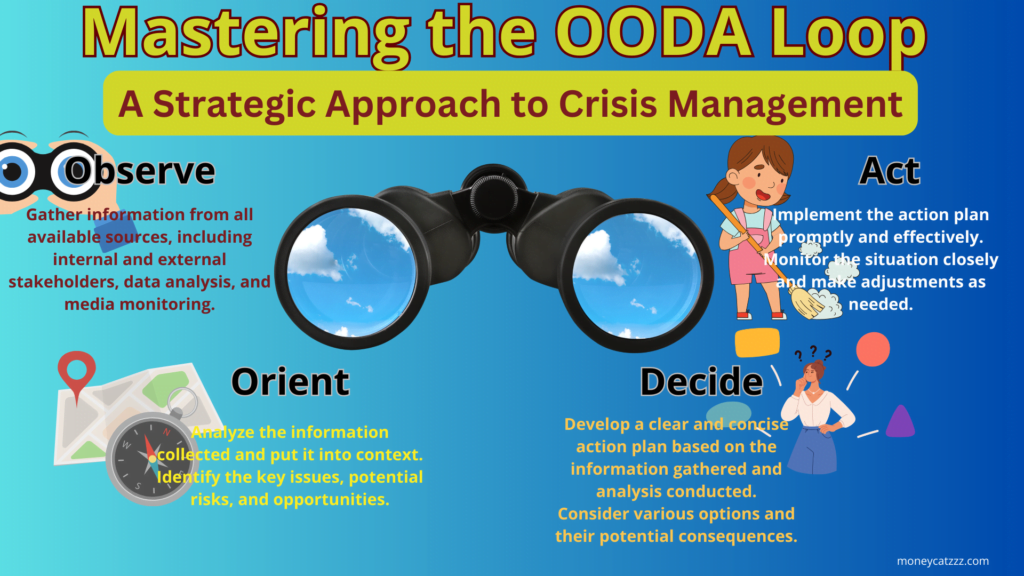
[“The OODA Loop” = moneycatzzz.com]
4. Use the OODA Loop
This military decision model—Observe, Orient, Decide, Act—helps eliminate chaos.
- Why it works: It promotes rapid, responsive decision-making when time is scarce and information is limited.
5. Practice Emotional Intelligence
EQ isn’t a luxury—it’s a leadership necessity.
- Focus areas: Self-awareness, emotional regulation, empathy, motivation, and social skills.
- Why it matters: Emotions are contagious. Your team will follow suit if you’re calm, focused, and clear.
Case Study: How Johnson & Johnson Turned Crisis Into a Leadership Masterclass
In 1982, Johnson & Johnson faced a nightmare: cyanide-laced Tylenol capsules killed seven people in Chicago. The company’s brand teetered on the edge of collapse.
But instead of hiding, J&J acted with transparency and courage. They:
- Recalled all Tylenol products nationwide—at a significant cost.
- Cooperated fully with authorities.
- Communicated openly with the public.
- Relaunched with tamper-proof packaging.
- Offered support and refunds to consumers.
The result? Their reputation recovered. Their market share rebounded. And their crisis response became the gold standard.
The takeaway: Swift, values-driven action works—every time.
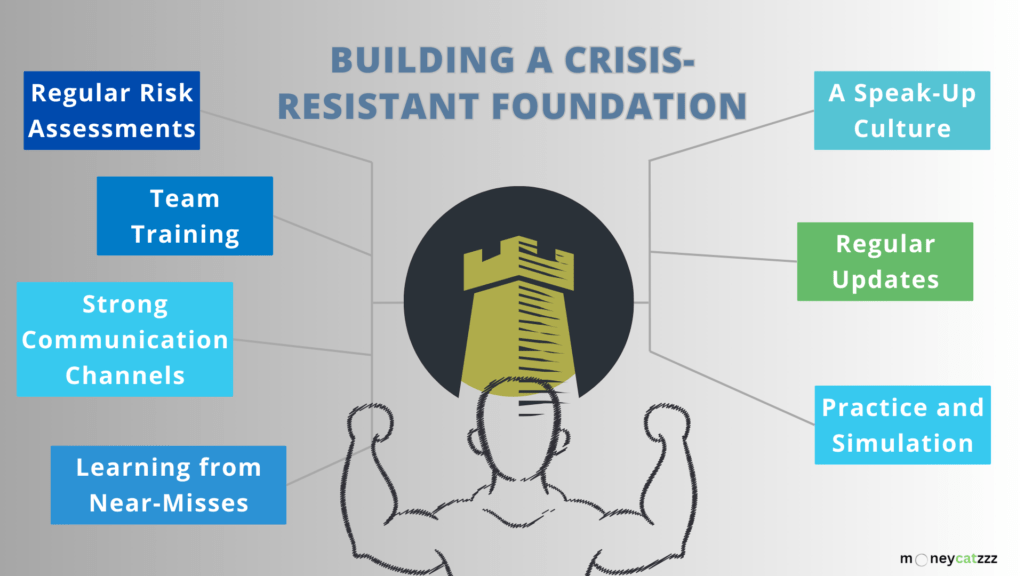
[“Building a Crisis-Resistant Foundation” – moneycatzzz.com]
Future-Proofing: How to Build a Crisis-Resistant Organization
Prevention is the best crisis strategy. Here’s how to inoculate your team:
- Run regular risk audits to catch issues before they ignite.
- Train your people—don’t assume they’ll rise to the occasion unprepared.
- Build clear, fast communication channels internally and externally.
- Learn from near-misses instead of sweeping them under the rug.
- Foster a speak-up culture where warning signs surface early.
- Keep your crisis plans fresh—update them quarterly.
- Practice under pressure—simulation drills make the real thing less scary.
The Growth Mindset: Turning Pain into Progress
Crises hurt. But they also teach. Organizations with a growth mindset recover faster and emerge wiser.
- Welcome feedback, even when it stings.
- Analyze failures without assigning blame.
- Look for root causes—not just quick fixes.
- Believe you can adapt. Then prove it.
Final Thoughts
Effective crisis management isn’t just about reacting fast. It’s about laying the groundwork for resilience—so when the heat comes, your foundation holds.
Yes, crises will come. But with the right systems, mindsets, and strategies in place, you won’t just survive. You’ll lead, inspire, and grow.
Recommended Reading
- “Crucial Accountability“ by Kerry Patterson et al. (For fostering a culture of transparency and accountability)
- “Emotional Intelligence 2.0“ by Travis Bradberry and Jean Greaves (For developing emotional intelligence skills)
- “The Black Swan“ by Nassim Nicholas Taleb (For understanding unexpected events and preparing for them)
- “Mindset: The New Psychology of Success“ by Carol Dweck (For adopting a growth mindset)

Disclosure: This post may contain affiliate links. We only recommend products we believe in, and We may receive a commission at no cost to you! Thanks for your support!”
Acknowledgement: Cover Photo by Matthias Groeneveld
Disclaimer: The information is provided for general information only – moneycatzzz.com makes no representations or warranties in relation to the information, including but not limited to any representation or warranty as to the fitness for any particular purpose of the information to the fullest extent permitted by law. While every effort has been made to ensure that the information provided in this article is accurate, reliable, and complete as of the time of writing, the information provided in this article should not be relied upon to make any financial, investment, real estate or legal decisions. Additionally, the information should not substitute advice from a trained professional who can take into account your personal facts and circumstances, and we accept no liability if you use the information to form decisions.