
 Reading Time: 8 mins #
 This post may contain affiliate links.
DeFi Revolution and the New Financial Order
The digital revolution is relentlessly reshaping every industry, with finance at the forefront. Decentralized Finance (DeFi) has emerged as a pivotal component of this evolution, offering innovative alternatives to traditional banking by leveraging blockchain technology to eliminate conventional intermediaries. This shift signifies a broader DeFi Revolution, where financial power transitions from centralized institutions to a decentralized network of users, enhancing transparency and control.
In The Infinite Machine, Camila Russo chronicles the evolution of Ethereum, highlighting its role as a catalyst in the DeFi movement. The narrative details how developers, led by Vitalik Buterin, created a platform capable of supporting various applications beyond digital currency. Ethereum has become a foundation for innovation, enabling the development of decentralized applications (dApps) and smart contracts that operate without intermediaries.
“Crypto is not just about making money; it’s about changing the world by democratizing finance and giving power back to the people.” – Andreas M. Antonopoulos.
However, as the DeFi sector matures, critical questions arise regarding its impact on the future of digital finance. While decentralized finance platforms promise a more inclusive financial system, they also introduce complexities and potential risks. Users should remain vigilant, as many projects may lack the safeguards to protect their investments. Risks of DeFi investing include vulnerabilities such as smart contract flaws, regulatory uncertainties, and market volatility. The decentralized nature of DeFi can also lead to challenges in governance and regulation, potentially exposing users to unforeseen risks.
As we look to the future of digital finance, it’s essential to balance the innovative potential of DeFi with a thorough understanding of its risks. Engaging in comprehensive research, exercising caution, and staying informed are crucial steps for anyone participating in the DeFi ecosystem.
What Is DeFi?
Redefining the Financial Intermediary
DeFi revolutionizes finance by eliminating intermediaries—like banks and brokers—using smart contracts, which are self-executing agreements programmed on blockchain networks such as Ethereum. These digital contracts automate lending, borrowing, trading, and insurance without the need for traditional oversight.
According to the World Economic Forum, this breakthrough unlocks financial services for millions worldwide, including over 1.4 billion unbanked individuals. For these individuals, DeFi offers a chance to access financial services that were previously out of reach, potentially reducing poverty and increasing economic stability.

Core Components of DeFi
Financial Services on the Blockchain
DeFi mimics and enhances traditional financial services with innovations such as:
- Lending & Borrowing: Users can lend cryptocurrencies to earn interest or use collateral to secure loans.
- Decentralized Exchanges (DEXs): Platforms like Uniswap enable trading without centralized custodians.
- Insurance Protocols: Projects such as Nexus Mutual offer community-driven coverage for smart contract vulnerabilities.
As detailed in Mastering Ethereum by Andreas M. Antonopoulos, smart contracts require meticulous security audits—any oversight can lead to severe financial losses.
[“DeFi Revolution 101” – Image by AI]
Navigating the Challenges in the DeFi Ecosystem
Security, Regulation, and Scalability
Security Vulnerabilities
DeFi’s decentralized structure bestows autonomy but also shifts the onus of security onto users. In 2021, a vulnerability in the BadgerDAO protocol led to losses exceeding $120 million, underscoring the need for robust security measures. This incident, along with others, highlights the importance of thorough security audits and the need for users to be vigilant against potential threats. For further details on such incidents, see the CoinDesk report.
Regulatory Uncertainty
The lack of consistent global regulatory frameworks poses significant challenges. The International Monetary Fund (IMF) has noted that a harmonized regulatory approach is essential to balance innovation with consumer protection. Learn more from the IMF.
Scalability Limitations
Network congestion and high gas fees on Ethereum have spurred the development of Layer-2 solutions like Optimism and Arbitrum. These solutions work ‘on top’ of the main Ethereum blockchain, increasing transaction speeds and lowering costs. For an in-depth discussion, Layered Money by Nik Bhatia explores these critical technological advancements.
DeFi vs. Traditional Finance
Coexistence in a Changing Ecosystem
The future of finance is not a zero-sum game between DeFi and conventional banking. Instead, a collaborative evolution is emerging, offering reassurance that traditional institutions are integrating DeFi innovations into their services.
In Cryptoassets: The Innovative Investor’s Guide by Chris Burniske and Jack Tatar, the authors articulate how institutional adoption of digital assets can mitigate the volatility typically associated with cryptocurrencies.
The Role of CBDCs in the New Financial Landscape
Central Banks Embrace Digital Transformation
Central Bank Digital Currencies (CBDCs) are redefining monetary systems by offering digital, state-backed currencies. These instruments combine the stability of traditional currencies with the efficiency of blockchain technology. The Bank for International Settlements reports that over 130 countries are exploring CBDCs, with early adopters like China and Sweden already running advanced pilot programs.
CBDCs, alongside stablecoins and DeFi platforms, contribute to an increasingly diversified digital finance ecosystem.
How to Embrace the DeFi Revolution
Steps for Informed Participation
Educate Yourself
Before diving into DeFi, gain a solid understanding of blockchain and cryptocurrency fundamentals. Resources like DeFi Pulse and reputable YouTube channels like Finematics provide valuable insights.
Start Small
Adopt a cautious approach by starting with user-friendly platforms like Aave or Compound. Experimenting with small investments can help you build confidence without exposing you to excessive risk.
Prioritize Security
With DeFi, you are responsible for safeguarding your assets. Use hardware wallets, enable two-factor authentication, and stay alert to phishing scams. Remember, losing your digital keys equates to losing your funds.
Engage with the Community
Active participation in Reddit, Discord, and Twitter (X) forums can offer real-time updates and practical advice. Networking with experienced users will enhance your understanding and mitigate potential mistakes.
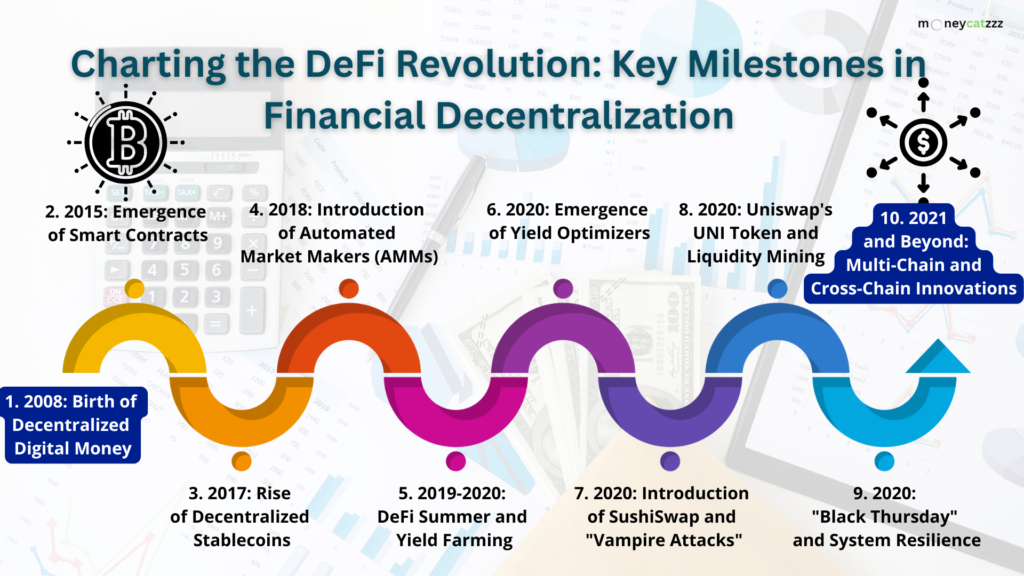
[‘Decoding DeFi: A Visual Journey Through Financial Decentralization” – Image by moneycatzzz.com]
Empower Yourself: beyond DeFi, Emerging Trends in FinanceA Broader Look at the Digital Financial Revolution
While DeFi is transforming finance, other technological trends are also reshaping the landscape:
Artificial Intelligence in Finance
AI and machine learning are revolutionizing investment strategies and fraud detection. Robo-advisors now offer personalized portfolio management that adjusts to individual risk profiles.
Open Banking
Open banking initiatives allow third-party developers to access consumer data (with consent), fueling competition and innovation. The EU’s PSD2 regulation is a prime example of how regulatory frameworks can foster this growth.
Embedded Finance
Financial services are increasingly integrated into everyday platforms. Imagine applying for a loan during an online shopping experience or securing travel insurance with a single click—this seamless integration sets new standards.
Financial Inclusion Through Fintech
Mobile-first solutions are bridging the gap for the unbanked in regions like Africa and Southeast Asia. Fintech innovations are proving that inclusive finance is both achievable and profitable.
Redefining Central Banking
As CBDCs and tokenized assets gain traction, central banks reimagine their roles. Enhanced digital control could streamline monetary policy and reduce the reliance on traditional banking infrastructures.
Together, these trends are forging a financial ecosystem that is more personalized, inclusive, efficient, and collaborative.
The Road Ahead for Digital Finance
The financial landscape is undergoing a seismic shift. Whether you are an investor, entrepreneur, or a casual observer, the best way to navigate this evolving space is to remain informed and adaptable. As Don Tapscott and Alex Tapscott articulate in Blockchain Revolution, we are witnessing more than a technological evolution—we are seeing a complete redefinition of economic power.
Innovation in finance has always been met with skepticism and excitement. DeFi, with its promise of democratizing financial services, may catalyze the next era of economic growth. Yet, like any disruptive force, it carries inherent risks that require careful management and continuous learning.
The future of money is digital, decentralized, and distinctly different from what we once knew. Embrace the change, educate yourself, and join the revolution—because the next chapter in finance is being written today.

Glossary: Key Terms You Should Know
- Blockchain: A decentralized digital ledger that records transactions across a network of computers.
- Smart Contract: Self-executing code that automatically enforces and executes contract terms on the blockchain.
- Stablecoin: A cryptocurrency pegged to a stable asset, such as the US dollar, to reduce volatility.
- CBDC: Central Bank Digital Currency, a digital version of a nation’s currency issued by its central bank.
- DEX (Decentralized Exchange): A platform enabling peer-to-peer trading of digital assets without intermediaries.
- Layer-2 Solutions: Off-chain protocols that boost transaction speeds and reduce costs on the primary blockchain.
- dApp: A decentralized application that operates on a blockchain without centralized control.
- Tokenized Deposits: Digital representations of traditional bank deposits on the blockchain.
Disclosure: This post may contain affiliate links. We only recommend products we believe in, and We may receive a commission at no cost to you! Thank you for your support!
Acknowledgement: Cover Image by Unsplash.com
Disclaimer: The information is provided for general information only – moneycatzzz.com makes no representations or warranties in relation to the information, including but not limited to any representation or warranty as to the fitness for any particular purpose of the information to the fullest extent permitted by law. While every effort has been made to ensure that the information provided in this article is accurate, reliable, and complete as of the time of writing, the information provided in this article should not be relied upon to make any financial, investment, real estate or legal decisions. Additionally, the information should not substitute advice from a trained professional who can take into account your personal facts and circumstances, and we accept no liability if you use the information to form decisions.