
 Reading Time: 10 mins #
 This post may contain affiliate links.
On August 28, 1963, Martin Luther King Jr. stood before a crowd of 250,000 people and uttered the words that would resonate through history: “I have a dream.” In that moment, he wasn’t just sharing a vision but demonstrating the awe-inspiring power of belief. King’s unwavering faith in a more just and equal America didn’t just inspire a movement—it literally moved mountains of systemic oppression and changed the course of history.
Fast forward to today, and the power of belief continues to shape our world in profound ways. Did you know that people with a strong sense of self-efficacy—belief in their ability to succeed—are 50% more likely to achieve their goals than those without? Or that companies led by optimistic CEOs outperform their peers by 48% in cumulative shareholder returns?
These aren’t just feel-good statistics. They’re a testament to a fundamental truth: belief can reshape reality, overcome seemingly insurmountable odds, and even move mountains. It’s a power that’s within your reach, waiting to be harnessed. But what exactly is belief, and how can we harness its transformative power to achieve the seemingly impossible in our lives?
“Your beliefs become your thoughts, your thoughts become your words, your words become your actions, your actions become your habits, your habits become your values, your values become your destiny.” – Mahatma Gandhi.
In exploring the power of belief, we’ll delve into the science behind this extraordinary force, uncover practical strategies for cultivating unshakeable conviction, and examine real-world examples of individuals and groups who have used belief to change their lives and the world around them. Whether facing a personal Everest or striving to make a dent in the universe, understanding and applying these strategies could be the key to unlocking your full potential.
Together, we can uncover the potential that belief holds for each of us.
The Foundation of Belief
At its core, belief is the unwavering conviction that something is actual or possible. The voice inside whispers, “You can,” when the world shouts, “You can’t.” This internal dialogue shapes our perceptions, decisions, and, ultimately, our actions.
Dr. Carol S. Dweck, in her groundbreaking book “Mindset: The New Psychology of Success,” explained how our beliefs about our abilities and potential fuel our behavior and predict our success. She argues that individuals with a “growth mindset” – those who believe their talents can be developed through hard work, good strategies, and input from others – are likelier to flourish than those with a more fixed mindset.
This perspective isn’t just feel-good psychology; it’s backed by hard science. Neuroscientific research has shown that our beliefs can alter our brain chemistry and genetic expression. In essence, what we believe creates the world we inhabit. This means that our beliefs not only influence our actions and decisions but also have the power to shape our physical and mental reality, making the seemingly impossible, possible.
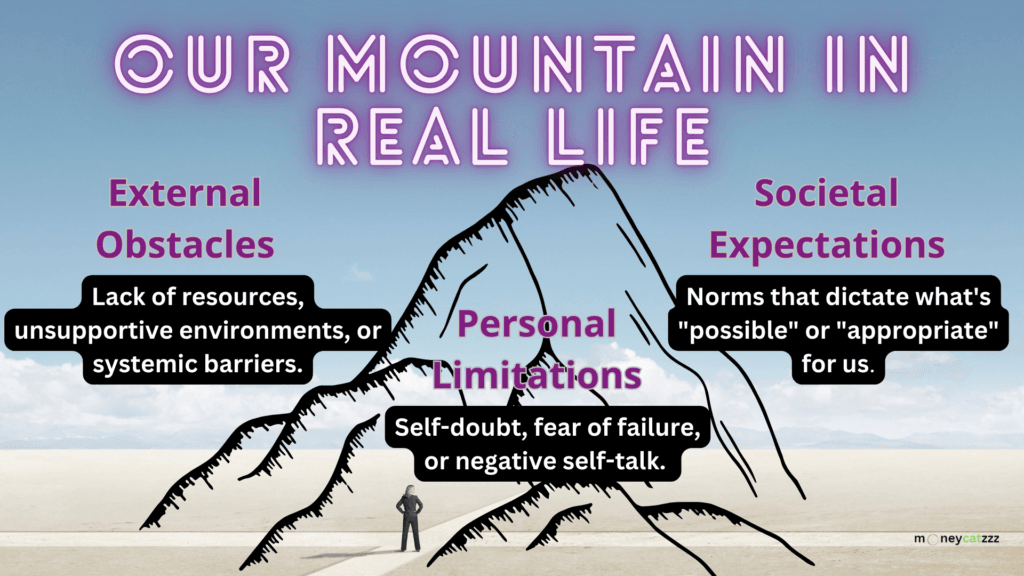
[“Our Mountain in Real Life” – moneycatzzz.com]
The Mountain Before Us
Let’s address the elephant – or the mountain – in the room. When we talk about ‘moving mountains,’ we’re not speaking literally (though the power of belief has been known to accomplish some pretty miraculous feats). Instead, we’re referring to those seemingly insurmountable challenges that loom large in our lives: career transitions, personal transformations, societal changes, or any goal that feels utterly out of reach. These are the ‘mountains‘ we aim to move with the power of belief.
These mountains often appear in various forms:
- Personal Limitations: Self-doubt, fear of failure, or negative self-talk.
- External Obstacles: Lack of resources, unsupportive environments, or systemic barriers.
- Societal Expectations: Norms that dictate what’s “possible” or “appropriate” for us.
The question is: how do we cultivate a belief strong enough to overcome these obstacles?
Cultivating Unshakeable Belief
Start with Self-Awareness
Before we can change our beliefs, we need to understand what they are. This involves deep introspection and honest self-assessment. What limiting beliefs are holding you back? Where did these beliefs come from?
In his book “Awaken the Giant Within,” Tony Robbins provides powerful strategies for identifying and challenging our limiting beliefs. He encourages readers to question the validity of these beliefs and replace them with empowering alternatives.
Visualize Success
Visualization is a powerful tool athletes, entrepreneurs, and high achievers use across all fields. By vividly imagining ourselves succeeding, we create neural pathways that make that success more likely.
A fascinating case study on the power of visualization comes from basketball. A study at the University of Chicago found that basketball players who visualized free throws improved almost as much as those who practiced shooting. This mental rehearsal created muscle memory and improved performance, even without physical practice.
Surround Yourself with Believers
Jim Rohn famously said, “You are the average of the five people you spend the most time with.” This principle applies to belief as well. Surrounding yourself with individuals who believe in you and your potential can significantly boost your own belief.
Roger Bannister did what was widely believed to be physically impossible by breaking the four-minute mile in 1954. The record was broken again 46 days later and many times since, compounding that collective belief about what was possible, illustrating how faith can be contagious.
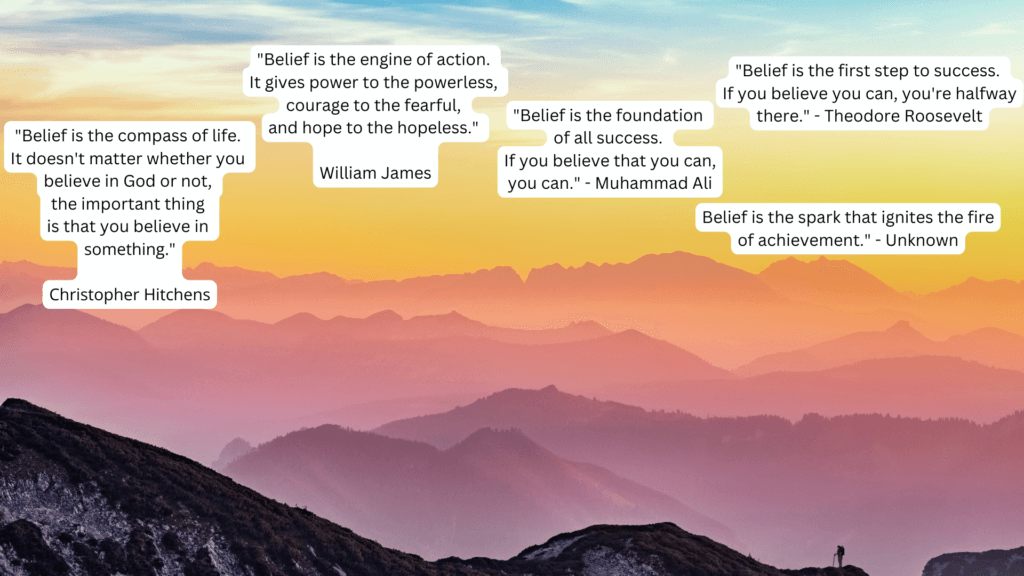
[“Belief” – Image by moneycatzzz.com on Canva]

Take Inspired Action
Belief without action is merely wishful thinking. We must align with our convictions to truly harness the power of belief. This doesn’t mean recklessly charging ahead; it involves taking calculated risks and persistent, inspired action.
In “The 7 Habits of Highly Effective People,” Stephen Covey emphasizes the importance of proactivity – taking responsibility for our lives and acting based on our values rather than reacting to external circumstances. This proactive approach is a direct manifestation of belief in action.
Embrace Failure as Feedback
Fear of failure is one of the biggest obstacles to maintaining strong belief. However, reframing failure as feedback can transform it from a threat to an opportunity for growth.
In his quest to invent the light bulb, Thomas Edison famously said, “I have not failed. I’ve just found 10,000 ways that won’t work.” This mindset allowed him to persist despite repeated setbacks, ultimately leading to one of the most transformative inventions in human history.
Overcoming Doubt and Setbacks
Even with the strongest belief, doubt and setbacks are inevitable. The key is not to eliminate these challenges but to develop resilience in the face of them.
In her book “Grit: The Power of Passion and Perseverance,” Angela Duckworth argues that the secret to outstanding achievement is not talent but a unique blend of passion and persistence, which she calls “grit.” This quality allows individuals to maintain their beliefs and keep pushing forward, even when faced with significant obstacles.
Developing grit involves:
- Finding Your Purpose: Connecting your goals to a larger sense of meaning.
- Practicing Deliberately: Focused, consistent effort to improve.
- Cultivating Hope: Maintaining optimism in the face of setbacks.
- Joining a Gritty Culture: Surrounding yourself with others who exemplify perseverance.
The Science of Belief
While the power of belief might seem purely psychological, it has tangible effects on our physiology and genetic expression.
Research in epigenetics has shown that our beliefs and experiences can change how our genes are expressed. This means that we can change our biological reality by changing our beliefs.
A groundbreaking study published in the Proceedings of the National Academy of Sciences found that meditation and mindfulness practices (which often involve cultivating positive beliefs) can lead to changes in gene expression that reduce inflammation and promote overall health.
[“The Power of Belief” – moneycatzzz.com]
Belief in Action: Real-World Examples
The power of belief isn’t just theoretical; it’s demonstrated time and again in real-world scenarios:
- Business: Steve Jobs believed in the potential of personal computing when most couldn’t imagine a computer in every home. This belief drove Apple to become one of the most valuable companies in the world.
- Sports: The USA men’s ice hockey team’s victory over the Soviet Union in the 1980 Olympics, known as the “Miracle on Ice,” was a triumph of belief over seemingly insurmountable odds.
- Science: When most believed ulcers were caused by stress, Dr. Barry Marshall believed bacteria caused them. His conviction led him to prove his theory, ultimately winning a Nobel Prize and revolutionizing treatment.
- Personal Development: Nick Vujicic, born without limbs, believed he could inspire others and live a full life. Today, he’s a world-renowned motivational speaker, author, and entrepreneur.
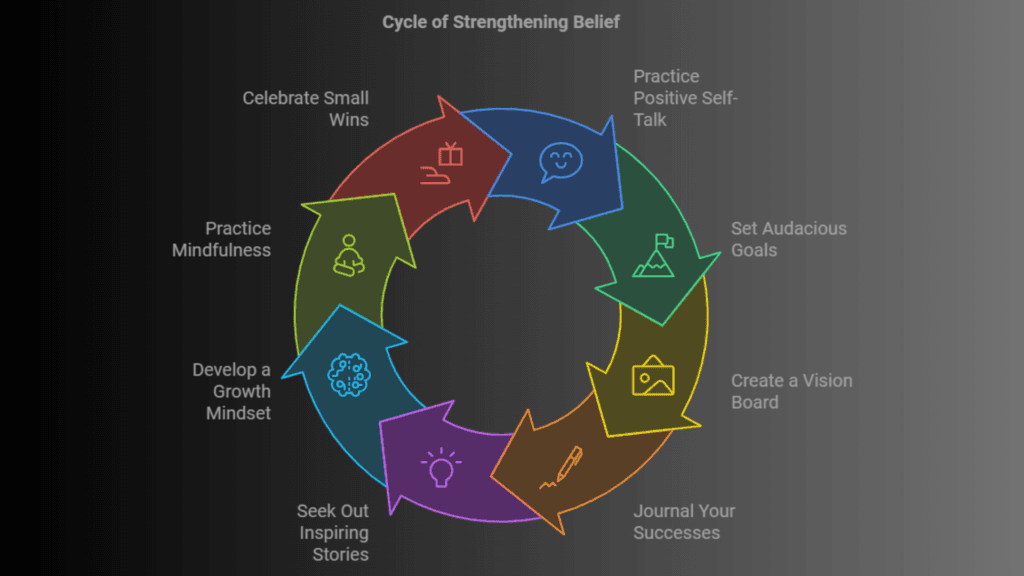
[“Cycle of Belief” – moneycatzzz.com]
Practical Steps to Strengthen Your Belief
- Practice Positive Self-Talk: Replace negative internal dialogue with affirming, empowering statements.
- Set Audacious Goals: Challenge yourself with goals that stretch your perception of what’s possible.
- Create a Vision Board: Visualize your goals and dreams tangibly.
- Journal Your Successes: Regularly record your achievements to build confidence.
- Seek Out Inspiring Stories: Read biographies or watch documentaries about individuals who’ve overcome great odds.
- Develop a Growth Mindset: Embrace challenges as opportunities to learn and grow.
- Practice Mindfulness: Stay present and aware of your thoughts and beliefs.
- Celebrate Small Wins: Acknowledge progress, no matter how small, to build momentum.

The Ethical Dimension of Belief
While the power of belief is undeniably transformative, it’s crucial to consider the ethical implications of our beliefs. Strong beliefs can move mountains, but they can also create them. History is replete with examples of misguided beliefs leading to harm and injustice.
As we cultivate our beliefs, we must also nurture a sense of responsibility and empathy. The most powerful beliefs are those that not only serve our personal growth but also contribute positively to the world around us.
Conclusion: Your Mountain Awaits
As we conclude this exploration of the power of belief, remember that the mountain before you – whatever form it may take – is not immovable. You can reshape your reality with unwavering belief, persistent action, and resilience in the face of setbacks.
The journey of a thousand miles begins with a single step, and the journey to move your mountain starts with a single belief: you can. So, what mountain will you move to? What seemingly impossible dream will you bring to life?
Your destiny awaits. Believe, and start moving your mountain today.
Disclosure: This post may contain affiliate links. We only recommend products we believe in, and We may receive a commission at no cost to you! Thank you for your support!
Acknowledgement: Cover Image by rawpixel.com
Signup to our Newsletter for regular updates:
Disclaimer: The information is provided for general information only – moneycatzzz.com makes no representations or warranties in relation to the information, including but not limited to any representation or warranty as to the fitness for any particular purpose of the information to the fullest extent permitted by law. While every effort has been made to ensure that the information provided in this article is accurate, reliable, and complete as of the time of writing, the information provided in this article should not be relied upon to make any financial, investment, real estate or legal decisions. Additionally, the information should not substitute advice from a trained professional who can take into account your personal facts and circumstances, and we accept no liability if you use the information to form decisions.