
Listen to the full essay here. Headphones highly recommended.
Reading Time: 8 mins #

This post may contain affiliate links.

The alarm went off as I had set it: 7:43 AM. The plan was to jump off the bed at 7:45 AM. Tuesday morning was never much to shout about, and I stared at the ceiling fan without moving.
I had spent six months in therapy, kept a daily journal, and set clear boundaries. By every self-help metric, I was due for a breakthrough.
Instead, I felt crushed under an invisible weight.
Victor Hugo wrote in Les Misérables that even the darkest night will end and the sun will rise. Reading that line on a cold Tuesday morning made me want to throw the book against the wall. I was not clinically depressed, nor was I physically ill. My chest felt as if it were filled with wet sand.
People kept telling me that the heavy mood meant the dawn was close. They told me to hang on, but the darkness felt suffocating. I did not realize then that the uncomfortable process of dissolving was the actual work required to change.
Why the Unraveling Happens First
Feeling worse after starting to address long-standing stress usually means you are handling deferred emotional maintenance. People often wonder why I feel worse before getting better when undertaking deep self-work.
Psychologists call this emotional processing theory. For your brain to digest stored stress, your nervous system has to reactivate it first. When long-standing defense mechanisms drop away, suppressed grief surfaces before any new stability can form.
The weeks following Thanksgiving 2020 were the hardest of my year. I finally told my family I would not host the holiday dinner. Saying no delivered twenty-four hours of sweet relief, followed by three straight weeks of suffocating guilt.
My old identity relied on keeping everyone else comfortable. The moment I dropped that costume, I lost my grip on who I was.
[MindValley Promo | Rewire your mind, transform life. | Nir Eyal]
Thomas Moore noted in Dark Nights of the Soul that heavy seasons are not syndromes or medical glitches. He framed them as essential quests for meaning.
Thomas Moore’s words hit somewhere raw. I sat at my kitchen table with a cold cup of coffee and cried.
I had spent years treating my emotional exhaustion like a broken appliance; something to patch up quickly so I could get back to work.
Moore forced a harder question into the quiet room: Who am I once I stop managing everyone else’s expectations?
Research on post-traumatic growth by psychologists Robert Tedeschi and Lawrence Calhoun at the University of North Carolina shows a clear pattern. Psychological disruption often happens right before structural clarity. Severe stress acts like a seismic event. It exposes the weak timber in how you live so that you can rebuild on solid stone.
Knowing the research did not make my mornings pleasant. Dropping old habits feels like failure long before it feels like progress. You are paying off the emotional debt built up while keeping your old life running on fumes.
[The Darkest Before the Dawn| moneycatzzz.com]
Physical and Psychological Signals of the Shift
Recognizing this phase requires looking beyond romanticized movie endings and understanding the classic breakdown-before-breakthrough timeline.
Behavioral psychologists compare this period to an extinction burst: a sudden spike in distress when an old survival strategy no longer delivers its usual safety reward.
Personal change rarely looks like a dramatic epiphany. It looks like unwashed coffee mugs sitting in the sink because you lack the energy to pretend everything is fine.
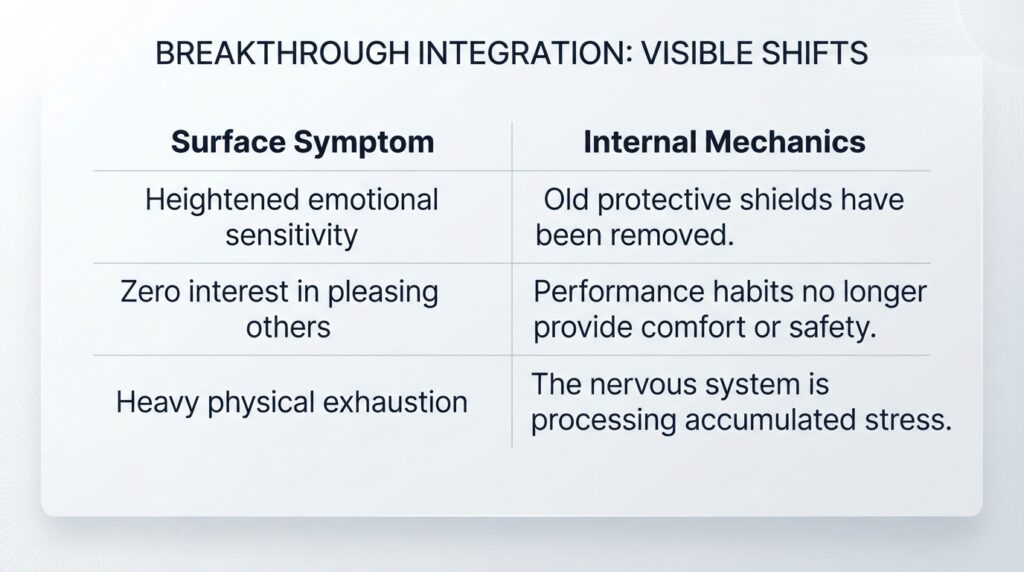
When old protective habits fall off, you feel exposed. If you are looking for a specific breakdown before breakthrough symptoms, you might notice these signals in your daily routine:
- Raw emotional reactions. You cry over minor inconveniences because your emotional reservoir is completely dry.
- Failure of old coping tools. Overworking or pleasing people no longer numbs your discomfort.
- Identity confusion. You feel detached from your old social circles, unsure where you belong next.
Recognizing these signs you’re about to have a breakthrough means accepting that the old routine has stopped working. You are left without a shield, forced to sit with your actual feelings for the first time in years.
Small Decisions in the Dark
Real integration happens through quiet behavioral choices, not forced optimism. Anyone trying to figure out how to have a breakthrough must learn that it is rarely forced; it is unlocked by enduring the messy middle.
Between January and June 2021, I had no clean answers when people asked how I was doing. I felt uncomfortable in my own skin, stuck between an old way of living and a new one I had not built yet.
The worst advice I got during that time was to stay positive and trust the process. I did not need empty optimism. I needed permission to feel lost without pretending I had a master plan.
Brianna Wiest addresses this struggle in The Mountain Is You, writing that internal roadblocks are rarely external obstacles. Instead, they reflect an individual’s deep resistance to changing their self-image. I underlined Wiest’s line in red ink. My resistance was keeping me tied to old habits because familiar pain felt safer than an unknown future.
Moving past that resistance does not happen through sweeping life overhauls. It requires intentional, micro-adjustments in how you handle daily friction. The following Daily Integration Practices serve as the practical bridge from intellectual realization to actual behavioral change:
[The Shift into Quiet Relief | moneycatzzz.com]
Daily Integration Practices
- Set small boundaries. Let text messages sit unread for two hours without sending an apology.
- Practice honest uncertainty. Answer “I don’t know” when colleagues or family demand immediate opinions.
- Choose physical rest. Go to sleep at 9:00 PM on a Friday instead of forcing social energy.
Real change happens in those quiet choices. You stop asking who you ought to be and start paying attention to who you are right now.
The Shift into Quiet Relief
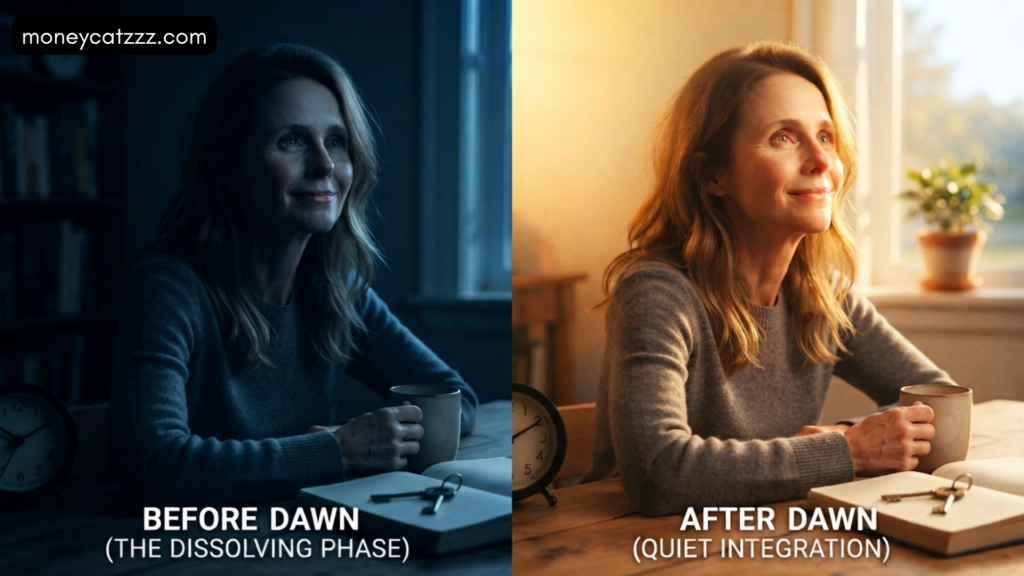
Understanding what comes after a breakthrough reveals that it is not a dramatic triumph. It is quiet integration: a steady sense of relief, clearer boundaries, and a lighter mental load.
My turning point did not arrive with noise.
It was a Wednesday morning in July 2021. I woke up at 6:47 AM and noticed the heavy weight in my chest was gone.
I did not feel like a new person, nor did I feel victorious. I felt lighter, like someone who had carried a hundred-pound pack up a steep hill and finally unbuckled the straps.
When the shift happens, expect quiet integration:
- You make decisions without running them through an internal approval committee.
- You say no to demands on your time without spending three days drafting an apology.
- You accept that being real is sustainable, while appearing strong is exhausting.
You do not emerge as a flawless hero. You emerge as yourself, unburdened by the need to put on a show.
The Work Ahead
April 2021 felt like a dead end. Looking back, that Tuesday at 7:43 AM marked the moment I stopped defending an exhausting way of living.
I still have difficult mornings where I stare at the ceiling fan and question my choices. I still catch myself slipping into old people-pleasing habits when stress levels rise. The difference now is that I no longer panic when the dark mood returns. I do not treat emotional fatigue as a personal failure or a sign that my life is falling apart.
Victor Hugo was right about the sun rising eventually. But the real work happens in the dark hours before dawn, when you choose to drop the heavy weights you were never meant to carry.
_________________________________________________
Disclosure: This post may contain affiliate links. We only recommend products we believe in, and we may receive a commission at no cost to you! Thank you for your support!
Acknowledgment: Cover Image by moneycatzzz.com
Disclaimer: The information is provided for general information only – moneycatzzz.com makes no representations or warranties in relation to the information, including but not limited to any representation or warranty as to the fitness for any particular purpose of the information to the fullest extent permitted by law. While every effort has been made to ensure that the information provided in this article is accurate, reliable, and complete as of the time of writing, the information provided in this article should not be relied upon to make any financial, investment, real estate or legal decisions. Additionally, the information should not substitute advice from a trained professional who can take into account your personal facts and circumstances, and we accept no liability if you use the information to form decisions.