
 Reading Time: 8 mins #
 This post may contain affiliate links.
When the Day Unravels
You wake up, and the day seems to stumble out of bed before you do. Your coffee sloshes onto your shirt like a careless signature. The train doors shut just as you reach them, and that one email you didn’t see coming tilts everything sideways.
In those moments, “embracing it” feels laughable, maybe even cruel. And yet—what if there’s a quiet rhythm at play beneath the mess and mayhem? What if life isn’t sabotaging you but redirecting you, gently (or not so gently) steering you toward something unseen?
It’s a hard sell, especially in a world that praises planning, control, and tidy outcomes. When things fall apart—when real heartbreak or injustice strikes—it’s natural to resist. But Amor Fati, the ancient call to “love your fate,” offers a different lens.
It doesn’t ask you to pretend everything is fine. It doesn’t dismiss pain or difficulty. Instead, it invites you to hold even the unwelcome parts of your story with reverence—as if each detour, delay, or disappointment were a hidden thread in a larger, unfolding tapestry.
As Nietzsche wrote, “What does not kill me makes me stronger.” It’s not just about survival. It’s about finding strength in surrender and wisdom in what we didn’t choose.
In the pages ahead, we’ll wander into the philosophy of Amor Fati—its roots, relevance, and how it might shift the way you meet life. Through stories, insights, and reflections, we’ll explore how learning to love your fate—even in its messiest form—can lead to more profound peace, resilience, and freedom that doesn’t depend on having all the answers.
.
“What does not kill me makes me stronger.” – Friedrich Nietzsche.
What Does Amor Fati Mean?
At its heart, Amor Fati means “love of fate.” It is the idea that we don’t just accept what life hands us—we learn to embrace it fully—with gratitude and joy.
That doesn’t mean throwing up our hands in resignation. Amor Fati isn’t about passivity. It’s a mindset shift—meeting life’s ups and downs with presence, curiosity, and courage. Instead of resisting what happens, we lean in. We ask what the moment is here to teach us. We let even the complex parts shape us.
This doesn’t mean we stop caring about growth or justice. We still take action where we can. But we also recognize what’s beyond our control—and rather than waste energy fighting it, we choose to meet it with grace.
In that way, Amor Fati is a radical form of acceptance. It invites us to step into life as it is, not as we wish, and trust that each twist in the path is part of something bigger. It’s like dancing without needing to lead—letting life move through you and discovering beauty in the unexpected steps.
Nietzsche’s Take on Amor Fati: A Love Letter to Existence
One of the most famous advocates of “Amor Fati“ was Friedrich Nietzsche, the German philosopher whose ideas have profoundly impacted modern thought. Nietzsche didn’t just accept fate—he embraced it with fervor—believing that loving your fate was not only the key to happiness—it is the key to a meaningful existence.
In his book “Thus Spoke Zarathustra,“ Nietzsche wrote:
“My formula for greatness in a human being is amor fate: that one wants nothing to be different, not forward, not backward, not in all eternity.”
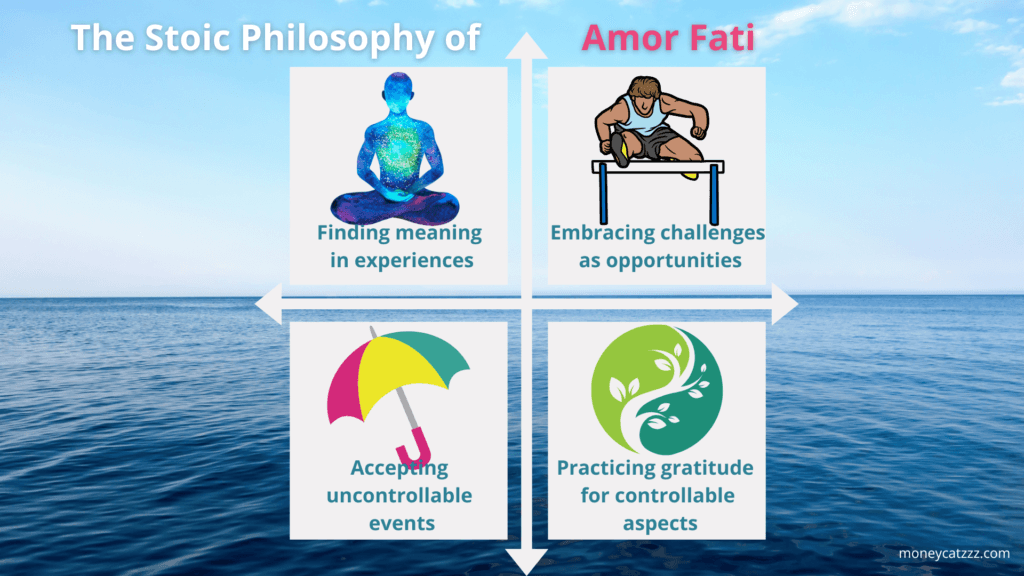
[“The Stoic Philosophy of Amor Fati” moneycatzzz.com]
What Nietzsche was getting at is that we often waste energy wishing things had been different or hoping for a future free of suffering. But the truth is that suffering and struggle are as much a part of life as joy and success. If we learn to love both the highs and the lows—we unlock a sense of Freedom beyond ordinary happiness.
Nietzsche’s philosophy of “Amor Fati“ encourages us to see our challenges not as burdens but as essential parts of the story of our lives. This mindset, Nietzsche suggests, helps us live more authentically, allowing us to move through life with strength and purpose.

The Stoic Roots of Amor Fati: Marcus Aurelius and Epictetus
Though Nietzsche famously embraced Amor Fati, its roots trace back to ancient Stoicism. This philosophy, born in the 3rd century BC through Zeno of Citium, taught that peace comes from focusing on what we can control—and accepting what we cannot. At its heart is living in harmony with nature, including life’s inevitable twists and turns.
Stoic thinkers like Marcus Aurelius and Epictetus wrote deeply about the power of accepting fate—not with resignation, but with quiet strength.
In Meditations, Marcus Aurelius encourages us to welcome life’s unfolding, writing:
“Accept whatever comes to you woven in the pattern of your destiny, for what could more aptly fit your needs?”
His message isn’t about giving up but transforming how we meet what life brings.
Epictetus echoed this in Discourses, reminding us that true freedom lies in letting go of what’s outside our control and directing our energy inward. “Freedom is the only worthy goal in life,“ he said.
Amor Fati wasn’t just a concept to the Stoics—it was a way of being. By leaning into what is rather than resisting it, we become more grounded, resilient, and at peace with ourselves and the world.
Embracing Life as It Is: Living Amor Fati in the Real World
It’s one thing to talk about loving your fate when life feels good—but what about when it doesn’t? How do you embrace disappointment, chaos, or change that arrives uninvited?
Here are a few grounded ways to start living Amor Fati—not just in theory, but in practice:
1. See Challenges as Teachers
Rather than label hardships as roadblocks, ask: What is this teaching me? Reframing struggle as part of your growth changes how you relate to it.
Take a setback—maybe not getting a job or losing something important. In the moment, it stings. But in time, it often reveals a new direction you wouldn’t have seen otherwise. What feels like rejection can sometimes be redirection.
2. Be Grateful for What Is
We feel a deeper sense of peace when we stop resisting the present moment. Practicing gratitude—even for small things—grounds us. Whether it’s the sun on your face or a quiet moment in the day, noticing what’s already here helps you meet life as it unfolds.
Gratitude doesn’t mean pretending everything is perfect. It means making space to appreciate life, not just as we wish.
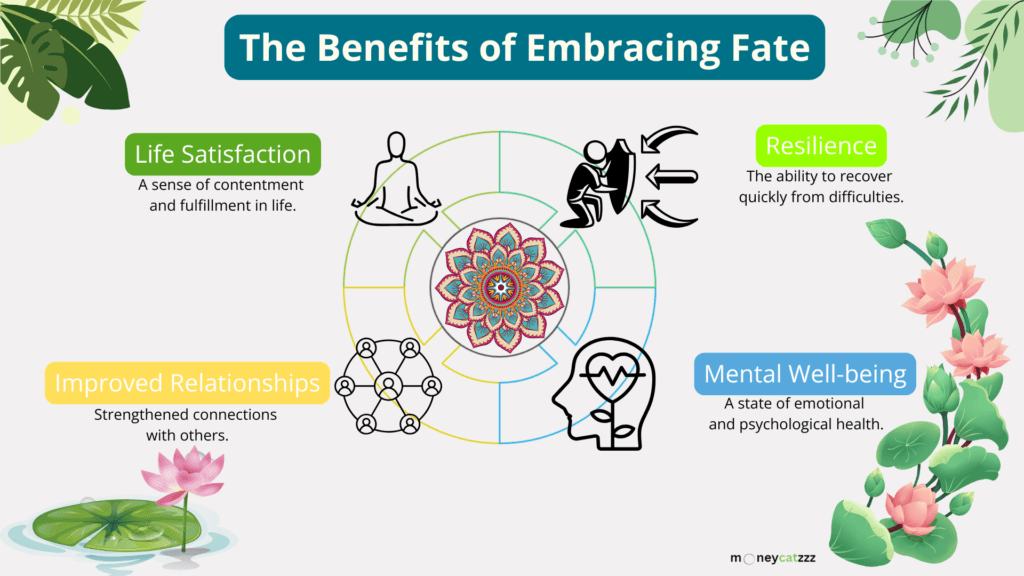
[“The Benefits of Embracing Fate” – moneycatzzz.com]
3. Loosen Your Grip on Control
So much of our suffering comes from trying to force outcomes. Amor Fati invites us to soften our grip, to allow life to move as it will. The less we resist what we can’t change, the more energy we have for what we can.
Letting go isn’t weakness—it’s wisdom. When we stop fighting reality, we make room for resilience and clarity.
4. Remember: Everything Changes
Nothing lasts forever—not the highs, not the lows. Knowing that all things pass helps us face difficult moments with more grace. Life’s impermanence can feel scary, but it’s also freeing. Each moment, even the tough ones, is part of a larger rhythm.
When we embrace that rhythm, we stop clinging or pushing away. We begin to meet life where it is—with openness, humility, and heart.

Understanding that everything changes is just the beginning. The next step is learning how to meet those changes—not with fear or resistance, but with grace. That’s where the art of embracing what is truly begins.
The Gentle Art of Embracing What Is
In a world that urges us to chase, fix, and control, the idea of Amor Fati offers something quieter—and perhaps wiser. It invites us to stop resisting life’s twists and turns and instead meet them with openness, gratitude, and trust.
To love your fate doesn’t mean pretending things are always easy. It means learning to see meaning even in challenging moments. As Nietzsche put it, it’s not just about accepting your fate—it’s about loving it, especially when it’s not what you planned.
So when life surprises you—when plans fall apart, or the path shifts—pause. Ask yourself: What’s this here to teach me? Can I soften around this moment instead of fighting it?
Amor Fati isn’t passive. It’s a bold choice to stand in the middle of chaos and still say yes to life. When we do that, we stop simply surviving—and begin to live truly.
Disclosure: This post may contain affiliate links. We only recommend products we believe in, and We may receive a commission at no cost to you! Thank you for your support!
Acknowledgement: Cover Image by Unsplash.com
Disclaimer: The information is provided for general information only – moneycatzzz.com makes no representations or warranties in relation to the information, including but not limited to any representation or warranty as to the fitness for any particular purpose of the information to the fullest extent permitted by law. While every effort has been made to ensure that the information provided in this article is accurate, reliable, and complete as of the time of writing, the information provided in this article should not be relied upon to make any financial, investment, real estate or legal decisions. Additionally, the information should not substitute advice from a trained professional who can take into account your personal facts and circumstances, and we accept no liability if you use the information to form decisions.