
 Reading Time: 8 mins #
 This post may contain affiliate links.
Matteo sat on the floor watching his cat, Gus. Gus had pressed his entire body against the heating vent. Stole all the warmth. Did nothing to earn it. Typical Gus. Matteo almost judged him. Then he thought about morality – his own, not the cat’s.
He remembered his morning. Twenty minutes of meditation on a cushion. Felt very enlightened. Then his daughter Sofia asked for help with her math homework, the same problem as yesterday. Matteo snapped at her. “Not now, Sofia.” She walked away. He did not call her back.
Gus had not moved. Still warm. Still unbothered.
Matteo talked to Gus sometimes in a fake French accent. “Le vent chaud, Gustave. You are a thief of heat.” Gus ignored him. Gus always ignored him.
But the snap at Sofia stayed. Matteo thought about all the times he had done something good: recycled, donated, voted thoughtfully, and then immediately felt entitled to be a little less kind. A little more impatient. A little cruel, even.
He sat with Gus for a long time. The vent hummed. He thought about the ledger he did not know he was keeping.
The Moral Kickback We All Carry
You have done this too. Do not pretend otherwise.
We all carry a quiet kickback scheme of self-justification. You perform a visible “good”: recycling, donating, or posting the correct opinion, and immediately collect a virtue toll from your own character. You aren’t being virtuous—you are purchasing a permit to be small.
Psychological research shows that “green” consumption or energy-efficient choices often license cheating or waste in other domains. The good deed serves as tiny bribes that enables behavioral collapse elsewhere. When you define yourself as a “Good Person,” you stop being exactly that, and start being an accountant of your own ego.

Psychologists call this moral licensing.
The racket works subtly without you realizing. You make a deposit: a good action, a correct opinion, a moment of virtue. Then you authorize a withdrawal: a snap at your kid, a harsh thought about a colleague, a lie you tell yourself is harmless.
The kickback loop never closes. You never go bankrupt because you keep finding new ways to justify the next withdrawal.
Matteo knows this intimately because he documented his own failures. In 2014, he started a consulting firm that promised ethical behavior to clients. Sixteen months later, the business collapsed. He had been so focused on appearing ethical that he ignored the cash flow. He “paid” for his neglect of payroll by talking about values.
He started a second business in 2016 and kept a spreadsheet, not of finance, but of predictions. Eighteen times, he forecast market shifts—eighteen times, he was wrong. After writing down a mistake, he noticed the kickback scheme in action; he felt entitled to be harsh with his team because he had done the “hard work” of admitting he was wrong.
The virtue toll had turned self-justification into a currency of cruelty.

[The Identity Surcharge (The Kickback Toll) | moneycatzzz.com]
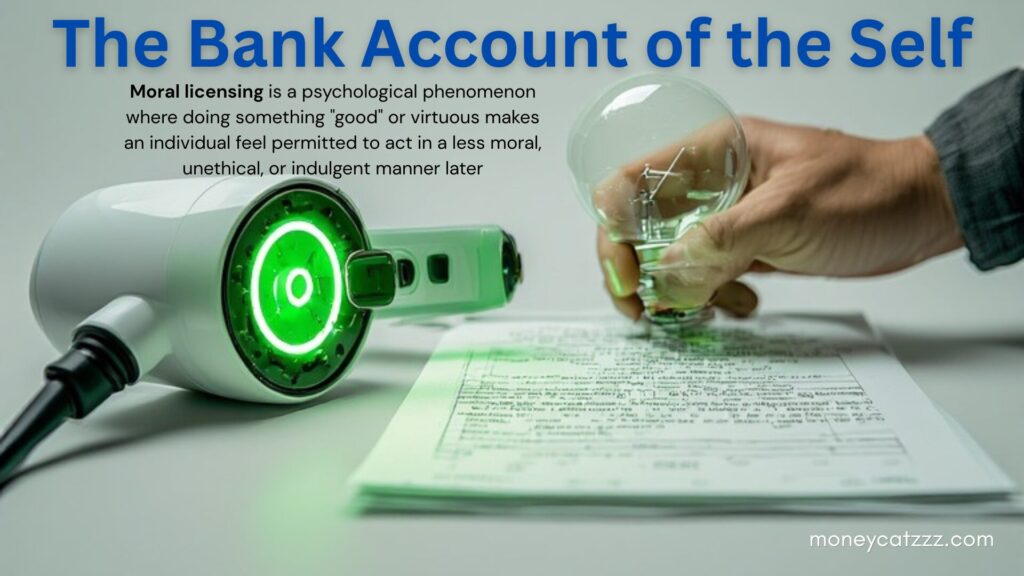
The Bank Account of the Self
Behavioral psychology has studied this for decades. A University of Toronto study ran a simple experiment. The study asked people to imagine buying a green product. Afterward, those people were more likely to lie, cheat, or steal in a different task. The good deed had licensed the bad behavior.
Another study found that people who bought energy-efficient lightbulbs felt entitled to leave lights on longer. The deposit authorized the withdrawal.
Matteo tried to explain this to Sofia once. She was eight. She said, “So you are saying you are nice to me only when you have not been nice to yourself?” He laughed. Then he felt embarrassed. She was right.
Morality is not supposed to work like a bank account. You are not supposed to earn credits for good behavior and then spend them on bad behavior. But isn’t that is exactly what most of us do?. We keep a quiet ledger. A deposit there. A withdrawal here. The balance always works in our favor.
Gus has never meditated a day in his life. He has also never snapped at his kittens. So who is really winning?
The Extremists and the Rest of Us
Larissa MacFarquhar spent years studying extreme altruists for her book Strangers Drowning. She compiled data on people who donate kidneys to strangers, adopt children from war zones, and live in poverty to give away their salaries. MacFarquhar found something surprising. Extreme altruists do not engage in moral licensing. They do not keep a ledger. They act.
Why? Simple, they do not think of themselves as good. They think of themselves as ordinary people doing what is required. Without the identity of “good person,” there is no deposit to spend.
Matteo read this and felt a familiar sting. He had spent years trying to be a good person. He had the meditation practice, the donations, and the correct opinions. And still, he snapped at Sofia. Still, he judged the cat.
Jonathan Haidt argues that morality binds and blinds, he is not wrong. In The Righteous Mind, he says it binds us to tribes. Morality closes our eyes to our own contradictions. We use good deeds to build identity, then defend that identity against contradictory evidence—the defense is self-justification.
The mind is a master accountant. Tavris and Aronson argue that the brain is wired to justify everything we do—a mechanical process of rationalization designed to protect the ego’s blueprint at all costs. Their work is the definitive diagnostic manual for anyone looking to expose the self-justification racket that funds our daily smallness.
[The Bank Account of the Self: The Green-Energy Bypass | moneycatzzz.com]
The Loop That Does Not Care
Matteo closed the notebook. Eighteen wrong predictions. Two failed businesses. He wasn’t a hero or a villain; he was just a man who had spent years operating a narrative subsidy and calling it morality. He had been pre-paying for his own smallness with every “good” deed he logged.
Gus didn’t care about the records. Gus was just warm.
The next morning, the meditation cushion was empty. Matteo made coffee and spoke to the cat in that fake French accent, again. “Bonjour, Gustave. Today, we aren’t keeping score.” Gus flicked an ear, indifferent to the end of the transaction.
Sofia still has issues with her math homework, Matteo simply sat beside her. He didn’t snap nor feel that familiar surge of entitlement to be impatient because he’d “earned” his calm earlier. He was just there. No deposit. No withdrawal. Just an un-subsidized presence.
The identity surcharge we pay doesn’t just disappear; it’s too addictive for that. Showing off your virtue is a separate drug entirely. Sometimes you can set the notebook down, be kind without a prior balance, and help without a line of credit—you can apologize without needing the ego-receipt.
It feels vulnerable. Acting without a scorecard feels like standing in the wind. You might get nothing back. You might help and still be wrong. You might be decent and find that no one is applauding.
Dan Ariely calls this predictable irrationality. We know the scorekeeping is a fraud, yet we fund it anyway to avoid the raw exposure of the “Mirror”.
“individuals are honest only to the extent that suits them (including their desire to please others” ― Dan Ariely, Predictably Irrational: The Hidden Forces That Shape Our Decisions
Matteo looked at Gus. The cat hadn’t moved. Still pressed against the vent, stealing warmth, entirely unbothered.
The loop does not care how much you understand it. It only cares that you are still paying to keep it running.

Turns Out Psychologists Have a Name for This

Strangers Drowning

The Righteous Mind
Mistakes Were Made
Disclosure: This post may contain affiliate links. We only recommend products we believe in, and we may receive a commission at no cost to you! Thank you for your support!
Acknowledgment: Cover Image by moneycatzzz.com
Disclaimer: The information is provided for general information only – moneycatzzz.com makes no representations or warranties in relation to the information, including but not limited to any representation or warranty as to the fitness for any particular purpose of the information to the fullest extent permitted by law. While every effort has been made to ensure that the information provided in this article is accurate, reliable, and complete as of the time of writing, the information provided in this article should not be relied upon to make any financial, investment, real estate or legal decisions. Additionally, the information should not substitute advice from a trained professional who can take into account your personal facts and circumstances, and we accept no liability if you use the information to form decisions.